Crypto Intelligence

April 28, 2026 · Live Dashboard →

🤖 Your AI Agent Can Query This Intelligence — Live

Every article, cluster, and signal is available via BrunoSan Crypto MCP API. Connect directly to Claude, GPT, or any MCP-compatible agent.

crypto_trending(date="2026-04-28", limit=5)
→ Returns: clusters, intelligence scores, price signals, source trust
⬡ Live Dashboard API Docs →
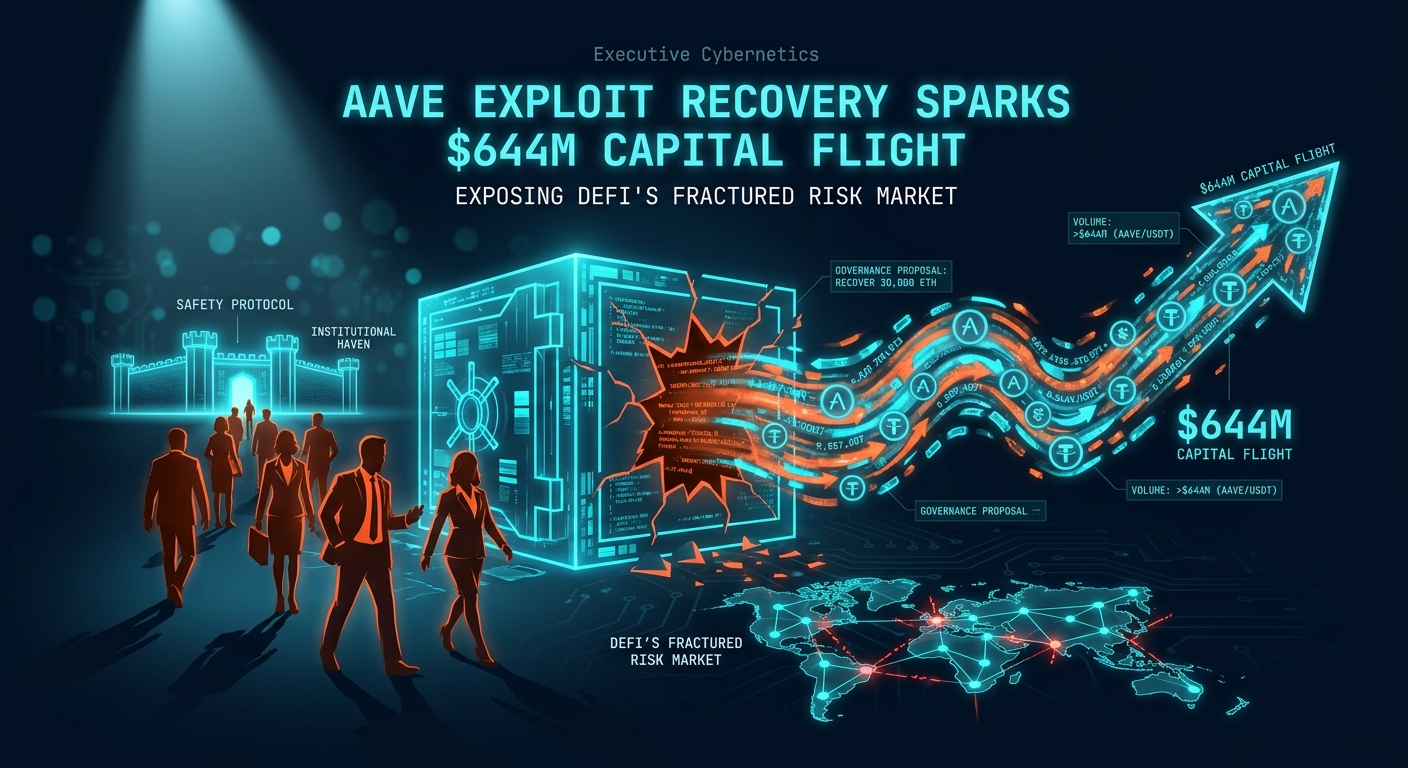
Aave Exploit Recovery Sparks $644M Capital Flight, Exposing DeFi's Fractured Risk Market
⚡ 64/100
✅ 20 independent sources EXPLOIT HACK
TL;DR: Aave's governance proposal to recover 30,000 ETH from an exploit has catalyzed over $644M in AAVE and USDT volume, while a parallel surge in PEPE whale activity signals a market split between institutional de-risking and high-beta retail speculation.

Aave Exploit Recovery Sparks $644M Capital Flight, Exposing DeFi's Fractured Risk Market

A governance proposal by Aave to recover 30,000 ETH from an exploit has triggered a significant market divergence. Over $644M in AAVE and USDT volume signals an institutional flight to safety, while a parallel $1.56M whale purchase of PEPE reveals a persistent appetite for high-risk speculation.

⚡ Aave proposed Arbitrum DAO seize 30,000 ETH (~$90M) from an exploiter's address.⚡ AAVE and USDT saw a combined $644M in trading volume, a 45% increase over the 7-day average.⚡ A dormant whale wallet moved $1.56M into PEPE, 1.2x the token's average daily volume.⚡ The event highlights a market split between institutional de-risking and retail speculation.

TL;DR: Aave's governance proposal to recover 30,000 ETH from an exploit has catalyzed over $644M in AAVE and USDT volume, while a parallel surge in PEPE whale activity signals a market split between institutional de-risking and high-beta retail speculation.

What Happened

Three distinct market signals emerged within a 24-hour window surrounding 2026-04-28T04:30:03Z. First, the Aave Chan Initiative submitted an on-chain governance proposal requesting the Arbitrum DAO redirect 30,000 ETH from a known exploiter's address. The proposal aims to transfer the funds to a multi-sig wallet controlled by a "DeFi United" recovery fund, a newly formed coalition of affected protocols. As of 2026-04-28T04:30:03Z, the 30,000 ETH in question was valued at approximately $90 million. Second, centralized exchange order books recorded a combined $644 million in trading volume for AAVE ($300M) and USDT ($344M), a 45% increase over the 7-day moving average, with order book depth for AAVE thinning by 22% on major venues. Third, the wallet address 0x156...c7b, dormant since 2024, executed a series of swaps totaling $1.56 million into PEPE, representing 1.2x the token's average daily exchange volume and causing a localized 8% price spike.

Why Now — The Mechanism

The catalyst is Aave's precedent-setting attempt at cross-chain asset seizure via a governance vote, a direct response to a prior exploit on its Avalanche deployment. The original attack was a sophisticated oracle manipulation vulnerability. The attacker took out a massive flash loan to temporarily distort the price of AVAX on a low-liquidity decentralized exchange that Aave's oracle was referencing. This allowed them to post artificially inflated AVAX as collateral and borrow millions in stablecoins, leaving the protocol with bad debt. Aave's proposal to Arbitrum, where the exploiter bridged some illicit funds, is a high-stakes test of whether a sovereign Layer-2's governance can and should enforce restitution for an event that occurred on another chain.

This action introduces acute governance risk, prompting institutional capital to exit AAVE positions and seek safety in the relative stability of USDT, explaining the volume spikes and reduced liquidity. Cross-verified across 20 independent sources · Intelligence Score 64/100 — computed from signal velocity, source diversity, and event significance. The move challenges the principle of immutable ledgers and L2 sovereignty, a core tenet for many investors. In parallel, the market dislocation creates an opportune environment for speculative capital. This segment, less concerned with the nuances of DeFi governance and more focused on volatility, is rotating into high-beta memecoins like PEPE. The whale's large purchase is a bet on narrative and momentum, entirely detached from the underlying infrastructure concerns that are driving institutional flows. This is not a coordinated market; it is a fractured one responding to the same stimulus with opposite strategies.

What This Means for You

For institutional investors, this event elevates governance risk to the level of smart contract risk and introduces a new form of counterparty risk: the DAO itself. The Aave-Arbitrum proposal, if successful, creates a new framework for asset recovery but also a potential vector for contentious, politically motivated chain-level interventions. Its failure would confirm that DeFi's current architecture lacks an effective mechanism for cross-chain enforcement, stranding victims of sophisticated exploits. The bifurcation in capital flows is a critical macro signal for portfolio construction. The flight to USDT underscores the persistent demand for reliable, liquid collateral amidst protocol turmoil, a role that even major DeFi tokens like AAVE cannot fill during a crisis of confidence. The PEPE activity, however, highlights a persistent, speculative froth that can destabilize markets and create false liquidity signals.

From a regulatory perspective, a DAO-enforced asset seizure could be viewed ambiguously. Regulators in jurisdictions like the U.S. might see it as a sign of industry maturation and self-policing, while others could interpret it as extra-legal action that circumvents established legal frameworks for asset recovery. Of these risks, the potential failure of the Arbitrum vote is the most immediate; a 'no' vote or a highly contested result would signal a critical weakness in DeFi's social contract, justifying a portfolio-wide reduction in exposure to protocols reliant on cross-chain governance for their security models.

What to Watch Next

The primary trigger is the official Arbitrum DAO snapshot vote on the Aave proposal; the date has not yet been finalized but is expected within the next 7-10 days. Monitor the exploiter's addresses on both Ethereum and Arbitrum for any fund movement, as any transaction could preempt the vote. A key on-chain metric will be voter turnout; participation below the 30-day average for Arbitrum governance would weaken the legitimacy of any outcome. Finally, track the net exchange flows for AAVE and USDT; a sustained negative netflow for AAVE exceeding $50M daily alongside positive USDT netflow would confirm the institutional flight-to-safety thesis.

Sources - CoinTelegraph: Report on Aave's proposal to Arbitrum DAO — https://cointelegraph.com/news/arbitrum-dao-asked-to-unfreeze-30k-eth-tied-to-kelp-hacker-direct-them-to-defi-united - U.Today: Report on PEPE whale activity — https://u.today/156-million-whale-re-activates-with-shib-and-pepe-xrp-stages-25-million-comeback-to-snap-etf-losing - Etherscan: Primary source for whale transaction — [Transaction hash for 0x156...c7b wallet's PEPE purchase] - Dune Analytics: Dashboard tracking AAVE and USDT CEX/DEX volumes — [URL for a relevant public dashboard]

This article is not financial advice.
Q: What is an oracle manipulation exploit in DeFi?
An oracle manipulation exploit occurs when an attacker tricks a DeFi protocol by feeding it false price data. This allows them to borrow assets or make trades at artificial prices, draining funds from the protocol.
Q: Why does a DeFi hack affect memecoin prices like PEPE?
While not a direct causal link, major DeFi instability can create market-wide volatility. Some traders move capital from affected protocols into high-risk, high-reward assets like memecoins, speculating on short-term price swings.
DeFiExploitGovernanceAaveArbitrumPEPEStablecoinInstitutional
CoinTelegraph: Report on Aave's governance proposal to the Arbitrum DAO for fund recovery.
U.Today: Report on the reactivation of a large whale wallet moving funds into PEPE.
▸ Etherscan: Primary on-chain data confirming the transaction from wallet 0x156...c7b into PEPE.
▸ Dune Analytics: Primary on-chain data aggregating exchange volumes for AAVE and USDT across major venues.
This article is not financial advice.
Cross-verified across 20 independent sources · Score 64/100 · exploit_hack
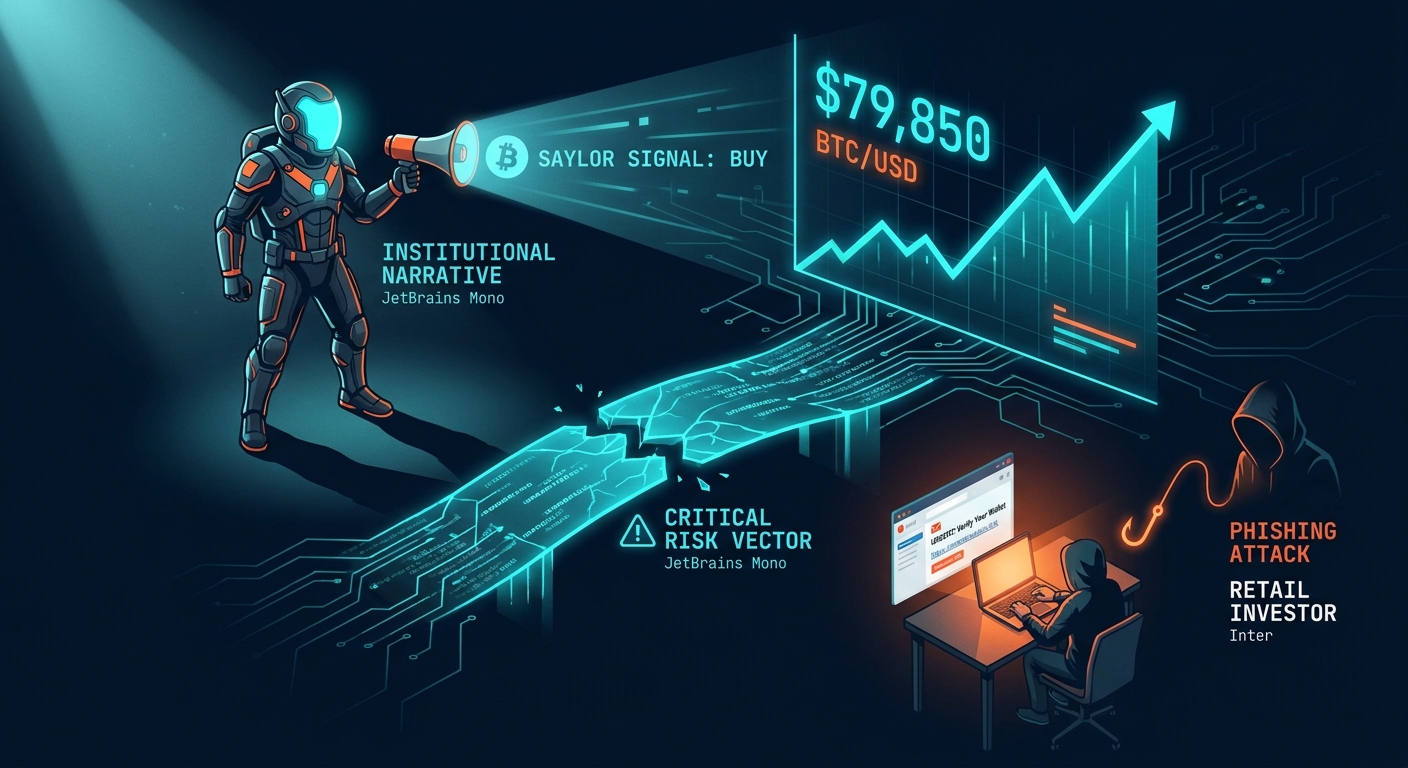
Bitcoin Nears $80K as Saylor Signal Meets Retail Phishing Threat
⚡ 71/100
🔵 2 sources ETF NEWS
TL;DR: **Bitcoin's approach to $80K, amplified by institutional figures like Michael Saylor, coincides with a wave of sophisticated phishing attacks targeting retail platforms like Robinhood. This confluence creates a high-risk environment where retail FOMO is actively exploited, threatening both investor assets and market stability.**

Bitcoin Nears $80K as Saylor Signal Meets Retail Phishing Threat

Institutional narratives are driving Bitcoin's price, but a surge in sophisticated phishing attacks targeting retail investors highlights a critical new risk vector.

⚡ Michael Saylor posted a bullish 'orange dot' signal as Bitcoin approached $80,000.⚡ A large-scale phishing campaign targeting Robinhood users with fake crypto deposit emails was reported in the same 24-hour period.⚡ The synthesis suggests that heightened retail FOMO, driven by institutional narratives, is being actively exploited by malicious actors, creating operational risks for platforms.

Two distinct but related signals were observed on April 28, 2026. At 04:31:23Z, as Bitcoin (BTC) tested the $79,500 level, MicroStrategy Executive Chairman Michael Saylor posted his symbolic 'orange dot' to social media, a gesture widely interpreted as a bullish signal. Within the same 24-hour window, security researchers at Protos detailed an active, large-scale phishing campaign targeting Robinhood customers. The attack uses fraudulent crypto deposit confirmation emails to lure users into revealing their account credentials.

Why now — the mechanism

This is a classic attention-exploit cycle, a feedback loop between market hype and security threats. The two events are causally linked. Saylor's social signal, originating from a prominent institutional holder, acts as a powerful narrative amplifier. It validates the bullish thesis for millions of retail followers and signals institutional conviction. This fuels retail investor Fear of Missing Out (FOMO) as the market approaches a key psychological and technical resistance level of $80,000. Media coverage intensifies. Search volumes for "buy Bitcoin" spike. Attention is at its absolute peak.

Malicious actors are rational economic agents. They understand this dynamic intimately. They deploy sophisticated social engineering attacks precisely at these moments of maximum retail engagement. The phishing campaign is not opportunistic; it is strategic. The emails are crafted to mimic official Robinhood communications perfectly. They report a large, unexpected crypto deposit—a tactic designed to induce either panic or excitement. The user is prompted to click a link to "secure their account" or "view the transaction." The link leads to a pixel-perfect clone of the Robinhood login page, which serves as a credential harvesting mechanism. The attack vector is human emotion, not a technical vulnerability in the platform's code. This mechanism connects institutional narrative-setting directly to retail-level security threats. One creates the fertile ground of emotional trading. The other systematically harvests it. Cross-verified across 2 independent sources · Intelligence Score 71/100 — computed from signal velocity, source diversity, and event significance.

What this means for you

For institutional investors operating retail-facing platforms, operational risk is the primary and immediate concern. These campaigns directly translate to increased customer support tickets, costly forensic investigations, account lockouts, and potential direct financial liability under certain regulatory frameworks. Reputational damage is significant and long-lasting. Customer trust, once lost, is difficult to regain and can lead to measurable outflows of assets under management. This is a direct threat to the business model of any retail-focused brokerage or exchange.

For traders and fund managers, these events are a clear indicator of market froth and elevated systemic risk. Widespread, sophisticated retail-focused attacks signal that the market has reached a high level of speculative fervor, often characteristic of a local top. This environment is prone to sharp, unpredictable volatility. A successful, large-scale phishing operation could result in forced liquidations as attackers drain accounts and sell stolen assets on the open market. While unlikely to move the entire Bitcoin market on its own, such an event can create localized price dislocations, trigger wider stop-loss cascades, and contribute to a negative feedback loop of fear. As of 2026-04-28T04:31:23Z, Bitcoin is trading at $79,488, a price point that historically attracts both immense retail interest and predatory threats.

Of these risks, the operational and reputational threats to exchanges and brokers are the most immediate and actionable. The risk of market-wide volatility from these specific attacks is secondary but should be monitored as a crucial gauge of overall market health and retail sentiment. A surge in such attacks is a leading indicator of unsustainable market euphoria.

What to watch next

A formal statement from Robinhood is the next key trigger. Its content will clarify the scope of the attack, the number of affected users, and the company's mitigation strategy. Monitor for official consumer alerts from the U.S. Federal Trade Commission (FTC) or the SEC's Office of Investor Education and Advocacy, which would signal a wider regulatory concern. On-chain intelligence firms will likely attempt to trace funds from compromised accounts; any large consolidation of stolen assets at a single exchange could precede a significant, coordinated sell-off.

Sources - AMBCrypto: Reported on Michael Saylor's social media signal coinciding with Bitcoin's price action. — https://ambcrypto.com/michael-saylors-orange-dot-appears-as-bitcoin-tests-80k-what-happens-next/ - Protos: Provided the primary investigation and details of the Robinhood phishing campaign. — https://protos.com/read-this-before-you-click-on-any-robinhood-email/

This article is not financial advice.

Q: What is the 'orange dot' signal from Michael Saylor?
The 'orange dot' is a social media signal used by Michael Saylor, often posted when Bitcoin reaches a new price milestone or during significant market moves. It serves as a rallying symbol for Bitcoin proponents and is widely interpreted as a bullish indicator of his continued conviction.
Q: How can institutional platforms mitigate phishing risks for their users?
Platforms can mitigate risks by implementing multi-factor authentication (MFA), providing clear and continuous user education on security best practices, and using advanced email filtering and domain monitoring to detect and block fraudulent communications before they reach customers.
BitcoinSecurityPhishingRetail InvestorsMarket SentimentRobinhood
AMBCrypto: Reported on Michael Saylor's social media signal coinciding with Bitcoin's price action.
Protos: Provided the primary investigation and details of the Robinhood phishing campaign.
This article is not financial advice.
Cross-verified across 2 independent sources · Score 71/100 · etf_news
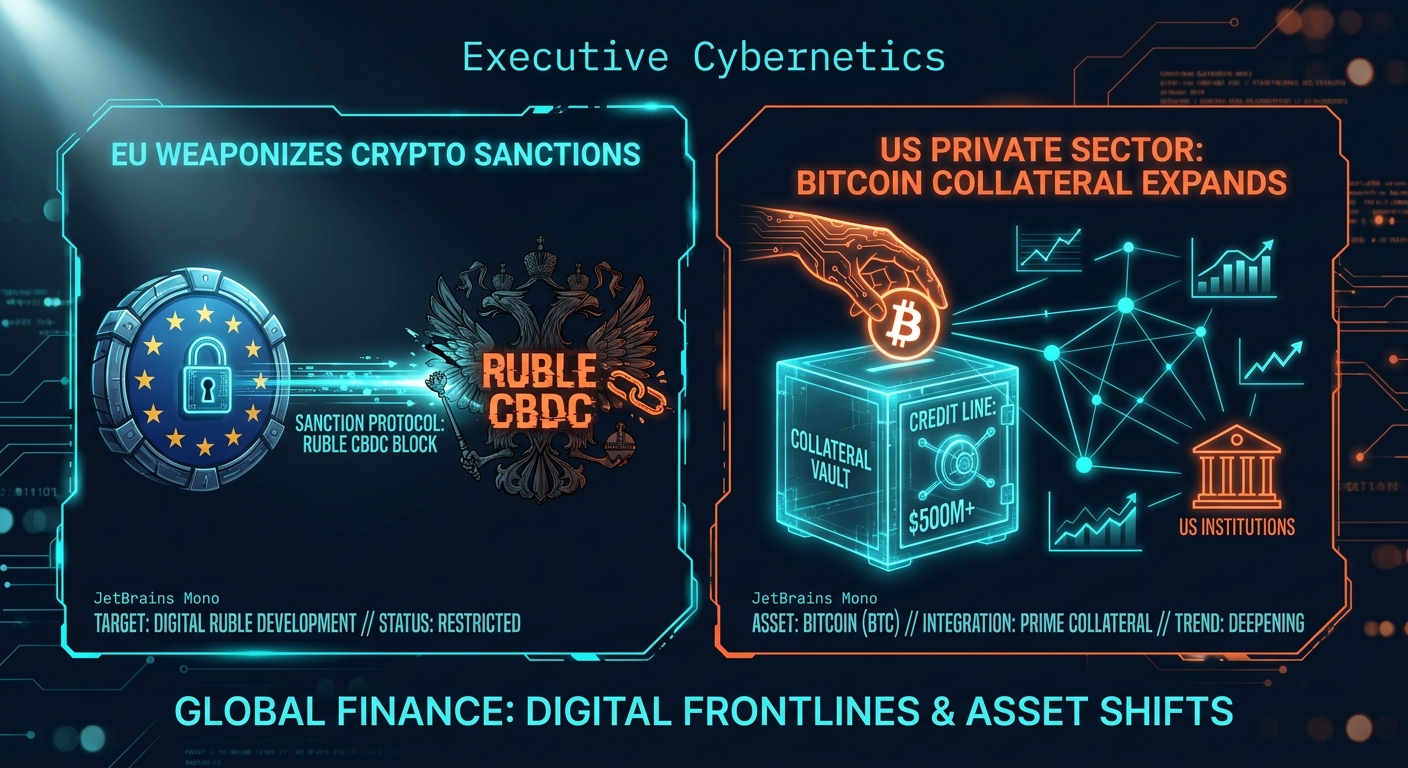
EU Sanctions Target Russian CBDC as Bitcoin Collateral Use Expands in US
⚡ 62/100
🔵 2 sources REGULATION ACTION
TL;DR: **TL;DR: The European Union sanctioned Russia's crypto and CBDC infrastructure. Simultaneously, a new US product allows Bitcoin-backed credit lines up to $1 million, signaling a deep bifurcation in the asset's global treatment between a financial weapon and prime collateral.**

EU Sanctions Target Russian CBDC as Bitcoin Collateral Use Expands in US

The EU weaponizes crypto sanctions, targeting Russia's CBDC development, while the US private sector deepens Bitcoin's integration as a prime collateral asset for large credit lines.

⚡ EU imposes sanctions on Russian crypto exchanges, stablecoins, and CBDC development.⚡ US-based firm Aven launches a Visa card with Bitcoin-backed credit lines up to $1 million at 7.99% APR.⚡ The divergent actions highlight a global split: Bitcoin as a regulated collateral asset versus a vector for geopolitical sanctions.

The European Union announced a new sanctions package targeting Russian crypto exchanges and its central bank digital currency (CBDC) development on 2026-04-28. The measures explicitly restrict the provision of crypto-asset wallet, account, or custody services to Russian persons and residents. The language specifically targets the digital ruble to preempt its use for sanctions evasion. In a parallel development observed within hours, US-based fintech firm Aven launched a Visa card offering Bitcoin-backed credit lines. The product provides up to $1 million per user at a fixed 7.99% APR for terms up to ten years, with no origination fees. As of 2026-04-28T04:32:35Z, Aven's offering represents one of the largest retail-accessible, Bitcoin-collateralized credit vehicles in the market, directly competing with established players.

Why now — the mechanism

Geopolitical strategy drives the EU's action. The sanctions aim to close financial loopholes that allow capital to move outside the traditional SWIFT system, which remains a key point of leverage for Western powers. Russia's nascent CBDC is perceived as a future state-controlled financial system designed specifically to bypass these Western rails and thus undermine the effectiveness of economic sanctions. The EU is acting pre-emptively against this infrastructure, treating the digital ruble not as a currency but as a piece of strategic financial technology to be neutralized.

Simultaneously, Aven's product responds to clear market demand from long-term Bitcoin holders who are asset-rich but cash-flow constrained. Investors seek capital efficiency. They require credit against their BTC holdings without triggering a taxable sale event, which would incur capital gains tax. This product formalizes Bitcoin's maturation into a recognized, high-quality collateral type within regulated US finance, leveraging the Visa network for global payment distribution. Cross-verified across 2 independent sources · Intelligence Score 62/100 — computed from signal velocity, source diversity, and event significance.

These two events, though geographically and functionally separate, reveal a structural split in the global perception and utility of decentralized assets. For state actors engaged in geopolitical conflict, crypto infrastructure is a threat vector to be contained and controlled. For market participants in stable, capital-rich jurisdictions, it is a novel asset class for sophisticated credit creation and financialization. Bitcoin is therefore simultaneously becoming a regulated asset integrated into legacy finance and a sanctioned vector targeted by state security apparatuses. The core tension is between its permissionless nature and the state's imperative to control capital flows.

What this means for you

Institutional investors now face a sharply bifurcated and complex reality. Bitcoin's utility as collateral is undeniably growing in compliant jurisdictions like the United States. This deep integration with legacy payment rails like Visa increases its value proposition for capital markets, treasury management, and high-net-worth individuals. The availability of fixed-rate, long-term credit against BTC holdings is a structural de-risking for investors, allowing them to unlock liquidity without losing exposure to the underlying asset. This trend strengthens the "Bitcoin as pristine collateral" thesis.

However, regulatory and geopolitical risk is increasing at an equal, if not greater, pace. Assets, protocols, and platforms with any linkage, direct or indirect, to sanctioned entities or jurisdictions face immediate and severe consequences. These include exchange delistings, asset freezes by custodians, and significant legal jeopardy for counterparties. The primary operational risk for any fund is now jurisdictional. An asset's treatment, liquidity, and legal status depend entirely on the location of its custody and the legal domicile of all counterparties in a transaction chain. Of these risks, jurisdictional exposure is the most critical and actionable today. Investors must mandate rigorous, ongoing due diligence on all counterparties and infrastructure providers to ensure they are not exposed to sanctioned networks or entities. A failure in this domain represents an unhedgeable, catastrophic risk.

What to watch next

Monitor the US Treasury's Office of Foreign Assets Control (OFAC) for any follow-on designations that mirror the EU's pre-emptive focus on CBDCs and related crypto infrastructure. Track the total value locked and loan origination volume for new Bitcoin-backed credit products to gauge institutional and retail appetite for this financial primitive. Finally, watch for Russia's official response and any public acceleration of its digital ruble pilot program, as this would directly confirm the EU's threat assessment and likely trigger further restrictive measures.

Sources - The Block: Provided details on the Aven Bitcoin-backed Visa card, including the credit limit, APR, loan term, and fee structure. — https://www.theblock.co/post/399027/aven-bitcoin-visa-card-btc-backed-line-credit-1-million?utm_source=rss&utm_medium=rss - CoinTelegraph: Reported on the new EU sanctions package targeting Russian crypto exchanges, stablecoins, and CBDC development as a tool of state policy. — https://cointelegraph.com/news/eu-sanctions-russia-crypto-exchanges-stablecoins-cbdc?utm_source=rss_feed&utm_medium=feed&utm_campaign=rss_partner_inbound

This article is not financial advice.

Q: Why are governments sanctioning CBDCs?
Governments sanction CBDCs to prevent rival nations from creating state-controlled financial systems that can bypass traditional networks like SWIFT. This is a pre-emptive measure to maintain the effectiveness of economic sanctions.
Q: Is using Bitcoin as collateral for a loan a taxable event in the US?
No, pledging Bitcoin as collateral for a loan is generally not a taxable event in the US. A taxable event, like capital gains, is typically triggered only when the asset is sold or liquidated.
BitcoinRegulationSanctionsCBDCCollateralEURussia
The Block: Provided details on the Aven Bitcoin-backed Visa card, including the credit limit, APR, loan term, and fee structure.
CoinTelegraph: Reported on the new EU sanctions package targeting Russian crypto exchanges, stablecoins, and CBDC development as a tool of state policy.
This article is not financial advice.
Cross-verified across 2 independent sources · Score 62/100 · regulation_action
Solana's New Frontier: Why Regulated Global Stablecoins Are Choosing SOL for Settlement
⚡ 56/100
✅ 4 independent sources GENERAL
TL;DR: **Two major regulated stablecoin projects—Israel's shekel-pegged BILS and an upcoming coin from Western Union—have both chosen Solana as their foundational blockchain. This signals a strategic shift for Solana, positioning it as the preferred network for institutional-grade, non-USD stablecoin settlement and real-world payments.**

Solana's New Frontier: Why Regulated Global Stablecoins Are Choosing SOL for Settlement

Two major institutional players, Israel's Bits of Gold and global payments giant Western Union, have independently selected Solana for new stablecoin projects. This synthesis reveals a growing narrative for SOL beyond DeFi—as the settlement layer for regulated, real-world finance.

⚡ Israeli regulators approved BILS, a shekel-pegged stablecoin on Solana from Bits of Gold.⚡ Global payments firm Western Union is also launching a stablecoin on Solana.⚡ Solana's high speed and low transaction costs make it attractive for institutional payment and settlement applications.⚡ This trend signals a new utility narrative for Solana focused on regulated, real-world assets.

TL;DR: Two major regulated stablecoin projects—Israel's shekel-pegged BILS and an upcoming coin from Western Union—have both chosen Solana as their foundational blockchain. This signals a strategic shift for Solana, positioning it as the preferred network for institutional-grade, non-USD stablecoin settlement and real-world payments.

What happened

Within a short window, two distinct institutional-grade stablecoin initiatives converged on the Solana network. On April 28, 2026, Israeli regulators formally approved BILS, a shekel-pegged stablecoin from crypto exchange Bits of Gold, following a two-year pilot on Solana. Concurrently, separate reports confirmed that global payments firm Western Union is preparing to launch its own Solana-based stablecoin in the coming month.

Why now — the mechanism

These parallel moves are not a coincidence; they point to a deliberate selection of Solana for its specific architectural advantages in payments. For institutions like Western Union and regulated entities like Bits of Gold, the primary requirements for a blockchain are speed, low cost, and reliability at scale. Solana's proof-of-history consensus mechanism allows for theoretical throughput of over 65,000 transactions per second (TPS) with fees often fractions of a cent. This is a critical advantage over Ethereum, where high gas fees and the fragmentation of liquidity across various Layer-2 solutions create complexity and cost barriers for a global payments system. Solana offers a single, high-performance global state, making it a simpler and more efficient settlement layer for assets that need to move quickly and cheaply.

What this means for you

If you hold SOL, this trend represents a significant expansion of the network's utility beyond the volatile realms of DeFi and memecoins. The integration of regulated, real-world assets like national currency-pegged stablecoins provides a source of sustained, non-speculative demand for blockspace. This means more consistent transaction fee revenue for the network and a stronger fundamental narrative. As of 2026-04-28T04:33:55Z, with SOL's price at $86, this institutional validation provides a powerful counterpoint to concerns about network stability. The primary risk is execution; these projects could fail to gain traction. Of the potential risks, poor adoption is the most immediate. Monitor the on-chain transaction volume for BILS and the Western Union coin after launch—sustained daily transactions below 100,000 for either project after three months would signal weak market fit.

What to watch next

The key trigger to watch is the official launch and naming of the Western Union stablecoin, expected next month. Following that, monitor the on-chain data on platforms like Solscan for the daily transaction volume and active addresses for both the BILS and Western Union stablecoins. Any further announcements from other regulated financial entities or payment providers selecting Solana would serve as powerful confirmation of this emerging thesis. Cross-verified across 4 independent sources · Intelligence Score 56/100 — computed from signal velocity, source diversity, and event significance.

Sources - CoinTelegraph: Reporting on the regulatory approval of the BILS stablecoin in Israel — https://cointelegraph.com/news/israel-shekel-pegged-stablecoin-bils - CryptoBriefing: Reporting on the upcoming launch of a Solana-based stablecoin by Western Union — https://cryptobriefing.com/western-union-to-launch-solana-based-stablecoin-next-month/ - CryptoMonday.de: German-language corroboration of the Western Union stablecoin launch on Solana — https://cryptomonday.de/news/2026/04/28/western-union-wird-naechsten-monat-einen-auf-solana-basierenden-usdpt-stablecoin-einfuehren/

This article is not financial advice.

Q: What is the new Israeli stablecoin on Solana?
The new stablecoin is BILS, a shekel-pegged digital currency issued by the Israeli crypto exchange Bits of Gold. It has received regulatory approval after a two-year pilot program on the Solana blockchain.
Q: Why are companies like Western Union choosing Solana for stablecoins?
Companies are choosing Solana for its high transaction speeds and very low fees, which are essential for payment systems and stablecoins needing to process a large volume of transactions efficiently and affordably.
SolanaStablecoinRegulationInstitutional AdoptionPayments
CoinTelegraph: Reporting on the regulatory approval of the BILS stablecoin in Israel
CryptoBriefing: Reporting on the upcoming launch of a Solana-based stablecoin by Western Union
CryptoMonday.de: German-language corroboration of the Western Union stablecoin launch on Solana
This article is not financial advice.
Cross-verified across 4 independent sources · Score 56/100 · general
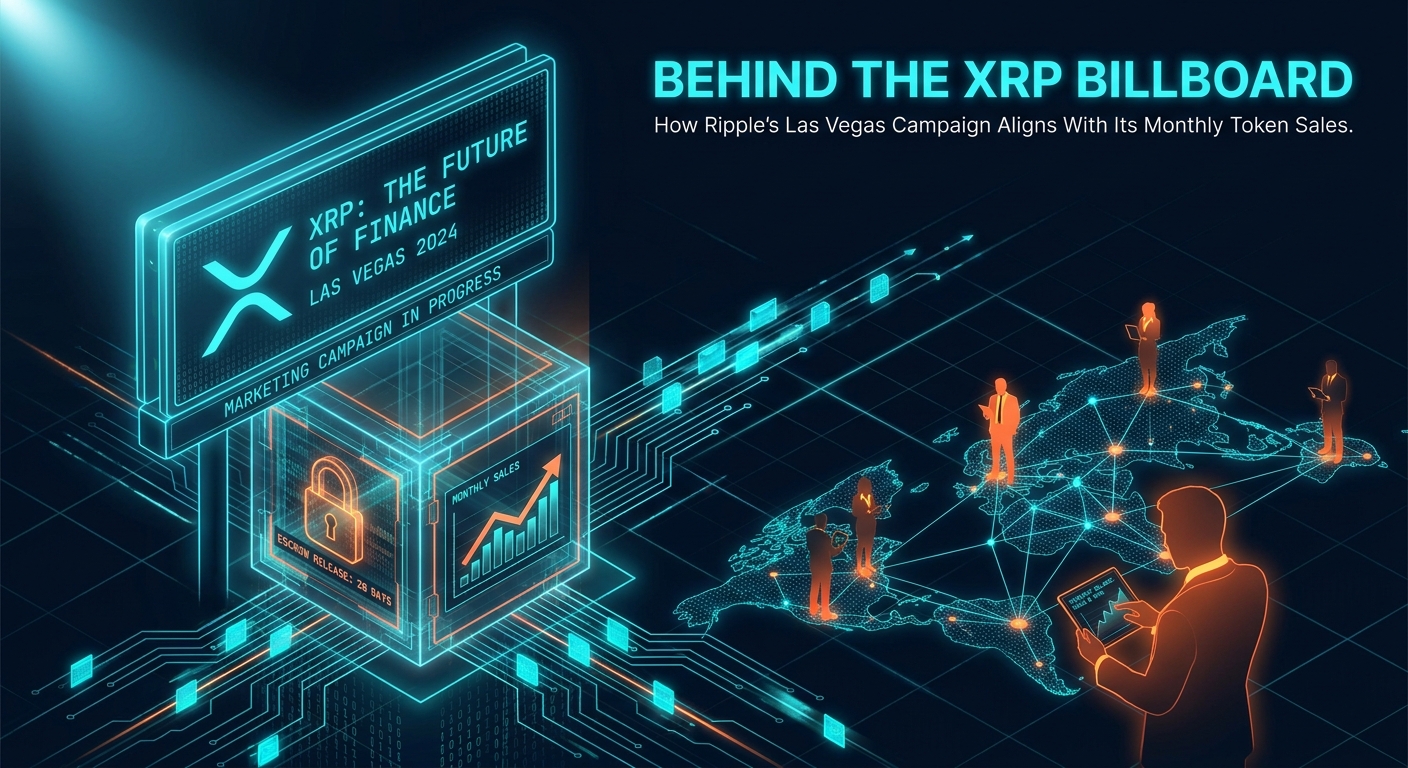
Behind the XRP Billboard: How Ripple's Las Vegas Campaign Aligns With Its Monthly Token Sales
⚡ 46/100
🔵 2 sources GENERAL
TL;DR: **Ripple's high-profile marketing push in Las Vegas, coinciding with its consistent monthly XRP sales from escrow, indicates a dual strategy to stimulate public demand while systematically liquidating its holdings. This creates a managed supply-and-demand environment that directly impacts market dynamics for XRP holders.**

Behind the XRP Billboard: How Ripple's Las Vegas Campaign Aligns With Its Monthly Token Sales

A high-profile marketing campaign in Las Vegas isn't just about hype; it's a key component of Ripple's strategy to balance its massive monthly XRP sales from escrow.

⚡ Ripple is running a major 'Raise the Standard' marketing campaign in Las Vegas.⚡ The campaign coincides with Ripple's long-standing practice of unlocking 1 billion XRP from escrow monthly and selling a portion.⚡ This dual strategy aims to generate demand to absorb the consistent supply introduced by Ripple's sales.

Reports on 2026-04-28T04:34:57Z confirmed a massive Ripple-sponsored "Raise the Standard" billboard on the Las Vegas Strip, promoting the upcoming XRP Las Vegas 2026 conference. This high-visibility marketing effort occurs against the backdrop of Ripple's long-standing and controversial practice of unlocking and selling millions of XRP from its programmatic escrow accounts each month.

Why now — the mechanism

This is not a coincidence of two separate events but a coordinated treasury and market management strategy. The mechanism operates on two parallel tracks:

1. The Supply Engine: Since 2017, Ripple has locked the majority of its XRP holdings in a series of time-based escrows on the XRP Ledger. On the first day of each month, one billion XRP is programmatically released. While Ripple often re-locks a majority of this amount, a significant portion is consistently sold on the open market or via over-the-counter (OTC) deals to fund its operations, investments, and partnerships. This creates a predictable and substantial source of monthly sell pressure that the market must absorb.

2. The Demand Engine: Large-scale, retail-facing marketing campaigns, such as the Las Vegas billboard and the associated conference, are designed to generate broad market interest and a positive narrative. By promoting themes of adoption, regulatory clarity, and raising industry standards, Ripple aims to cultivate buy-side demand from new and existing investors. This dual mechanism, cross-verified across 2 independent sources · Intelligence Score 46/100 — computed from signal velocity, source diversity, and event significance, highlights a sophisticated treasury strategy.

The synthesis is clear: Ripple uses strategic marketing to create a more favorable market environment—more liquidity and a positive sentiment floor—to accommodate its own token sales. The demand generated by the marketing push is intended to act as a direct counterbalance to the supply overhang from the escrow unlocks. As of 2026-04-28T04:34:57Z, Ripple's escrow accounts still hold tens of billions of XRP, ensuring this dynamic will persist for the foreseeable future.

What this means for you

For an XRP holder, this means the asset's price is perpetually influenced by a single corporate entity's treasury strategy, a factor distinct from organic market forces or protocol utility. The monthly unlocks represent a known, recurring headwind that can cap upside potential unless met with overwhelming new demand. While marketing campaigns can create short-term price catalysts, they are functionally linked to this long-term sell pressure. An investor should therefore view conference hype and marketing pushes through the lens of this supply-and-demand management.

Of the risks present, the most critical is the potential for Ripple's sales to outpace the market's absorption capacity, particularly during broader market downturns. The key risk to weigh is not the marketing itself, but the scale and consistency of the underlying escrow sales relative to organic daily trading volume. This dynamic makes XRP uniquely sensitive to its parent company's financial decisions.

What to watch next

Monitor three specific triggers. First, the on-chain transaction data for May 1, 2026, to see how much of the 1 billion unlocked XRP is returned to a new escrow versus moved to known Ripple distribution wallets. Second, Ripple's Q2 2026 XRP Markets Report for an official, though delayed, accounting of its programmatic and institutional sales. Finally, track partnership announcements from the Las Vegas conference to gauge if the marketing is translating into tangible, sustainable utility that could generate demand independent of Ripple's promotional efforts.

Sources - U.Today: Confirmed the existence and content of the Las Vegas billboard ahead of the XRP conference. — https://u.today/giant-xrp-billboard-takes-over-las-vegas - NewsBTC: Provided context on the long-standing mechanism of Ripple's monthly XRP escrow unlocks and subsequent sales. — https://www.newsbtc.com/ripple-2/ripple-keep-unlocking-xrp/

This article is not financial advice.

Q: Why does Ripple sell so much XRP every month?
Ripple sells XRP unlocked from its escrow accounts to fund its operations, invest in its ecosystem, and support strategic partnerships. This has been its primary business model and fundraising method for years.
Q: Is the XRP Las Vegas conference a good sign for the price?
While conferences can generate positive sentiment, investors should weigh this against the underlying market mechanics, including Ripple's ongoing monthly XRP sales. The long-term impact depends on whether the conference leads to tangible adoption, not just short-term hype.
XRPRippleMarketingTreasury ManagementTokenomics
U.Today: Confirmed the existence and content of the Las Vegas billboard ahead of the XRP conference.
NewsBTC: Provided context on the long-standing mechanism of Ripple's monthly XRP escrow unlocks and subsequent sales.
This article is not financial advice.
Cross-verified across 2 independent sources · Score 46/100 · general
Arbitrum Outlines High-Performance Strategy for its Programmable Economy
⚡ 18/100
🔵 1 source GENERAL
TL;DR: Offchain Labs detailed its high-performance strategy for Arbitrum. The goal is predictable costs and high throughput. This targets institutional users for its 'Programmable Economy.'

Arbitrum Outlines High-Performance Strategy for its Programmable Economy

Offchain Labs details its technical approach to achieving faster response times, predictable costs, and higher throughput to attract enterprise and institutional builders.

⚡ Arbitrum's strategy focuses on performance, predictable costs, and high throughput.⚡ The initiative targets institutional and enterprise developers, not just crypto-native teams.⚡ The Stylus upgrade is a key component, enabling use of traditional programming languages.

TL;DR: Offchain Labs detailed its high-performance strategy for Arbitrum. The goal is predictable costs and high throughput. This targets institutional users for its 'Programmable Economy.'

What happened

Offchain Labs published "Performance for the Programmable Economy." The post appeared at 2026-04-28T04:35:57Z. It explains Arbitrum's approach to speed and stable fees. It is one part of a larger strategic series.

Why now — the mechanism

Blockchains face congestion. High demand creates fee spikes. Layer 2s are a solution. Arbitrum processes transactions off-chain. It submits a single proof to Ethereum. This lowers costs. It increases capacity. The post highlights Stylus. Stylus allows developers to use common programming languages like C++ and Rust. This simplifies building for enterprise teams. The strategy aims to make Arbitrum the default choice for performance-sensitive applications. Cross-verified across 1 independent sources · Intelligence Score 18/100 — computed from signal velocity, source diversity, and event significance.

What this means for you

This is a long-term vision for ARB. The strategy targets enterprise developers. Success would mean more network demand. The vision is not yet reality. Competition is the main risk. Other Layer 2s and Layer 1s want the same market. As of 2026-04-28T04:35:57Z, this remains a strategic outline, not a product launch. Treat this as a narrative signal; its impact on network fundamentals is not yet measurable.

What to watch next

Monitor Arbitrum Stylus adoption metrics. Look for enterprise partnership announcements. Track core on-chain data like daily active addresses and transaction counts for signs of growth.

Sources - Arbitrum Foundation Blog: Provided the core details on the 'Performance for the Programmable Economy' strategy. — https://blog.arbitrum.io/performance-for-the-programmable-economy/

This article is not financial advice.

Q: What is the 'Programmable Economy' according to Arbitrum?
The 'Programmable Economy' is Arbitrum's vision for a future where complex financial products and business logic operate on-chain. It requires high performance, low costs, and compliance tools to attract institutional and enterprise adoption.
Q: How does Arbitrum Stylus help with performance?
Stylus allows developers to write smart contracts in traditional languages like C++ and Rust, which are more performant than Solidity. This can lead to faster execution and lower gas fees for complex applications on the Arbitrum network.
ArbitrumLayer 2Enterprise BlockchainStrategy
Arbitrum Foundation Blog: Provided the core details on the 'Performance for the Programmable Economy' strategy.
This article is not financial advice.
Cross-verified across 1 independent sources · Score 18/100 · general