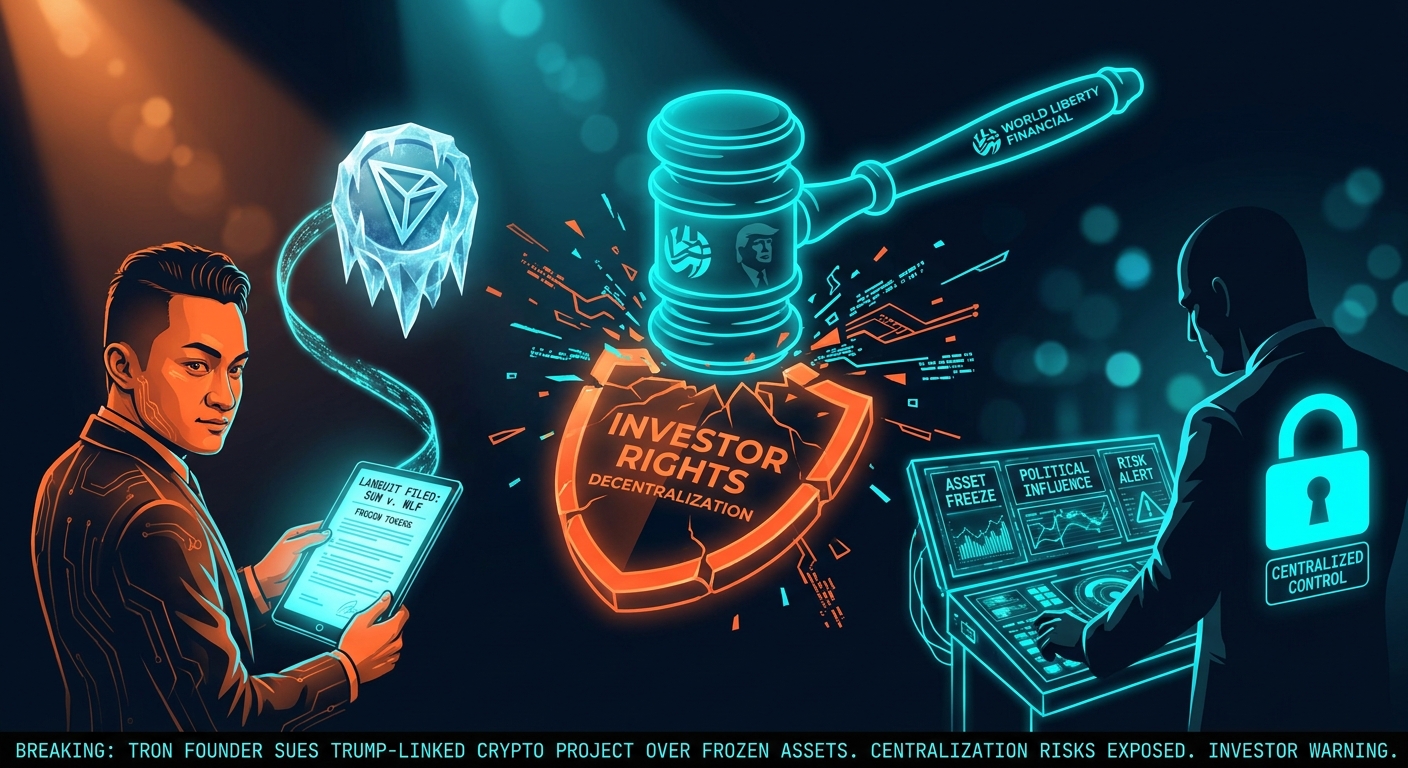
TL;DR: TRON founder Justin Sun has sued World Liberty Financial for freezing his tokens, escalating a private dispute into a public legal battle. This case serves as a critical test for the enforceability of centralized token controls under US law and represents a strategic attempt by Sun to reposition himself as a proponent of token holder rights amid his own regulatory challenges.
What happened
On April 22, 2026, TRON founder Justin Sun announced via social media that he had filed a lawsuit against World Liberty Financial in a California federal court. The legal action, cross-verified across 2 independent sources · Intelligence Score 93/100 — computed from signal velocity, source diversity, and event significance, alleges the company froze Sun’s token holdings and threatened to burn them “without any proper justification.” This event is synthesized with the ongoing regulatory action by the U.S. Securities and Exchange Commission (SEC) against Sun, which commenced in March 2023, to provide a complete strategic context.Why now — the mechanism
The immediate trigger for the lawsuit is the alleged freezing of Sun's assets by the World Liberty Financial team. This action was likely possible due to centralized administrative functions embedded within the project's token contract, granting the issuers the power to unilaterally restrict token transfers or even destroy them. Such functions represent a form of governance risk, where a central party can override the otherwise immutable nature of blockchain transactions.The mechanism being tested is not technical but legal and strategic. By bringing this case in a US federal court, Sun is forcing a legal examination of the rights of token holders versus the powers of token issuers. This move is significant for two reasons: 1. Precedent Setting: The court's decision could establish a key precedent for how US law views centralized control mechanisms. A ruling in Sun’s favor could empower token holders and limit the ability of project teams to arbitrarily freeze assets, while a ruling against him could validate such centralized controls as a legitimate part of a token's terms of service. 2. Strategic Repositioning: This lawsuit occurs while Sun and his associated entities, including the Tron Foundation, are defendants in an SEC case alleging the sale of unregistered securities and market manipulation. By positioning himself as a victim of centralized overreach and a defender of token holder rights, Sun is attempting to construct a counter-narrative to the one presented by US regulators. He is paradoxically using the American legal system to champion crypto-native principles, a calculated move to influence both public perception and potentially the legal environment he operates in.
What this means for you
For institutional investors, this lawsuit crystallizes the importance of legal and governance due diligence. The primary implication is the spotlight on centralized counterparty risk within tokenized assets. Projects retaining administrative keys for freezing, pausing, or burning tokens introduce a layer of risk that cannot be assessed through smart contract audits alone. As of 2026-04-23T04:30:04Z, the specific amount of frozen tokens has not been publicly disclosed in court filings, but the principle remains critical regardless of the value.This event underscores that an investment in a token is also an investment in its governance model and the legal jurisdiction of its issuers. The legal standing of a project's administrative controls should be a core component of any institutional due diligence framework. The most significant risk exposed by this event is legal ambiguity surrounding issuer powers. Therefore, the actionable threshold for investors is to re-evaluate portfolio holdings for exposure to tokens with centralized administrative functions and to clarify the legal recourse available under the project's governing law. This case serves as a reminder that on-chain immutability can be subordinate to off-chain legal and corporate structures.
What to watch next
The key developments to monitor are the initial filings and responses in the California federal court case, which will clarify the legal arguments from both Sun and World Liberty Financial. A formal public statement or legal response from World Liberty Financial is the most immediate expected signal. Concurrently, watch for any motions or rulings in the SEC’s ongoing case against Sun, as developments in one legal battle may be referenced or influence strategy in the other.Sources - CoinTelegraph: Reporting on Justin Sun's social media announcement and the lawsuit against World Liberty Financial. — https://cointelegraph.com/news/justin-sun-sues-world-liberty-financial-token-freeze - CoinDesk: Independent reporting corroborating the lawsuit and providing context on World Liberty Financial. — https://www.coindesk.com/policy/2026/04/21/tron-s-justin-sun-sues-trump-linked-world-liberty-financial-over-frozen-assets - U.S. Securities and Exchange Commission: Official press release from March 22, 2023, detailing the charges against Justin Sun and the Tron Foundation. — https://www.sec.gov/news/press-release/2023-59
This article is not financial advice.