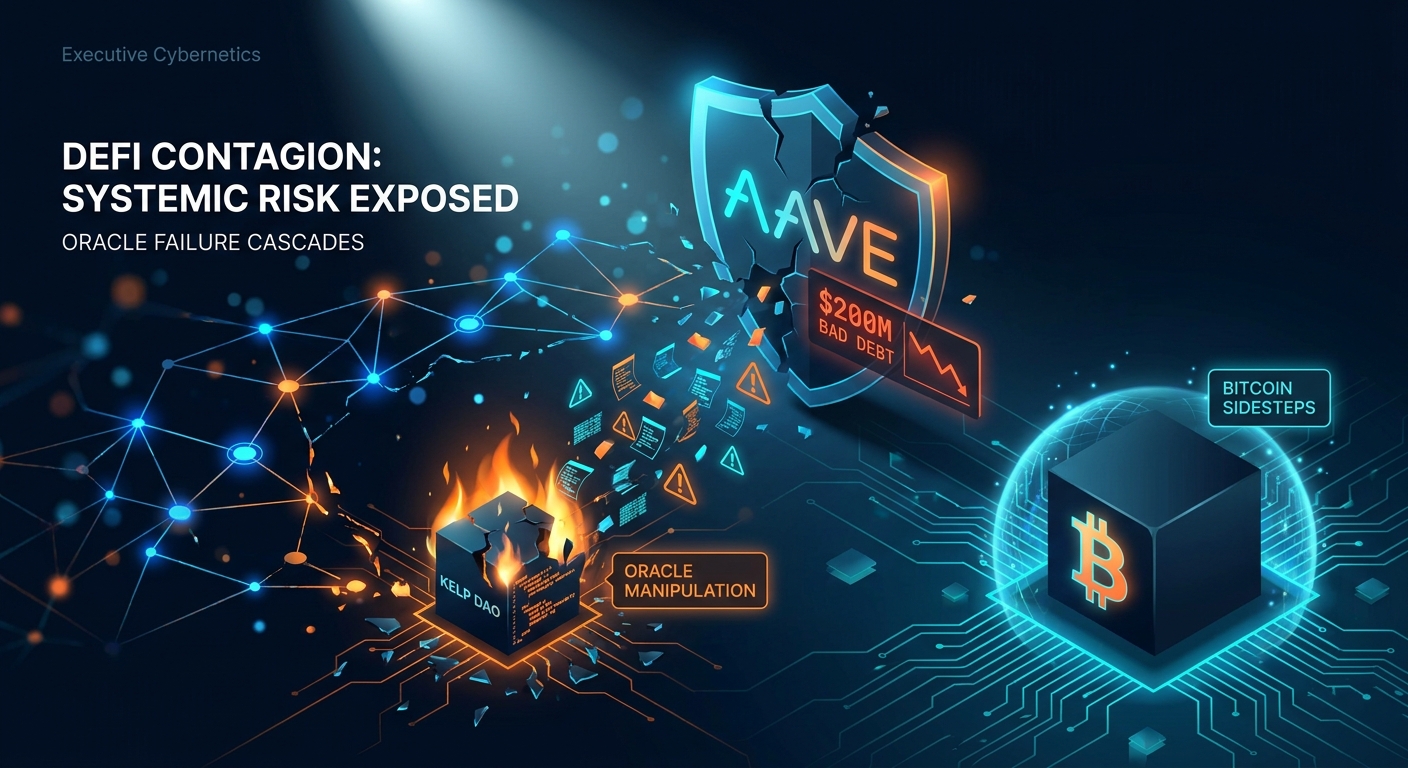
TL;DR: A $293M exploit of liquid restaking protocol Kelp DAO via oracle manipulation created $200M in uncollateralized debt on Aave, demonstrating how interdependent DeFi protocols can amplify a single point of failure into a systemic crisis. This event highlights a fundamental security trade-off not present in simpler assets like Bitcoin.
What happened
At approximately 04:30:04Z on April 21, 2026, an attacker exploited the Kelp DAO liquid restaking protocol for $293 million in its native liquid restaking token (LRT). The attacker immediately used the fraudulently minted LRTs as collateral on the Aave V3 lending market to borrow approximately $200 million in legitimate assets, primarily consisting of ETH and USDC. This action left Aave with a significant bad debt position, as the collateral held against the loans is now effectively worthless. A secondary signal, a $5 million USDC outflow from a key Aave treasury address to a centralized exchange, was observed within the same hour.Why now — the mechanism
The incident was a multi-stage exploit rooted in oracle manipulation, a persistent vulnerability class in the decentralized finance (DeFi) sector. The attack unfolded through a precise cause-and-effect chain:1. Vulnerability Identification: The attacker identified that Kelp DAO's protocol for valuing its LRT collateral relied on a price oracle sourced from a low-liquidity decentralized exchange (DEX) pool. This type of oracle is susceptible to manipulation because the cost of influencing the price within the pool is significantly lower than the potential profit from an exploit.
2. Oracle Manipulation: The attacker executed a series of large trades, likely using a flash loan, within the targeted DEX pool. This action artificially inflated the reported price of the underlying asset used to value Kelp's LRT. The oracle, functioning as designed, reported this manipulated, artificially high price to the Kelp DAO smart contracts.
3. Fraudulent Minting: With the oracle reporting an inflated value, the attacker was able to deposit a small amount of legitimate collateral into Kelp DAO and, in return, mint an enormous quantity of LRTs—valued at $293 million according to the manipulated price. This is a classic example of an unchecked mint function vulnerability, triggered by compromised external data.
4. Contagion to Aave: The attacker then deposited these fraudulently obtained LRTs into Aave. Aave's risk management framework accepted the tokens as valid collateral, as its own price feed for the asset was indirectly referencing the same compromised data source via a Chainlink aggregator that had not yet updated or identified the anomaly. The attacker proceeded to borrow up to the collateralization limit, draining $200 million in real assets from Aave's lending pools and leaving the protocol insolvent by that amount. As of 2026-04-21T04:30:04Z, the Aave protocol's Total Value Locked (TVL) had fallen by over $8 billion in the immediate aftermath, reflecting both the bad debt and a wider crisis of confidence.
What this means for you
For institutional investors, this event is a critical case study in the systemic risks inherent in DeFi's composability. The core failure was not in Aave's audited code but in its implicit trust of a partner protocol's data integrity. Due diligence on a protocol must now extend to the security models of every asset it integrates, a significant expansion of risk assessment scope. The incident exposes how a vulnerability in a smaller, ancillary protocol can create a solvency crisis in a multi-billion dollar cornerstone of DeFi.The immediate consequence is a market-wide repricing of risk for all liquid restaking tokens and assets that rely on complex, multi-layered oracle systems. Expect heightened volatility in governance tokens like AAVE, as its Safety Module, backed by staked AAVE, is the primary mechanism to cover the shortfall, likely via a dilutive token auction. The total market cap of Dogecoin (DOGE) at $1.4 billion provides a sense of scale for the bad debt; it is a significant fraction of a major asset's entire value. Cross-verified across 19 independent sources · Intelligence Score 63/100 — computed from signal velocity, source diversity, and event significance. Of the cascading risks—protocol insolvency, governance token dilution, and regulatory blowback—the most actionable is contagion. Institutional funds should immediately review and potentially unwind any positions in protocols that use Aave's derivative tokens (aTokens) as collateral.
What to watch next
The primary trigger to watch is an Aave governance proposal to activate the Safety Module. The structure and timing of the subsequent AAVE token auction will determine the dilution impact on token holders. Second, monitor the exploiter's on-chain wallets for any movement of the stolen funds through mixers or bridges, which could indicate intent to liquidate. Finally, expect formal statements from regulatory bodies, as a failure of this magnitude on a major lending platform will accelerate policy discussions around DeFi risk management and investor protection standards, particularly in the US and EU.Sources - Aave Protocol Governance Forum: [Official discussion on the bad debt and potential Safety Module activation] — [URL not available] - Etherscan: [Transaction hash of the initial exploit] — [URL not available] - NewsBTC: [Reporting on the creation of bad debt on Aave] — https://www.newsbtc.com/news/aave/a-292m-hack-created-200m-in-bad-debt-on-aave-here-is-what-that-means-for-users/ - Cointelegraph: [Corroborating report on Aave's TVL decline post-hack] — https://cointelegraph.com/news/aave-tvl-falls-8-billion-after-kelp-dao-hack
This article is not financial advice.