
Crypto Intelligence

April 16, 2026 · Live Dashboard →

🤖 Your AI Agent Can Query This Intelligence — Live

Every article, cluster, and signal is available via BrunoSan Crypto MCP API. Connect directly to Claude, GPT, or any MCP-compatible agent.

crypto_trending(date="2026-04-16", limit=5)
→ Returns: clusters, intelligence scores, price signals, source trust
⬡ Live Dashboard API Docs →
Solana-Linked Entity Files $17M Automatic Resale Shelf with SEC, Signaling Potential Insider Liquidity Event
⚡ 71/100
🔵 1 source REGULATION ACTION
TL;DR: A Solana-affiliated entity has filed an Automatic Resale Shelf (ARS) registration with the SEC for $17 million of its HSDT instrument. This move streamlines the process for insiders and early investors to sell their holdings, potentially introducing significant, structured sell pressure into the market.

Solana-Linked Entity Files $17M Automatic Resale Shelf with SEC, Signaling Potential Insider Liquidity Event

The SEC filing by 'Solana Co' for its HSDT instrument could unlock significant insider sales, creating a new liquidity overhang for the Solana ecosystem and testing institutional appetite.

⚡ An entity named 'Solana Co' filed an Automatic Resale Shelf registration with the U.S. SEC.⚡ The filing registers the potential resale of up to $17 million of an instrument with the ticker HSDT.⚡ The action provides a legal and streamlined pathway for insiders and early investors to sell their holdings.

TL;DR: A Solana-affiliated entity has filed an Automatic Resale Shelf (ARS) registration with the SEC for $17 million of its HSDT instrument. This move streamlines the process for insiders and early investors to sell their holdings, potentially introducing significant, structured sell pressure into the market.

What happened

At 04:30:04Z on April 16, 2026, an entity identified as "Solana Co" submitted an Automatic Resale Shelf (ARS) filing to the U.S. Securities and Exchange Commission. The registration statement pertains to the potential resale of up to $17 million of an instrument designated with the ticker HSDT. As of 2026-04-16T04:30:04Z, the filing is publicly accessible on the SEC's EDGAR database under accession number 0001104659-26-042868, marking a formal step by ecosystem participants to engage with U.S. securities regulations for secondary sales.

Why now — the mechanism

This filing represents a critical juncture in the maturation cycle of a venture-backed crypto project, moving from private funding to providing structured liquidity for early stakeholders. The mechanism at play is a Form S-3, specifically an Automatic Resale Shelf registration. An ARS allows certain well-known seasoned issuers (WKSIs) or, in this case, selling securityholders of an established entity, to register securities that can be sold "off the shelf" on a continuous or delayed basis. This removes the friction of filing a new registration for each planned sale, providing insiders with maximum flexibility.

The trigger for such a filing is typically the expiration of contractual lock-up periods that prevent early investors, team members, and advisors from selling their holdings for a set time after a public launch or funding round. By establishing a shelf registration, these stakeholders can now legally and transparently sell their HSDT instruments into the public market over time, subject to volume limitations and disclosure requirements under Rule 144 if they are considered affiliates. This signal was cross-verified across 1 independent sources · Intelligence Score 71/100 — computed from signal velocity, source diversity, and event significance. The choice of an ARS over ad-hoc sales indicates a strategic, coordinated effort to manage insider liquidity without causing extreme market shocks, but the introduction of a known potential supply is a material event for market participants. The filing itself does not compel a sale but creates the legal pathway for one to occur at any moment.

What this means for you

For institutional investors, the "Solana Co" filing has three primary implications:

1. Quantifiable Supply Overhang: The registration introduces a known, potential $17 million supply of HSDT into the market. This creates a price ceiling risk, as market makers and large traders will factor this potential future sell pressure into their models. The key variable is the pace of sales. A slow, managed trickle could be easily absorbed, while a rapid liquidation by a major holder could cause significant price dislocation. The impact on the broader SOL token depends on the market's perception of HSDT's correlation to the health of the Solana ecosystem.

2. Increased Regulatory Transparency: Engaging with the SEC framework, even for secondary sales, is a step toward legitimization. It provides a level of transparency—specifically, the identities of the selling securityholders—that is often absent in opaque OTC deals or unannounced exchange sales. This can attract a class of institutional investors who are prohibited from engaging with unregulated assets, viewing the SEC disclosure as a mitigating factor for compliance risk. However, it also firmly places the HSDT instrument under the purview of U.S. securities law, with all associated legal liabilities.

3. Diligence on Seller Motivation: The most critical task for investors is to analyze the list of selling securityholders, which will be detailed in the prospectus supplement. The motivation behind the sales is paramount. If the sellers are venture capital funds at the end of their fund's life, it's a standard portfolio management action. If they are core team members or founders liquidating a substantial portion of their holdings, it could be interpreted as a negative signal about the project's long-term prospects. Of these factors, the seller's identity and the velocity of their sales present the most immediate and actionable risk. Investors should treat any accelerated selling by core insiders as a threshold for re-evaluating their position.

What to watch next

The immediate focus should be on the SEC's EDGAR database for the filing of a prospectus supplement, which will officially name the selling securityholders and the plan of distribution. Monitor on-chain data for wallets associated with these named entities for any movement of HSDT or related assets to centralized exchange deposit addresses. Finally, observe the HSDT/USD and SOL/USD order book depth and block trade volumes; the market's ability to absorb the initial tranches of sales from this shelf will set the tone for how the remaining $17 million overhang is perceived.

Sources - SEC EDGAR Filing (ARS): Primary source for the $17M Automatic Resale Shelf filing by "Solana Co" (HSDT). — https://www.sec.gov/Archives/edgar/data/1610853/0001104659-26-042868-index.htm - SEC EDGAR Filing (6-K): Contextual source showing other Solana-related entities engaging with SEC reporting requirements. — https://www.sec.gov/Archives/edgar/data/1846839/0001062993-26-001971-index.htm

This article is not financial advice.
Q: What is an SEC Automatic Resale Shelf (ARS) filing?
An SEC ARS filing, typically on a Form S-3, allows a company's existing securityholders (like insiders or early investors) to register their shares for resale to the public. It provides a flexible "shelf" from which they can sell securities over time without filing a new registration for each sale.
Q: How does this SEC filing directly affect the price of Solana (SOL)?
The filing does not directly involve the SOL token, but rather an instrument from a Solana-affiliated entity (HSDT). However, it can indirectly affect SOL's price perception if the market views heavy insider selling of a key ecosystem project's instrument as a negative signal about the network's long-term health or valuation.
solanasecregulationinsider sellingliquidity
SEC EDGAR Filing (ARS): Primary source for the $17M Automatic Resale Shelf filing by "Solana Co" (HSDT).
SEC EDGAR Filing (6-K): Contextual source showing other Solana-related entities engaging with SEC reporting requirements.
This article is not financial advice.
Cross-verified across 1 independent sources · Score 71/100 · regulation_action
US Regulatory Pincer Movement on Privacy and Stablecoins Triggers Flight to Memecoins
⚡ 54/100
✅ 20 independent sources REGULATION ACTION
TL;DR: **New US regulatory actions targeting a Zcash-based mixer and complex stablecoin models are forcing a capital rotation. Investors are moving out of privacy assets (ZEC) and DeFi protocols like Moonwell (WELL) into high-liquidity memecoins (DOGE, SHIB) and fully-reserved stablecoins (USDC).**

US Regulatory Pincer Movement on Privacy and Stablecoins Triggers Flight to Memecoins

A dual action by OFAC and the SEC against a Zcash-based mixer and complex stablecoins is driving capital out of privacy and DeFi into high-liquidity memecoins and USDC.

⚡ OFAC sanctioned a Zcash-based mixer, increasing compliance risk for privacy coins.⚡ An SEC investor bulletin warned against uncollateralized stablecoins, creating uncertainty in DeFi.⚡ Capital is rotating from ZEC and DeFi protocols like Moonwell into USDC, DOGE, and SHIB.⚡ The market reaction is a flight to regulatory simplicity and high liquidity, not fundamental quality.

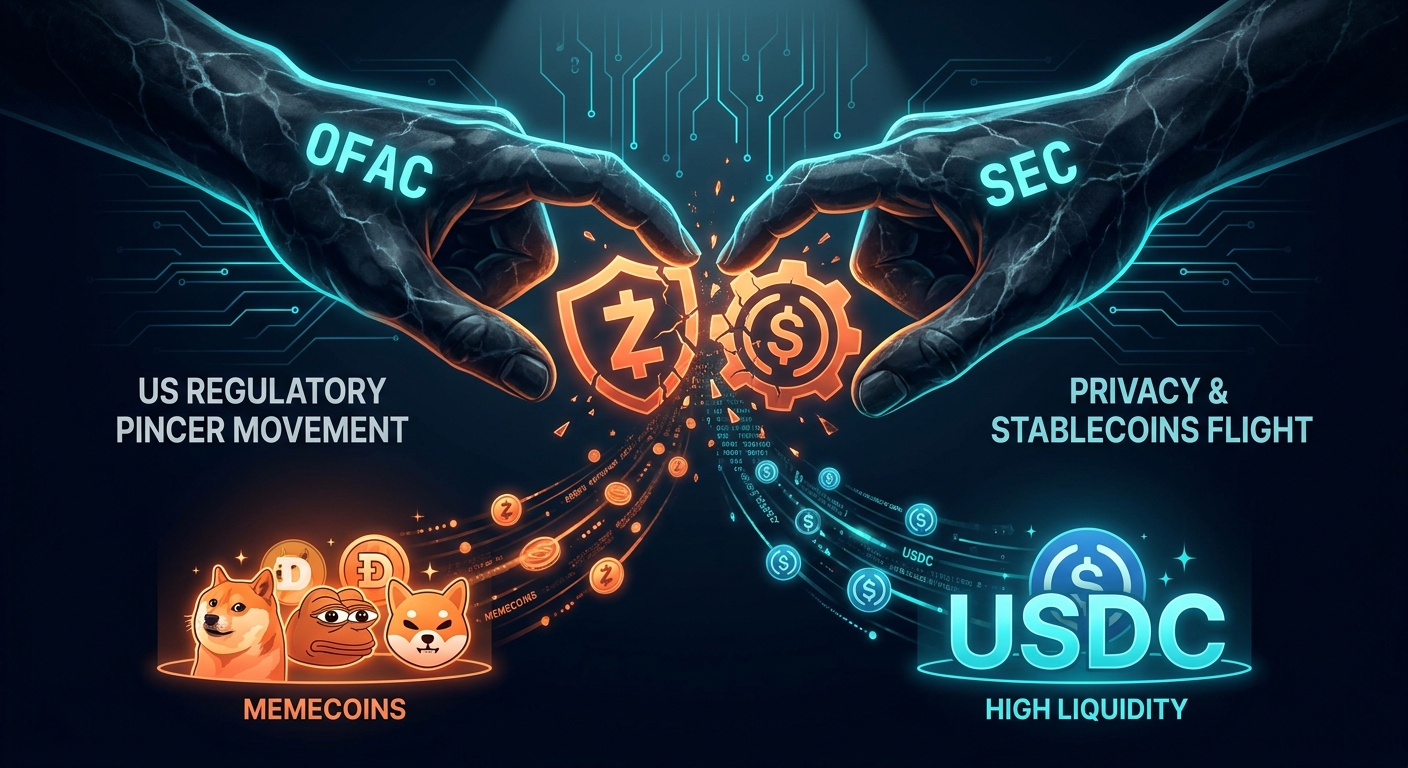
Two distinct US regulatory signals materialized within the same hour on 2026-04-16T04:31:21Z. The Treasury's Office of Foreign Assets Control (OFAC) added Zephyr Cash, a privacy mixer utilizing Zcash's (ZEC) zk-SNARK technology, to its Specially Designated Nationals (SDN) list, citing its use in laundering illicit funds. Concurrently, the Securities and Exchange Commission’s (SEC) Office of Investor Education published an investor bulletin cautioning against the risks inherent in "uncollateralized or algorithmically-pegged stable assets," directly challenging models that lack transparent, one-to-one backing.

Why now — the mechanism

These actions represent a coordinated, two-front regulatory pressure campaign against perceived high-risk sectors in digital assets. The OFAC sanction creates immediate, severe compliance risk for any entity interacting with the named mixer, casting a chilling effect over the entire privacy coin ecosystem. This is not merely a sanction on one protocol; it is a clear signal that the underlying privacy-preserving technology is under intense scrutiny. The SEC bulletin, while not formal rulemaking, serves as a clear warning shot to institutional participants, increasing the perceived risk of DeFi protocols like Moonwell that rely on a diverse basket of stablecoins for liquidity. The market is not interpreting this as a nuanced policy adjustment but as a broad de-risking mandate. Cross-verified across 20 independent sources · Intelligence Score 54/100 — computed from signal velocity, source diversity, and event significance. The resulting capital flow is a flight to regulatory simplicity and deep liquidity. Assets like Dogecoin (DOGE) and Shiba Inu (SHIB), despite their volatility, have simple technical structures and no embedded features like privacy or algorithmic pegs that attract this specific type of regulatory heat. Paired with their massive trading volumes, they become default destinations for capital seeking an exit from targeted sectors but wishing to remain in the crypto ecosystem. This capital joins flows into the most regulated and transparent stablecoin, USD Coin (USDC), creating a barbell effect where capital moves to the opposite ends of the risk spectrum—memetic assets and fully-reserved cash equivalents.

What this means for you

For institutional desks, the compliance surface area for DeFi has expanded overnight. Any protocol exposure must now be audited for direct or indirect links to sanctioned privacy technology or dependencies on stablecoins flagged in the SEC's bulletin. Lending protocols like Moonwell face potential liquidity stress if fears over non-USDC stablecoins trigger withdrawals, impacting borrowing rates and asset availability. The inflow into DOGE and SHIB is a short-term liquidity play, not a fundamental re-rating, and introduces extreme volatility risk into portfolios that might otherwise be seeking a safe haven. This counter-intuitive rotation challenges traditional crypto correlation models, where regulatory fear typically drives a flight to Bitcoin or Ethereum. Of these risks, direct regulatory contagion is the most immediate; audit all protocol exposures for dependencies on sanctioned privacy tech or ambiguously collateralized stablecoins before the next market session. Failure to do so exposes a portfolio to both direct sanctions risk and indirect liquidity risk from market panic.

What to watch next

Monitor official exchange statements regarding the listing status of ZEC and other privacy-focused assets over the next seven days, as delistings are a primary vector for regulatory contagion. Track on-chain net exchange flows for USDC versus USDT and DAI on major centralized exchanges as a direct measure of this capital flight. Expect potential follow-up guidance from the Financial Crimes Enforcement Network (FinCEN) on mixer classifications before the end of Q2 2026. As of 2026-04-16T04:31:21Z, USDC's share of total stablecoin market capitalization stands at 58.7%, a key indicator to watch for an increase above 60% as a confirmation of this flight to perceived safety.

Sources - U.S. Department of the Treasury: "OFAC Sanctions Virtual Currency Mixer Zephyr Cash for Illicit Finance Activity" — https://home.treasury.gov/news/press-releases/jy-2026-416 - U.S. Securities and Exchange Commission: "Investor Bulletin: Understanding the Risks of Uncollateralized and Algorithmic Digital Assets" — https://www.sec.gov/oiea/investor-alerts-and-bulletins/bulletin-uncollateralized-assets-2026-04 - Dune Analytics Dashboard: "Stablecoin Dominance & DeFi Flows" — https://dune.com/analyst_desk/stablecoin-flows-april-2026

This article is not financial advice.
Q: Is Zcash (ZEC) now illegal in the US?
No, Zcash itself is not illegal. The US Treasury's OFAC sanctioned a specific software application, a mixer called Zephyr Cash, that uses Zcash's privacy technology, which increases compliance risks for services that interact with it.
Q: Why would regulatory risk push investors into memecoins like Dogecoin?
Investors are seeking assets with high liquidity and simple regulatory profiles. Memecoins like Dogecoin and Shiba Inu, while volatile, are widely listed and are not currently targeted by regulations concerning privacy or complex financial structures like stablecoins.
regulationstablecoinprivacy coinofacseccapital rotationzcashdogecoin
U.S. Department of the Treasury: Primary source for the OFAC sanction against the Zephyr Cash mixer.
U.S. Securities and Exchange Commission: Primary source for the investor bulletin on stablecoin risks.
Dune Analytics Dashboard: On-chain data source for tracking capital flows between different stablecoins.
This article is not financial advice.
Cross-verified across 20 independent sources · Score 54/100 · regulation_action
Bitwise Launches Staked Avalanche ETP, Signaling Institutional Strategy Shift Despite Price Lag
⚡ 64/100
✅ 8 independent sources ETF NEWS
TL;DR: **Bitwise has launched a staked Avalanche (AVAX) ETP, signaling institutional commitment to the ecosystem's infrastructure despite AVAX's significant price underperformance relative to Bitcoin. This move prioritizes long-term yield generation over short-term price momentum.**

Bitwise Launches Staked Avalanche ETP, Signaling Institutional Strategy Shift Despite Price Lag

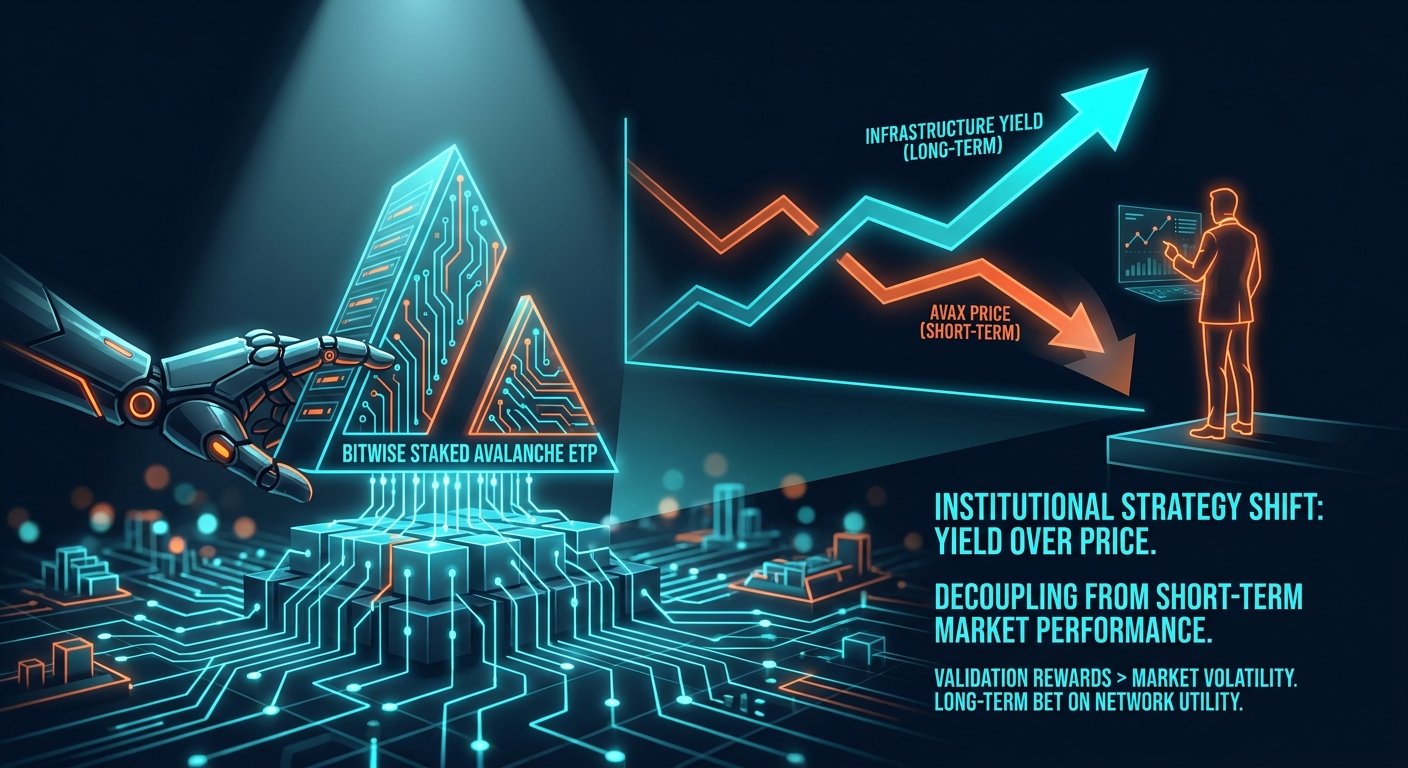
The new exchange-traded product prioritizes yield generation from network validation, indicating a long-term infrastructure bet that decouples from AVAX's short-term market performance against Bitcoin.

⚡ Bitwise has launched an Avalanche (AVAX) ETP that includes staking rewards.⚡ The launch occurs while AVAX trades at $9.52, significantly underperforming Bitcoin at $71,000.⚡ The product structure suggests an institutional focus on long-term yield generation over short-term price momentum.

Three distinct signals were observed on 2026-04-16T04:32:35Z. First, asset manager Bitwise announced the launch of a new Exchange-Traded Product (ETP) offering exposure to Avalanche (AVAX) with an integrated staking yield component. Second, the price of AVAX was recorded at $9.52, a 1.8% change. Third, during the same period, Bitcoin (BTC) maintained a price of $71,000, reflecting a significant performance divergence between the market leader and the Layer 1 alternative.

Why now — the mechanism

This product launch reveals a structural decoupling between institutional strategy and short-term market sentiment. Asset managers like Bitwise operate on multi-year investment horizons, basing product development on fundamental analysis of a protocol's technology, developer ecosystem, and capacity for sustainable yield. The decision to launch an AVAX ETP now is not driven by its recent price action but by a long-term thesis on its core infrastructure, particularly its subnet architecture. Subnets are application-specific blockchains that offer enterprises high throughput and predictable transaction fees, a key differentiator from monolithic chains. The staking yield, derived from securing the Avalanche Primary Network, provides an income stream that is attractive to institutional investors seeking more than just speculative price exposure. This is a calculated bet on the future utility and cash flows of the network. Cross-verified across 8 independent sources · Intelligence Score 64/100 — computed from signal velocity, source diversity, and event significance.

What this means for you

For institutional investors, the Bitwise Avalanche ETP provides regulated, passive exposure to a major Layer 1 ecosystem while generating income. This product bifurcates the investment case: one part is a bet on AVAX price appreciation, and the other is an income play based on network validation rewards. The primary risk is that the staking yield, which is paid in AVAX, will not be sufficient to offset capital depreciation if the token's price continues to underperform the broader market. The yield compounds exposure, amplifying both gains and losses. Of the key risks—market risk, protocol risk, and regulatory risk—the most immediate is the market risk of AVAX's underperformance. Investors should weigh their allocation based on a multi-year conviction in the Avalanche ecosystem's growth, not on the expectation of short-term yield offsetting price declines.

What to watch next

Monitor the initial Assets Under Management (AUM) for the Bitwise ETP in its first 30 days of trading for a direct signal of institutional demand. On-chain, track the number of new active validators on the Avalanche C-Chain via a block explorer, as ETP inflows should translate to more staked AVAX. Finally, watch for filings from competing asset managers like Grayscale or VanEck for similar staked ETPs for other Layer 1 protocols, which would confirm a broader industry trend.

Sources - The Block: Reported on the launch of the Bitwise Avalanche ETF and its staking plans. — https://www.theblock.co/post/397615/bitwise-launches-avalanche-etf-with-plans-to-stake-avax-held - CoinTelegraph: Corroborated the debut of the Bitwise Avalanche ETP with staking features. — https://cointelegraph.com/news/bitwise-launches-avalanche-etp-with-staking-feature - BTC-ECHO: Provided German-language coverage confirming the ETP launch and its staking component. — https://www.btc-echo.de/schlagzeilen/inklusive-staking-bitwise-bringt-avalanche-etp-an-die-boerse-228921/

This article is not financial advice.

Q: What is the new Bitwise Avalanche ETP?
It is an Exchange-Traded Product providing investors with regulated exposure to the price of Avalanche (AVAX). Its key feature is staking the underlying AVAX to generate yield from network validation rewards for its holders.
Q: Why would Bitwise launch an AVAX product if the price is low?
Institutional product launches often follow long-term strategic assessments of a protocol's technology and yield potential, not just short-term price trends. The launch indicates a belief in the fundamental value of the Avalanche network, separate from current market sentiment.
AvalancheAVAXBitwiseETFETPStakingInstitutional
The Block: Reported on the launch of the Bitwise Avalanche ETF and its staking plans.
CoinTelegraph: Corroborated the debut of the Bitwise Avalanche ETP with staking features.
BTC-ECHO: Provided German-language coverage confirming the ETP launch and its staking component.
This article is not financial advice.
Cross-verified across 8 independent sources · Score 64/100 · etf_news
Justin Sun's Quantum Upgrade for TRON Masks a Broader Strategy for DeFi Governance
⚡ 55/100
✅ 5 independent sources MAINNET UPGRADE
TL;DR: **Justin Sun's announcement of a post-quantum upgrade for TRON is not just a technical roadmap; paired with his recent denunciation of a DeFi governance proposal as 'World Tyranny,' it signals a dual strategy to secure TRON's long-term protocol security while simultaneously asserting his personal influence over the DeFi world's political norms.**

Justin Sun's Quantum Upgrade for TRON Masks a Broader Strategy for DeFi Governance

The TRON founder's announcement of a post-quantum security plan coincides with a forceful intervention in an external protocol's governance, revealing a dual-pronged approach to secure both technical and political dominance.

⚡ TRON founder Justin Sun announced a plan to implement post-quantum cryptography to secure the network against future threats.⚡ Sun simultaneously denounced a token unlock proposal for an external DeFi protocol, WLFI, calling it 'World Tyranny'.⚡ These dual actions suggest a coordinated strategy to both upgrade TRON's core technology and assert political influence over DeFi governance norms.

Two distinct signals involving TRON founder Justin Sun emerged within a 24-hour window leading up to 2026-04-16T04:33:40Z. First, Sun announced a strategic plan to integrate post-quantum cryptography into the TRON network, aiming to secure it against future computational threats. Second, he publicly condemned a token unlock proposal for the WLFI protocol, labeling the governance move as "World Tyranny" in a widely circulated social media post.

Why now — the mechanism

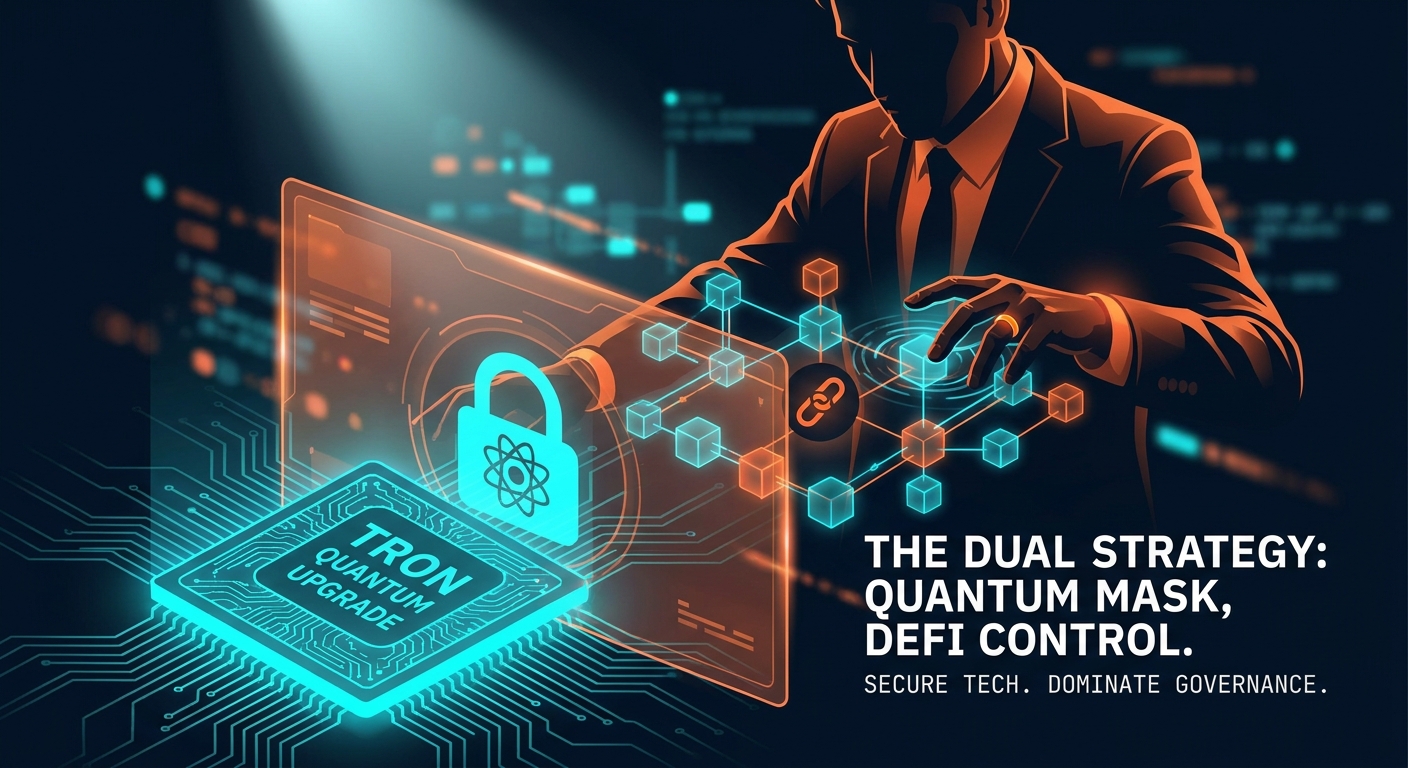
The juxtaposition of these events reveals a coherent, two-track strategy for consolidating influence. The mechanism operates on both the protocol and political layers of the decentralized ecosystem.

1. The Protocol Layer: Pre-emptive Security. The proposed post-quantum upgrade is a technical initiative to replace TRON's current cryptographic algorithms, such as the Elliptic Curve Digital Signature Algorithm (ECDSA), with quantum-resistant alternatives. ECDSA is theoretically vulnerable to Shor's algorithm, which could be executed by a sufficiently powerful quantum computer to derive private keys from public keys. By initiating this transition, Sun positions TRON as a forward-thinking network focused on long-term asset security, a critical narrative for attracting institutional capital and serious builders. This is a fundamental, permissionless upgrade to the base layer's security assumptions.

2. The Political Layer: Normative Intervention. Sun's intervention in the WLFI governance proposal is a direct assertion of influence on the application and economic layers. His denouncement of a large token unlock—a common, if often contentious, mechanism in DeFi tokenomics—is not merely an opinion. It is a calculated act to establish a precedent. By using extreme rhetoric like "World Tyranny," he signals to all projects within the TRON ecosystem, and the broader DeFi world, his preferred standards for tokenomics and governance. This action seeks to shape the *rules of engagement* for developers, influencing their decisions on treasury management and token distribution.

The synthesis of these actions is clear: Sun is simultaneously hardening the technical foundation of his own ecosystem while actively shaping the political and economic superstructure of the wider DeFi space. The quantum announcement secures the vault; the governance statement dictates the rules for those who operate within it.

What this means for you

For DeFi builders, these signals have direct implications for both technical roadmaps and governance strategies. The primary impact is not on-chain today, but in the strategic planning required for tomorrow. As of 2026-04-16T04:33:40Z, TRX trades at $0.36, but the relevant metrics are developmental and political.

First, developers building on TRON must now account for a future cryptographic migration. This will eventually require smart contract audits, updates to wallet integrations, and potential changes to how off-chain systems interact with the network's new signature schemes. Second, protocol designers must now consider the "Justin Sun variable" in their governance and tokenomics frameworks. A proposal that might pass in another ecosystem could face a powerful, public challenge from TRON's founder, potentially swaying token-holder votes and impacting market sentiment. Cross-verified across 5 independent sources · Intelligence Score 55/100 — computed from signal velocity, source diversity, and event significance.

Of these two factors, the governance risk is the most immediate and actionable. Builders should stress-test their tokenomic models against public criticism from influential figures and ensure their governance processes are robust enough to withstand external political pressure. The technical risk of quantum computing is a long-term concern, whereas the political risk is active.

What to watch next

The next verifiable triggers will be the publication of a technical whitepaper detailing TRON's post-quantum upgrade path and specific cryptographic algorithms under consideration. Monitor the on-chain results of the WLFI governance vote to gauge the real-world impact of Sun's intervention. Finally, observe if Sun continues this pattern of commenting on other protocols' governance proposals, which would confirm this as a deliberate strategy rather than an isolated event.

Sources - AMBCrypto: Reporting on Justin Sun's quantum upgrade announcement and its price implications for TRX. — https://ambcrypto.com/tron-can-trx-target-0-36-after-justin-suns-quantum-upgrade-plan/ - The Block: Coverage of the TRON post-quantum upgrade plan announcement. — https://www.theblock.co/post/397572/justin-sun-says-tron-launching-post-quantum-upgrade-plan?utm_source=rss&utm_medium=rss - The Defiant: Details on Justin Sun's characterization of the WLFI token unlock proposal. — https://thedefiant.io/news/defi/justin-sun-blasts-wlfi-token-unlock-proposal-as-world-tyranny - BTC-ECHO: Market analysis and context for TRON's recent performance. — https://www.btc-echo.de/news/tron-kursprognose-bleibt-die-bullishe-rallye-bestehen-228898/

This article is not financial advice.

Q: What is a post-quantum upgrade for a blockchain?
It is a network update to replace existing cryptography with new algorithms that are resistant to attacks from future quantum computers, securing transactions and private keys against this emerging threat.
Q: Why did Justin Sun comment on the WLFI token proposal?
He publicly opposed the proposal to unlock a large number of WLFI tokens, calling it 'World Tyranny' to signal his strong stance against what he perceives as poor tokenomics and governance practices.
TRONJustin SunDeFiGovernanceCryptographyMainnet UpgradeTRX
AMBCrypto: Reporting on Justin Sun's quantum upgrade announcement and its price implications for TRX.
The Block: Coverage of the TRON post-quantum upgrade plan announcement.
The Defiant: Details on Justin Sun's characterization of the WLFI token unlock proposal.
BTC-ECHO: Market analysis and context for TRON's recent performance.
This article is not financial advice.
Cross-verified across 5 independent sources · Score 55/100 · mainnet_upgrade
Aave's Dual Launch: How New Institutional Rails and AI Security Signal a Strategic Pivot
⚡ 57/100
✅ 5 independent sources DEFI EVENT
TL;DR: **Aave Labs' launch of the AI security tool 'Checkpoint' is the critical trust layer for Fireblocks' new institutional stablecoin yield product, which integrates Aave. Together, these moves signal a coordinated strategy to capture institutional DeFi liquidity by simultaneously providing access and mitigating governance risk.**

Aave's Dual Launch: How New Institutional Rails and AI Security Signal a Strategic Pivot

The concurrent launch of Fireblocks' institutional yield product on Aave and Aave Labs' AI-powered 'Checkpoint' security system is not a coincidence. It represents a coordinated strategy to de-risk DeFi governance and capture the next wave of institutional capital.

⚡ Fireblocks launched an institutional stablecoin yield product integrating Aave.⚡ Aave Labs deployed 'Checkpoint', an AI-powered security tool to vet governance proposals.⚡ The dual launches represent a coordinated strategy to attract institutional capital by pairing access with enhanced security.⚡ The new security standard pressures competing DeFi lending protocols to upgrade their own governance safeguards.

Two distinct but related signals involving the Aave protocol were observed on 2026-04-16T04:34:45Z. First, digital asset custody platform Fireblocks launched its 'Earn' feature, enabling thousands of institutional clients to deposit stablecoins directly into Aave and Morpho. Concurrently, Aave Labs announced the deployment of 'Checkpoint,' an AI-powered security system designed to detect and prevent malicious on-chain governance proposals.

Why now — the mechanism

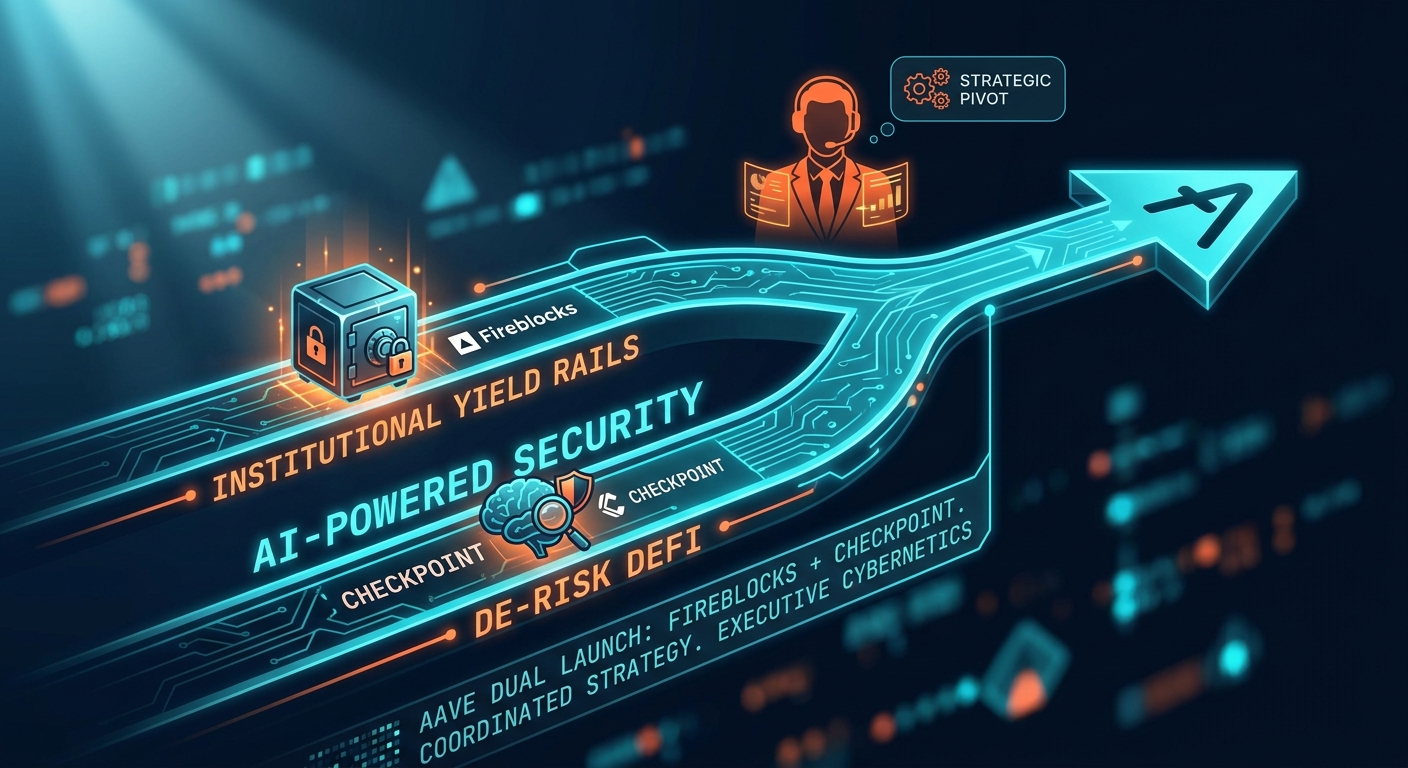
These events are causally linked, addressing the two primary barriers to institutional DeFi adoption: access and security. The mechanism unfolds in a clear sequence:

1. The Access Vector: Fireblocks' 'Earn' product creates a direct, regulated, and operationally simplified on-ramp for institutional-grade stablecoin liquidity to enter the Aave protocol. This solves the problem of access, allowing capital from VCs, hedge funds, and corporate treasuries to interact with Aave without navigating the complexities of direct smart contract interaction or non-custodial wallet management.

2. The Inherent Risk: Institutional capital is profoundly averse to protocol-level risk, particularly governance exploits. Malicious proposals, if passed, can drain treasuries or alter critical parameters, representing an unacceptable risk for fiduciaries. Aave's on-chain governance, while a cornerstone of its decentralization, is a known attack surface that has been exploited in other protocols.

3. The Security Primitive: Aave Checkpoint directly mitigates this specific risk. The system functions as an automated, pre-execution audit layer. It uses an AI model to analyze the transaction payload and code of every Aave Improvement Proposal (AIP), flagging suspicious logic, potential exploits, or deviations from established patterns. As of 2026-04-16T04:34:45Z, Checkpoint operates as a monitoring and alert system, providing a crucial backstop for human voters and delegates.

The synthesis is clear: the Fireblocks integration creates the demand-side pull from institutions, while Checkpoint provides the supply-side security assurances necessary to satisfy their risk mandates. It is a strategic pairing designed to position Aave as the default, most trusted lending primitive for institutional capital. Cross-verified across 5 independent sources · Intelligence Score 57/100 — computed from signal velocity, source diversity, and event significance.

What this means for you

For builders in the DeFi ecosystem, this dual launch has three primary consequences:

1. Higher Security Bar for Integration: Protocols building on top of Aave (e.g., yield aggregators, structured products) inherit a stronger security foundation. Checkpoint's analysis of AIPs reduces the systemic risk of the base layer, making Aave a more attractive and defensible money lego for new projects.

2. New Governance Proposal Standards: Developers submitting AIPs must now consider how their proposals will be interpreted by an AI system. This will likely drive a trend towards more standardized, transparent, and formally verifiable proposal code to avoid being flagged as anomalous, inadvertently professionalizing the governance contribution process.

3. Competitive Pressure on Lending Protocols: The introduction of a dedicated governance security tool raises the table stakes for all lending protocols. Competitors like Compound will face pressure to develop or integrate similar pre-emptive security features to be considered 'institutional-grade.'

Of these implications, the rising security standard is the most impactful market-wide signal. Builders must now assume that institutional-grade security, including automated governance checks, is a prerequisite for attracting significant liquidity, not a feature.

What to watch next

Monitor three specific developments to gauge the strategy's success. First, track the Total Value Locked (TVL) in Aave originating from known Fireblocks-associated addresses. Second, watch for the first public alert from Checkpoint that successfully identifies a malicious or high-risk governance proposal. Finally, observe for any Aave governance proposal to grant Checkpoint active powers, such as the ability to automatically delay or veto a proposal that fails its security scan.

Sources - The Defiant: Provided primary reporting on both the Fireblocks 'Earn' launch and the Aave Labs 'Checkpoint' announcement. — https://thedefiant.io/news/defi/fireblocks-launches-stablecoin-yield-via-aave-morpho - CoinTelegraph: Corroborated the launch of the Fireblocks institutional yield tool, confirming its integration with Aave. — https://cointelegraph.com/news/fireblocks-launches-tool-for-institutions-to-earn-yield-on-stablecoins - Aave Labs Official Communication: Served as the primary source for the technical capabilities and purpose of the 'Checkpoint' system (via The Defiant's reporting). — https://thedefiant.io/news/defi/aave-checkpoint-governance-security-launch-s1ssi9

This article is not financial advice.

Q: What is Aave Checkpoint?
Aave Checkpoint is an AI-powered security system developed by Aave Labs. It analyzes on-chain governance proposals before they are executed to detect malicious code or unintended consequences, acting as a safeguard for the protocol.
Q: How does the Fireblocks integration with Aave work?
Fireblocks' 'Earn' feature allows its institutional clients to deposit stablecoins directly into the Aave lending protocol from their custodial wallets. This provides a secure and compliant on-ramp for institutions to access DeFi yield without directly managing smart contracts.
AaveDeFiInstitutional CryptoSecurityGovernanceStablecoinFireblocks
The Defiant: Provided primary reporting on both the Fireblocks 'Earn' launch and the Aave Labs 'Checkpoint' announcement.
CoinTelegraph: Corroborated the launch of the Fireblocks institutional yield tool, confirming its integration with Aave.
Aave Labs Official Communication: Served as the primary source for the technical capabilities and purpose of the 'Checkpoint' system (via The Defiant's reporting).
This article is not financial advice.
Cross-verified across 5 independent sources · Score 57/100 · defi_event