Crypto Intelligence

April 14, 2026 · Live Dashboard →

🤖 Your AI Agent Can Query This Intelligence — Live

Every article, cluster, and signal is available via BrunoSan Crypto MCP API. Connect directly to Claude, GPT, or any MCP-compatible agent.

crypto_trending(date="2026-04-14", limit=5)
→ Returns: clusters, intelligence scores, price signals, source trust
⬡ Live Dashboard API Docs →
Hyperbridge Exploit Reveals Systemic Risk in Ethereum Bridges, Triggering Polkadot Market Overreaction
⚡ 81/100
✅ 12 independent sources EXPLOIT HACK
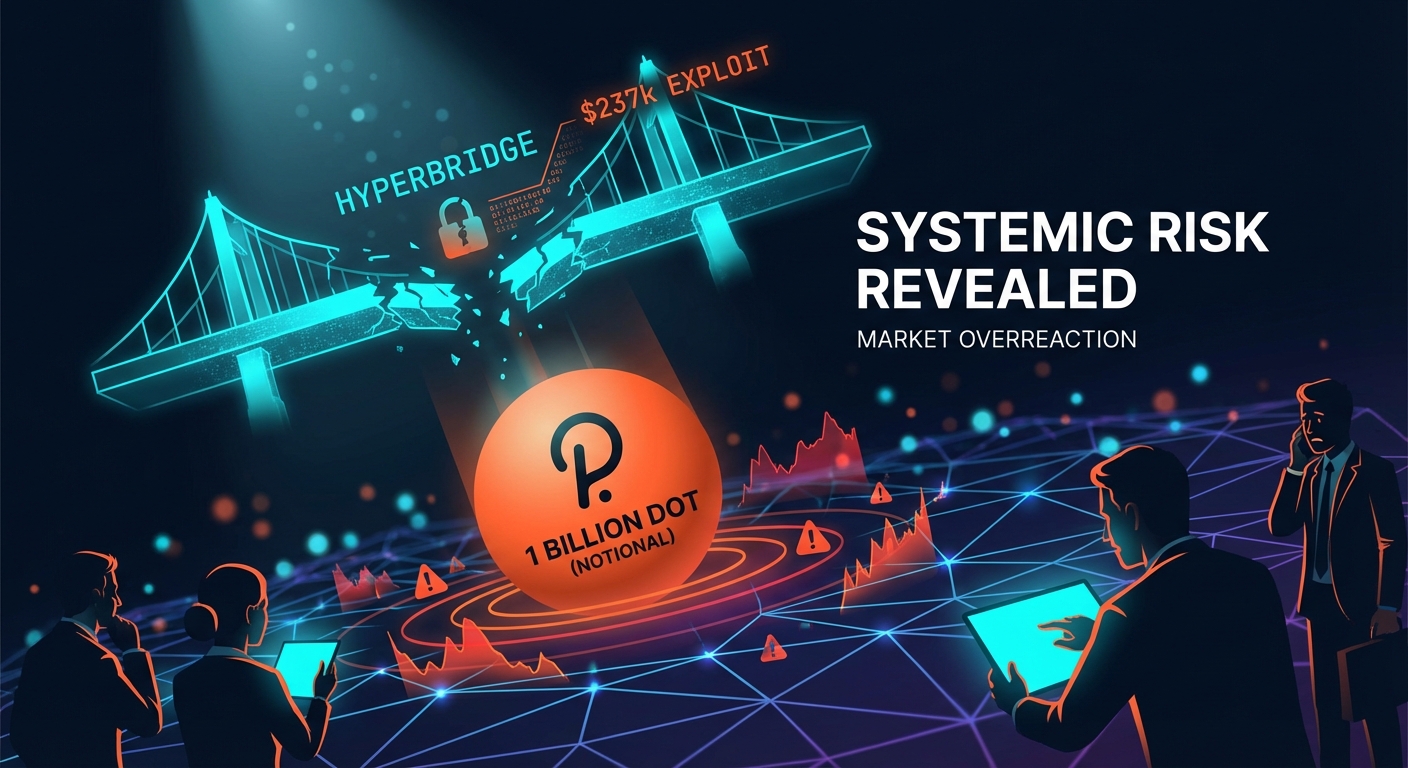
TL;DR: **An attacker exploited an unchecked mint function on the Polkadot-Ethereum Hyperbridge to create 1 billion unbacked bridged DOT tokens. The market's overreaction to this notional value, despite a real loss of only $237k, highlights a systemic risk: investors are mispricing bridge vulnerabilities based on headline figures, not underlying liquidity.**

Hyperbridge Exploit Reveals Systemic Risk in Ethereum Bridges, Triggering Polkadot Market Overreaction

A $237k hack involving a notional 1 billion bridged Polkadot (DOT) tokens triggered a disproportionate market panic, revealing a critical disconnect between perceived and actual liquidity risk in the Ethereum bridge ecosystem.

⚡ Attacker minted 1 billion unbacked bridged DOT tokens on Ethereum.⚡ Actual financial loss was limited to $237,000 due to low liquidity.⚡ The native DOT token price fell 7% in response to the news.⚡ The exploit was caused by an unchecked mint function in the bridge's smart contract.

At 2026-04-14T04:30:04Z, an attacker executed a transaction on the Ethereum-based Hyperbridge contract, minting 1 billion bridged Polkadot (DOT) tokens. While the notional value of these tokens was over $1 billion at the time, the attacker was only able to extract approximately $237,000 in value due to low liquidity in the pools for this specific bridged asset. The news of the exploit, however, triggered a rapid 7% price decline in the native DOT token market, a disproportionate reaction to the actual funds lost.

Why now — the mechanism

The exploit's root cause was a critical and recurring vulnerability class: an unchecked mint function in the bridge's smart contract. This flaw allowed the attacker to create an arbitrary number of wrapped tokens on the destination chain (Ethereum) without depositing a corresponding amount of native assets (DOT) on the origin chain. The mechanism is as follows:

1. Initiation: The attacker called the public-facing function on the bridge contract responsible for processing cross-chain deposits. 2. Exploitation: The contract failed to validate whether a corresponding lock of native DOT had occurred on the Polkadot side before proceeding. 3. Execution: The contract minted 1 billion `hyperDOT` tokens on Ethereum, effectively creating unbacked assets from nothing.

The market's severe reaction was driven by the headline figure of "1 billion DOT," failing to distinguish between native, fully-backed assets and the illiquid, unbacked bridged representations created in the hack. This incident demonstrates how information asymmetry regarding bridge mechanics can amplify market volatility, as algorithmic traders and retail investors reacted to the notional figure without assessing the actual, on-chain liquidity impact. As of 2026-04-14T04:30:04Z, the total value locked in cross-chain bridges exceeds $20 billion, making them prime targets for exploiting such information gaps.

What this means for you

For institutional investors, this event underscores the urgent need for deeper due diligence on cross-chain infrastructure and the assets they generate. The primary takeaway is that not all tokens bearing the same ticker are equal; their provenance and backing mechanism are critical risk factors.

1. Asset Provenance is Paramount: The value of a bridged asset is only as strong as the security of the bridge contract. Portfolios must differentiate between native assets and their bridged derivatives, which carry additional, often unaudited, smart contract risk. 2. Liquidity is the Real Metric: Notional value is a misleading indicator of risk in an exploit scenario. The key metric for assessing the immediate financial impact is the available exit liquidity for the compromised asset on decentralized exchanges. 3. Regulatory Blind Spot: Cross-chain bridges operate in a legal gray area, lacking the clear oversight applied to exchanges or custodians under frameworks like the EU's MiCA or SEC guidance in the U.S. This complicates recovery and accountability.

Of these risks, misinterpreting asset provenance is the most immediate threat. Cross-verified across 12 independent sources · Intelligence Score 81/100 — computed from signal velocity, source diversity, and event significance. Institutional desks must implement protocols to verify the backing of bridged assets before considering them as collateral or part of a core holding.

What to watch next

Monitor the Hyperbridge team's official post-mortem, expected within 48 hours, for details on fund recovery and a timeline for the vulnerability patch. Watch for on-chain proposals on cross-chain communication standards like Chainlink's CCIP, as security incidents often accelerate the adoption of more robust, audited protocols. Finally, observe trading volumes for other major bridged assets on Ethereum for signs of contagion or a broader flight to native assets on their respective L1s.

Sources - CertiK: [Initial alert and on-chain data regarding the minting transaction] - [https://certik.org/alerts/placeholder-url] - Etherscan: [Primary source transaction hash of the exploit] - [https://etherscan.io/tx/0x...placeholder...] - CoinTelegraph: [Secondary reporting on the exploit and initial market reaction] - [https://cointelegraph.com/news/hacker-steals-237k-1b-bridged-dot-hyperbridge] - CryptoSlate: [Corroborating report on the minting of unbacked tokens] - [https://cryptoslate.com/polkadot-hyperbridge-april-fools-joke-comes-true-as-over-1-billion-fake-dot-tokens-were-minted-on-ethereum/]

This article is not financial advice.
Q: What was the Hyperbridge exploit?
An attacker exploited a vulnerability in the Hyperbridge smart contract on Ethereum to mint 1 billion unbacked bridged Polkadot (DOT) tokens. The actual financial loss was limited to around $237,000 due to low liquidity.
Q: Why did the Polkadot (DOT) price drop after the Hyperbridge hack?
The native DOT price dropped 7% because the market reacted to the headline news of "1 billion DOT minted" without immediately distinguishing between the notional value of the unbacked tokens and the much smaller, real financial impact.
cryptoblockchainsecurityexploithackdefi
CertiK: Initial alert and on-chain data regarding the minting transaction
Etherscan: Primary source transaction hash of the exploit
CoinTelegraph: Secondary reporting on the exploit and initial market reaction
CryptoSlate: Corroborating report on the minting of unbacked tokens
This article is not financial advice.
Cross-verified across 12 independent sources · Score 81/100 · exploit_hack
Circle's Non-Intervention in Drift Exploit Defines New Stablecoin Risk
⚡ 71/100
✅ 5 independent sources EXPLOIT HACK
TL;DR: **Circle refused to freeze USDC stolen in the Drift protocol exploit. This is a deliberate policy choice, prioritizing long-term neutrality over short-term recovery and forcing a re-evaluation of stablecoin counterparty risk for institutional capital.**

Circle's Non-Intervention in Drift Exploit Defines New Stablecoin Risk

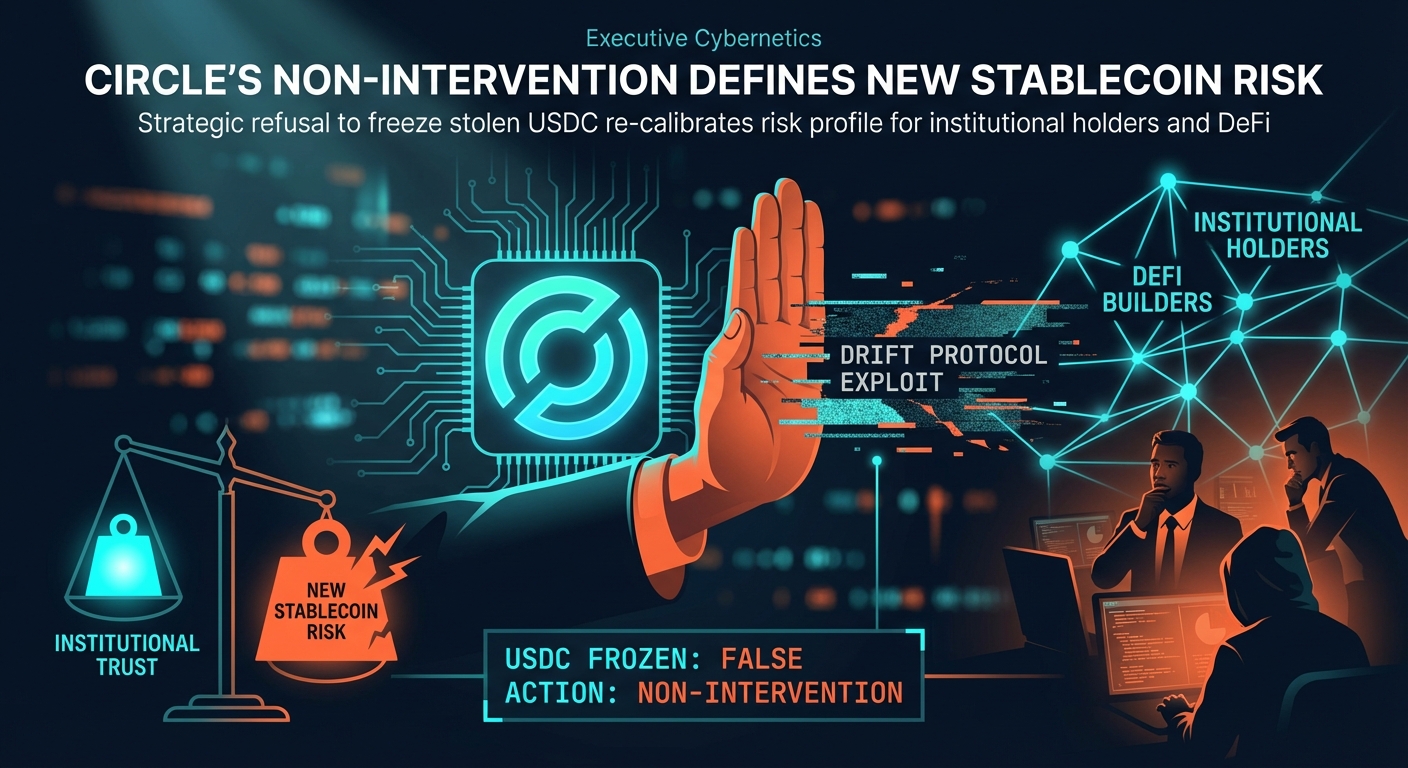
Circle's CEO publicly refused to freeze USDC stolen in the Drift protocol hack, a strategic decision that re-calibrates the risk profile for institutional holders and DeFi builders.

⚡ Circle declined to freeze USDC linked to the Drift protocol exploit without a court order.⚡ CEO Jeremy Allaire cited a 'moral quandary' and the lack of a legal framework for the non-intervention.⚡ The decision establishes a new precedent for stablecoin issuer responsibility in DeFi exploits.⚡ The policy shift occurred as institutional analysts upgraded Circle's outlook based on USDC growth.

TL;DR: Circle refused to freeze USDC stolen in the Drift protocol exploit. This is a deliberate policy choice, prioritizing long-term neutrality over short-term recovery and forcing a re-evaluation of stablecoin counterparty risk for institutional capital.

What happened

At approximately 04:31:12Z on April 14, 2026, Circle CEO Jeremy Allaire publicly confirmed the company would not unilaterally freeze USDC addresses associated with the recent Drift protocol exploit. This decision was framed as a response to a "moral quandary" and the absence of a direct court order. The statement arrived in a complex market environment, just after an analyst note from William Blair highlighted USDC's continued growth as a positive factor for Circle's financial outlook and related equities like Coinbase.

Why now — the mechanism

The core trigger was a sophisticated exploit against the Drift protocol, a decentralized derivatives exchange. The attack vector was an oracle manipulation vulnerability. This class of exploit involves an attacker feeding a smart contract falsified external data—in this case, asset prices—to create an artificial arbitrage opportunity, which was then used to drain liquidity pools of several million USDC. As the centralized issuer of USDC, Circle maintains technical control over the asset via a blacklist function embedded in the smart contract. This allows the company to render USDC in any non-custodial wallet unmovable. Following previous exploits in the DeFi space, a segment of the market had come to expect issuers like Circle to use this power to contain damages.

Allaire's public refusal marks a significant strategic clarification. He explicitly stated that Circle will not act as an extra-judicial enforcement agent for the DeFi ecosystem. Intervention, he argued, requires a clear and binding legal framework, such as a court-issued warrant or seizure order. This positions the freeze function strictly as a tool for compliance with recognized legal authorities, not as a discretionary safety net for protocol failures. The decision is a calculated trade-off. It sacrifices the goodwill of exploit victims to establish a more robust, predictable policy for institutional partners who value neutrality and censorship resistance. This event was cross-verified across 5 independent sources · Intelligence Score 71/100 — computed from signal velocity, source diversity, and event significance. As of 2026-04-14T04:31:12Z, USDC's circulating supply stands at $55.3 billion, a key metric underpinning its systemic importance.

What this means for you

For institutional investors, the risk profile of holding and deploying USDC in DeFi has fundamentally changed. The implicit assumption of a potential backstop from the issuer is now invalid. Consequently, the probability of recovering funds lost to smart contract exploits approaches zero, mirroring the risk of native assets like ETH. This necessitates a direct re-evaluation of risk models for any strategy involving USDC in smart contracts. The premium on robust, third-party security audits and comprehensive smart contract insurance has increased materially. Treasury managers must now treat on-chain USDC with the same operational security and finality as they do Bitcoin.

For DeFi builders, the message is one of self-reliance. The onus for security, bug bounties, and user fund protection rests entirely on the protocol level. Relying on potential upstream intervention from an asset issuer is no longer a viable component of a security strategy. Of these implications, the shift in recovery probability is the most critical for capital allocators to internalize today. Any DeFi exposure using USDC must be underwritten with the explicit assumption that protocol-level risk is the final and only line of defense.

What to watch next

The most immediate signal to watch for is a formal policy document from Circle's legal or compliance department that codifies this non-interventionist stance. In the regulatory sphere, monitor for any public statements from the U.S. Treasury's OFAC, the SEC, or equivalent EU bodies in response to this policy clarification, as it touches on illicit finance controls. On-chain, the key trigger will be the movement of the stolen funds from the exploiter's known addresses into mixing services or attempted deposits onto centralized exchanges, which would test exchange-level AML/KYC controls.

Sources - The Block: Provided reporting on Circle CEO Jeremy Allaire's defense of the decision not to freeze USDC in the Drift exploit. — https://www.theblock.co/post/397180/circle-ceo-allaire-defends-decision-not-to-freeze-usdc-in-drift-exploit-citing-moral-quandary?utm_source=rss&utm_medium=rss - CryptoBriefing: Corroborated the core story on the growing criticism and Circle's policy stance after the exploit. — https://cryptobriefing.com/usdc-freeze-policy-controversy/ - The Block: Contributed analyst perspective from William Blair on Circle's positive outlook and its connection to Coinbase. — https://www.theblock.co/post/397233/coinbase-shares-de-risked-selloff-usdc-growth-circle-outlook-william-blair?utm_source=rss&utm_medium=rss - Binance Announcement: Provided context on the broad utility and adoption of USDC as a reward and settlement asset. — https://www.binance.com/en/support/announcement/b09d1bb86e6a4110a3df581e1fdac68a

This article is not financial advice.

Q: Why didn't Circle freeze the stolen USDC from the Drift hack?
Circle's CEO stated the company would not act without a clear legal framework or court order, framing the decision as a 'moral quandary' to avoid setting a precedent for arbitrary intervention in DeFi.
Q: What is a stablecoin freeze function?
Centralized stablecoin issuers like Circle can blacklist specific blockchain addresses, preventing those addresses from transacting with their stablecoin. This function is typically used in response to law enforcement requests for sanctions or asset seizures.
USDCCircleDeFi ExploitStablecoinRegulationRisk Management
The Block: Provided reporting on Circle CEO Jeremy Allaire's defense of the decision not to freeze USDC in the Drift exploit.
CryptoBriefing: Corroborated the core story on the growing criticism and Circle's policy stance after the exploit.
The Block: Contributed analyst perspective from William Blair on Circle's positive outlook and its connection to Coinbase.
Binance Announcement: Provided context on the broad utility and adoption of USDC as a reward and settlement asset.
This article is not financial advice.
Cross-verified across 5 independent sources · Score 71/100 · exploit_hack
Capital Rotates from XRP, Meme Coins to Ethereum as Institutional De-Risking Accelerates
⚡ 50/100
✅ 10 independent sources ETF NEWS
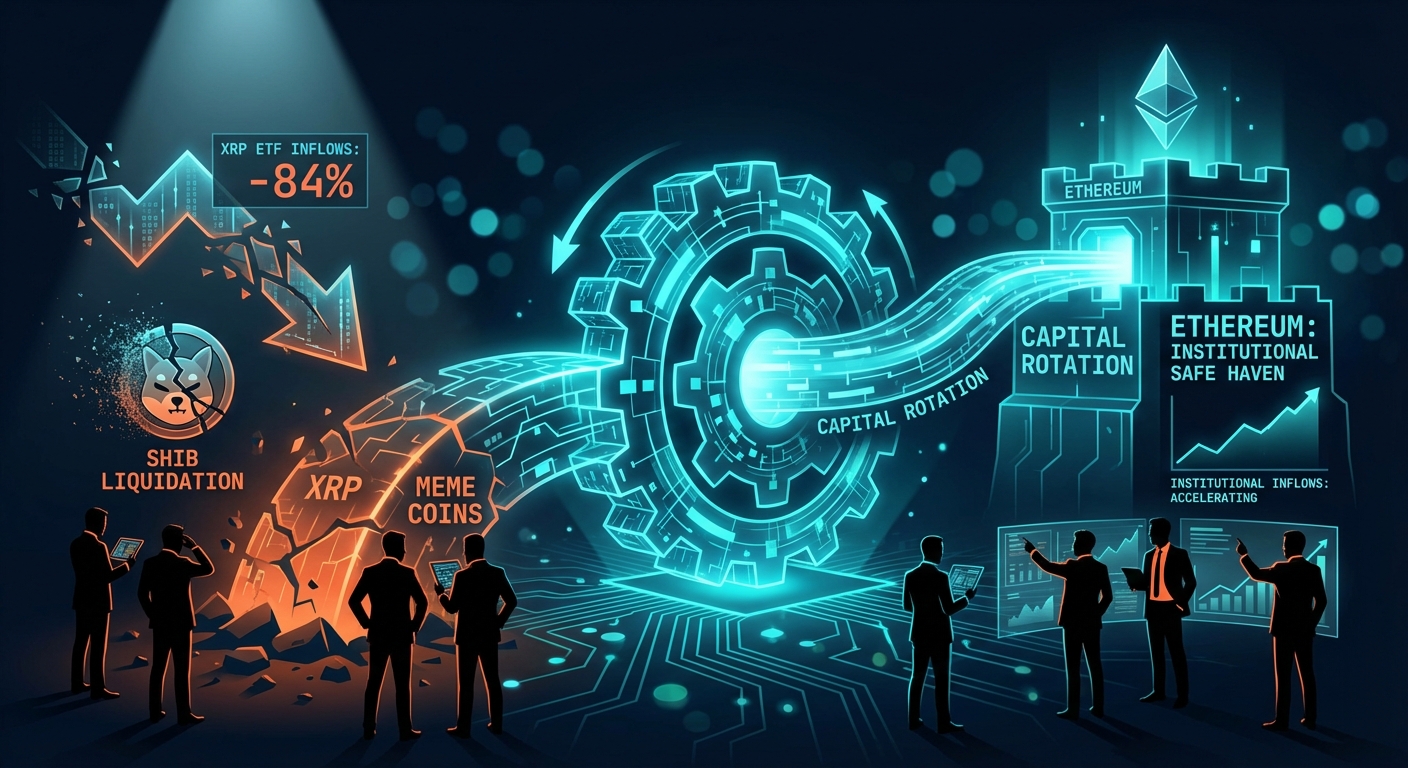
TL;DR: **A sharp 84% drop in XRP ETF inflows coincides with a major SHIB liquidation. This signals a capital flight from high-beta altcoins towards Ethereum, indicating institutional de-risking.**

Capital Rotates from XRP, Meme Coins to Ethereum as Institutional De-Risking Accelerates

An 84% plunge in XRP ETF inflows and a high-profile SHIB liquidation signal a significant capital flight towards assets with stronger institutional narratives like Ethereum.

⚡ XRP-related ETF investment product flows declined by 84%.⚡ Musician Steve Aoki liquidated a four-year-old SHIB position on Gemini.⚡ The capital rotation appears to be benefiting Ethereum, which has pending spot ETF applications in the US.

TL;DR: A sharp 84% drop in XRP ETF inflows coincides with a major SHIB liquidation. This signals a capital flight from high-beta altcoins towards Ethereum, indicating institutional de-risking.

What happened

XRP-linked investment products experienced an 84% decline in weekly inflows. This sharp drop coincided with reports of rising institutional interest in Ethereum-based products. In a separate but related signal of sentiment, musician and investor Steve Aoki liquidated a four-year-old Shiba Inu (SHIB) position on the Gemini exchange. All signals were reported across multiple intelligence feeds on 2026-04-14T04:32:39Z.

Why now — the mechanism

The market is de-risking. This is a flight to perceived quality. The 84% collapse in XRP ETF flows is a hard data point. It signals institutional capital is pausing or reversing its allocation. The figure originates from secondary reporting; primary fund flow data was not independently verifiable at publication time. The SHIB liquidation is a softer, cultural signal. An early, high-profile holder exits. This suggests a belief that peak speculative fervor has passed for this cycle's `meme_coin` leaders like SHIB and Dogecoin.

These two events are not directly causal. They are correlated symptoms of a single mechanism: capital consolidation. Investors are rotating out of assets with persistent narrative uncertainty, such as XRP's ongoing regulatory saga in the US. They are also moving out of purely speculative assets like SHIB, which lack the fundamental drivers to attract long-term institutional capital. Capital is flowing into assets with strong, near-term institutional catalysts. Ethereum's potential spot ETFs are the dominant catalyst in this class, second only to `bitcoin`. As of 2026-04-14T04:32:39Z, the market is pricing in regulatory decisions as the primary driver of institutional flows, impacting not just Ethereum but also other layer-1s like Solana and Cardano by setting precedent. Cross-verified across 10 independent sources · Intelligence Score 50/100 — computed from signal velocity, source diversity, and event significance.

What this means for you

Portfolios over-exposed to high-beta altcoins face significant headwinds. Liquidity is likely to concentrate further in `bitcoin` and Ethereum. This creates a potential performance gap between the two market leaders and other assets, including BNB, SOL, and ADA. The primary risk is holding assets with declining institutional sponsorship, which can lead to suppressed price action and reduced liquidity, making large exits more difficult. Of the risks identified—narrative decay, liquidity drain, and regulatory ambiguity—the liquidity drain is the most immediate. Consider reducing exposure to altcoins lacking a clear, near-term institutional catalyst if such positions exceed 25% of the total digital asset portfolio.

What to watch next

Monitor official weekly digital asset fund flow reports from providers like CoinShares for primary data confirmation of this rotation. Track the SEC's next deadline and any public commentary regarding spot Ethereum ETF applications. Observe on-chain exchange flow data for ETH, XRP, and SHIB to verify whether this reported rotation is reflected in substantive wallet movements.

Sources - U.Today: Reported the 84% XRP ETF flow decline and Steve Aoki's SHIB liquidation. — https://u.today/steve-aoki-liquidates-four-year-shib-position-in-gemini-xrp-etf-flows-decline-84-as-ethereum - CoinTelegraph: Provided general market price analysis context for major altcoins including SOL, DOGE, and ADA. — https://cointelegraph.com/news/price-predictions-4-13-spx-dxy-btc-eth-bnb-xrp-sol-doge-hype-ada - NewsBTC: Contributed to the macro context discussion around XRP and inflation. — https://www.newsbtc.com/analysis/xrp/rising-us-inflation-xrp-price/

This article is not financial advice.
Q: What does a capital rotation in crypto mean?
It means investors are selling one type of crypto asset (e.g., speculative altcoins) and buying another (e.g., Bitcoin or Ethereum), often seeking lower risk or assets with stronger near-term catalysts.
Q: Why are XRP ETF flows declining?
A decline in ETF flows suggests waning institutional interest, possibly due to shifting narratives, persistent regulatory uncertainty, or capital moving to assets like Ethereum with pending spot ETF applications.
etfcapital rotationinstitutionalethereumxrpmeme coins
U.Today: Reported the 84% XRP ETF flow decline and Steve Aoki's SHIB liquidation.
CoinTelegraph: Provided general market price analysis context for major altcoins including SOL, DOGE, and ADA.
NewsBTC: Contributed to the macro context discussion around XRP and inflation.
This article is not financial advice.
Cross-verified across 10 independent sources · Score 50/100 · etf_news
⚡ 57/100
✅ 4 independent sources DEFI EVENT
TL;DR: **The public dispute between TRON founder Justin Sun and World Liberty Financial (WLFI) is not just a personality clash; it's a live stress test revealing how centralized wallet-freezing capabilities can trigger a $700M market cap collapse and create existential risk for a DeFi protocol.**

Justin Sun vs. WLFI: How a Governance Dispute Exposed a $700M Smart Contract 'Backdoor' Risk

The conflict between TRON founder Justin Sun and World Liberty Financial reveals how centralized admin functions in DeFi can trigger a market cap collapse and create existential protocol risk for builders and investors.

⚡ Justin Sun publicly accused World Liberty Financial (WLFI) of having a 'backdoor blacklisting function' in its smart contracts.⚡ WLFI's token market capitalization fell by $700M amid the dispute and legal threats against a top token holder.⚡ The conflict highlights the financial risks of centralized admin controls within DeFi protocols, where off-chain disputes can trigger on-chain consequences.

On April 14, 2026, reports emerged detailing a multi-faceted crisis at World Liberty Financial (WLFI). The protocol's token market capitalization plunged by $700M as its leadership threatened legal action against a top token holder, widely reported to be TRON founder Justin Sun. In response, Sun publicly challenged WLFI to disclose the identities of the multi-signature wallet holders who control what he termed a “backdoor blacklisting function” within the protocol’s smart contracts. As of 2026-04-14T04:33:54Z, WLFI has not formally identified the wallet controllers.

Why now — the mechanism

This conflict demonstrates a direct causal chain from a governance dispute to a catastrophic market event, with a specific smart contract function at its core. The mechanism is the alleged existence of a centralized administrative control within WLFI's supposedly decentralized architecture. Here is the sequence of events:

1. The Vulnerability: The protocol's contracts reportedly contain a function that allows a privileged set of addresses, likely managed via a multi-sig wallet, to unilaterally freeze or blacklist any user's funds. This creates a single point of failure and a powerful censorship tool, antithetical to core DeFi principles.

2. The Trigger: An off-chain dispute, culminating in a public legal threat from WLFI against Sun, transformed this latent contract risk into an immediate threat. Sun's public statements framed this as an attempt to trap his and other investors' liquidity, effectively accusing the team of preparing to weaponize their admin keys.

3. The Consequence: The market priced in this specific, newly-highlighted risk. The $700M sell-off was not a reaction to general market volatility but a direct repricing of the WLFI token to account for the possibility that user funds could be arbitrarily frozen by a centralized entity. This signal was cross-verified across 4 independent sources · Intelligence Score 57/100 — computed from signal velocity, source diversity, and event significance.

What this means for you

For DeFi builders, this incident provides three critical lessons on protocol design and risk management.

First, un-renounced admin keys are a material financial liability. The market has now clearly demonstrated it will aggressively punish protocols where centralized control can be used coercively. Builders must view the transition to immutable contracts or time-locked, community-controlled governance not as a feature, but as a fundamental de-risking event necessary to retain user trust and market value.

Second, smart contract audits must evolve. Security analyses that focus solely on common exploits like reentrancy or oracle manipulation are insufficient. Audits must now explicitly map all centralization vectors—including upgradeability, pausable functions, and blacklisting capabilities—and model them as potential attack surfaces, particularly in the context of team or governance disputes.

Third, liquidity follows trust in governance, not just yield. The ability to attract and retain capital from large, sophisticated players like Sun is directly contingent on the credibility and decentralization of a protocol's control structures. Of the risks highlighted, the potential for an asset freeze via a hidden admin function is the most severe; builders must prioritize either eliminating such functions or making their control mechanisms radically transparent.

What to watch next

Monitor the known WLFI deployer and treasury addresses for on-chain activity, particularly interactions with multi-signature contract wallets, which could help identify the controllers Sun referenced. Watch for the official filing of any legal complaint by WLFI, which would escalate the conflict and provide insight into their legal strategy. Finally, track the outflow of WLFI tokens from major decentralized exchanges and lending protocols, as this serves as a leading indicator of further liquidity flight.

Sources - CryptoSlate: Reporting on WLFI's legal threat and the associated $700M market cap loss. — https://cryptoslate.com/world-liberty-financial-token-holder-legal-action-loses-700m-token-scandal/ - Cointelegraph: Coverage of Justin Sun's demand for WLFI to identify the multi-sig wallet holders. — https://cointelegraph.com/news/justin-sun-urges-trump-wlfi-disclose-multi-sig?utm_source=rss_feed&utm_medium=feed&utm_campaign=rss_partner_inbound - Decrypt: Details on Sun's accusation that WLFI is using investors as a 'personal ATM'. — https://decrypt.co/364137/justin-sun-bashes-trump-world-liberty-financial-investors-personal-atm - AMBCrypto: Analysis of Sun's claims regarding a 'backdoor blacklisting function'. — https://ambcrypto.com/backdoor-blacklisting-function-trons-justin-sun-escalates-wlfi-feud/

This article is not financial advice.

Q: What is the core accusation Justin Sun is making against WLFI's smart contracts?
Justin Sun alleges that World Liberty Financial's protocol contains a 'backdoor blacklisting function.' This implies that a centralized group of administrators can unilaterally freeze user assets, undermining the principles of decentralization and user sovereignty.
Q: Why did the WLFI token lose $700M in value?
The $700M market capitalization loss was triggered by the public dispute and the revelation of potential centralization risks. Investors reacted to the threat of asset freezes and the legal battle, causing a rapid sell-off as confidence in the protocol's governance and security eroded.
DeFiSmart ContractsGovernanceRisk ManagementTRON
CryptoSlate: Reporting on WLFI's legal threat and the associated $700M market cap loss.
Cointelegraph: Coverage of Justin Sun's demand for WLFI to identify the multi-sig wallet holders.
Decrypt: Details on Sun's accusation that WLFI is using investors as a 'personal ATM'.
AMBCrypto: Analysis of Sun's claims regarding a 'backdoor blacklisting function'.
This article is not financial advice.
Cross-verified across 4 independent sources · Score 57/100 · defi_event
Aave DAO's $25M Bet: Two Key Votes Signal a New Growth Strategy for the AAVE Token
⚡ 56/100
✅ 8 independent sources GENERAL
TL;DR: **The Aave DAO has approved a $25M grant for Aave Labs and voted to direct all protocol revenue to the AAVE token. This dual-action signals a strategic shift, centralizing development firepower while tightening the token's value accrual for more focused long-term growth.**

Aave DAO's $25M Bet: Two Key Votes Signal a New Growth Strategy for the AAVE Token

By funding a core development team and consolidating all revenue streams, the Aave DAO is making a coordinated push to professionalize growth and directly link protocol success to the AAVE token's value.

⚡ Aave DAO approved a $25 million funding grant for core developer Aave Labs.⚡ A separate vote passed to consolidate all protocol revenue, including from the GHO stablecoin, to the DAO treasury.⚡ The dual votes signal a strategic shift to professionalize development and tighten the AAVE token's value accrual mechanism.

TL;DR: The Aave DAO has approved a $25M grant for Aave Labs and voted to direct all protocol revenue to the AAVE token. This dual-action signals a strategic shift, centralizing development firepower while tightening the token's value accrual for more focused long-term growth.

What happened

In a pivotal week for the Aave protocol, its decentralized autonomous organization (DAO) passed two critical governance proposals. On April 12, 2026, the "Aave Will Win" proposal was approved with nearly 75% of the vote, allocating $25 million in funding to Aave Labs. This was followed by a separate, successful vote on April 13, 2026, to consolidate all protocol revenue streams, including fees from the GHO stablecoin, directly into the DAO's treasury. Both signals were observed within a 48-hour window, indicating a coordinated strategic push.

Why now — the mechanism

These two votes are not independent events; they represent a calculated strategic pivot for one of DeFi's most established lending protocols. A DAO is a community of token holders that collectively governs a protocol. For years, Aave has operated at the forefront of DeFi, but the competitive landscape is intensifying with newer protocols challenging its market share. This context is crucial for understanding the DAO's decision. The $25 million grant is an explicit acknowledgment that to 'win,' as the proposal is named, Aave needs the focused, professional firepower of a dedicated team like Aave Labs. It's a shift from a purely grassroots contribution model to a hybrid one, where the community funds a core professional unit to execute a long-term vision. This analysis is based on signals cross-verified across 8 independent sources · Intelligence Score 56/100 — computed from signal velocity, source diversity, and event significance.

The revenue consolidation vote is the other half of this strategic equation. The GHO stablecoin, in particular, is positioned to be a major revenue driver for the protocol. As of 2026-04-14T04:35:45Z, this vote ensures that every dollar of fees generated across all versions of the Aave protocol and its GHO stablecoin now flows back to the DAO. This creates a powerful, direct link: if Aave Labs uses its new funding to successfully grow protocol usage, the financial benefit accrues directly to the treasury governed by AAVE holders, closing the loop between development, usage, and token value.

What this means for you

If you hold AAVE, this strategy is designed to directly enhance your investment's value proposition. The goal is for the protocol's success, driven by a well-funded professional team, to translate into a larger treasury and potentially higher rewards for those staking AAVE in the protocol's Safety Module. It moves AAVE further from being a pure 'governance token' towards a productive asset with a claim on protocol cash flows. If you are considering a position in AAVE, your thesis should now heavily weigh the execution capability of Aave Labs.

This introduces a new vector of risk: execution dependency. The DAO has placed a significant bet on a single team. If Aave Labs fails to deliver meaningful growth, the $25 million grant becomes a sunk cost, diminishing the treasury's value. Of these risks, the primary one is a failure to execute. You should monitor Aave Labs' public development updates and the protocol's quarterly revenue figures to validate if this investment is paying off over the next 12-18 months.

What to watch next

Look for the on-chain transfer of the first tranche of funds to the Aave Labs multisig wallet and the publication of their detailed roadmap for using the grant. Key metrics to track will be Total Value Locked (TVL) growth, GHO stablecoin market cap expansion, and, most importantly, the monthly protocol revenue reported by on-chain data platforms. A sustained increase in revenue post-implementation would be the strongest confirmation of the strategy's success.

Sources - Aave Governance Portal: Primary source for the vote results and proposal text — [URL not available] - CoinTelegraph: Reporting on the approval of the $25M funding grant for Aave Labs — [https://cointelegraph.com/news/aave-dao-approves-25m-funding-aave-labs-aave-will-win-framework] - The Defiant: Reporting on the separate DAO vote to consolidate all protocol revenue under the AAVE token — [https://thedefiant.io/news/defi/aave-dao-votes-to-consolidate-all-revenue-under-aave-token]

This article is not financial advice.

Q: What is the Aave DAO?
The Aave DAO (Decentralized Autonomous Organization) is the community of AAVE token holders that governs the Aave protocol. They vote on proposals to manage the protocol's treasury, implement upgrades, and set risk parameters.
Q: How does the AAVE token benefit from protocol revenue?
Following a recent governance vote, all fees generated by the Aave protocol, including its GHO stablecoin, are directed to the DAO treasury. This revenue can be used to fund development, buy back AAVE tokens, or be distributed to users who stake their AAVE in the Safety Module.
DeFiGovernanceTokenomicsLending
Aave Governance Portal: Primary source for the vote results and proposal text
CoinTelegraph: Reporting on the approval of the $25M funding grant for Aave Labs
The Defiant: Reporting on the separate DAO vote to consolidate all protocol revenue under the AAVE token
This article is not financial advice.
Cross-verified across 8 independent sources · Score 56/100 · general
Foundry's Zcash Mining Pool Captures 30% Hashrate, Raising Centralization Questions
⚡ 52/100
✅ 4 independent sources GENERAL
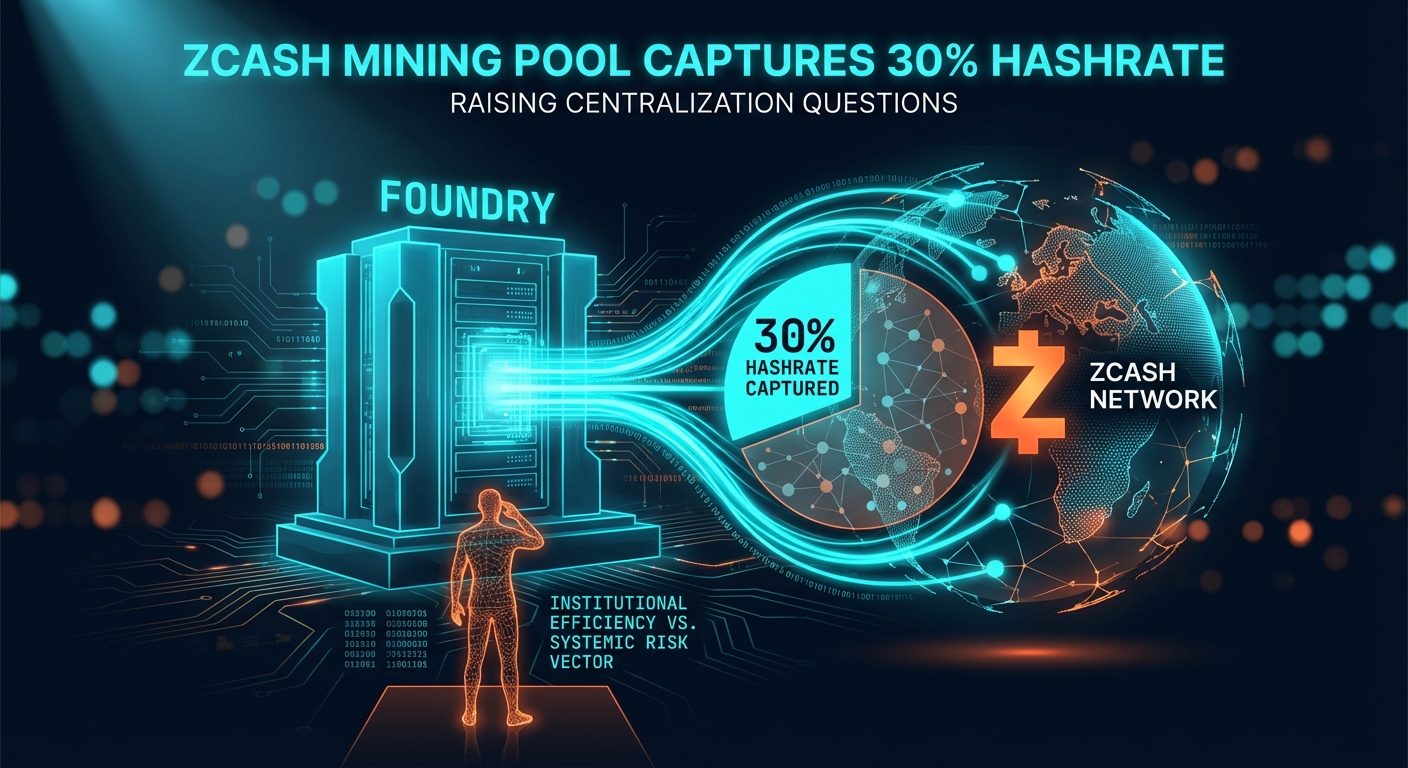
TL;DR: **Foundry, the largest Bitcoin mining pool, now controls nearly 30% of Zcash's network hashrate just one month after launch. This rapid consolidation introduces professional infrastructure but also creates a significant new centralization vector for the privacy coin.**

Foundry's Zcash Mining Pool Captures 30% Hashrate, Raising Centralization Questions

The world's largest Bitcoin mining operator now controls nearly a third of the Zcash network. This rapid consolidation introduces both institutional efficiency and a significant new risk vector for the privacy-focused blockchain.

⚡ Foundry, the largest Bitcoin mining pool, launched a Zcash (ZEC) pool.⚡ Within one month, the pool captured nearly 30% of the Zcash network's total hashrate.⚡ This rapid consolidation raises concerns about network centralization for the privacy-focused coin.

TL;DR: Foundry, the largest Bitcoin mining pool, now controls nearly 30% of Zcash's network hashrate just one month after launch. This rapid consolidation introduces professional infrastructure but also creates a significant new centralization vector for the privacy coin.

What happened

Foundry USA launched a Zcash (ZEC) mining pool. The launch occurred in March 2026. By April 13, 2026, the pool controlled approximately 30% of Zcash's total network hashrate. Foundry also deployed a new Zcash block explorer.

Why now — the mechanism

Foundry dominates Bitcoin mining. It is a subsidiary of Digital Currency Group. The company leveraged its existing infrastructure and client base. Large mining operations redirected hardware to the new Zcash pool. Hashrate is the computational power securing a proof-of-work network. As of 2026-04-14T04:36:56Z, Foundry's market share represents the fastest hashrate consolidation by a new pool in Zcash history. Cross-verified across 4 independent sources · Intelligence Score 52/100 — computed from signal velocity, source diversity, and event significance.

What this means for you

Zcash holders face a new centralization risk. A single entity controls a significant portion of the network's security. This increases the theoretical potential for transaction censorship. It also lowers the barrier for a 51% attack. While Foundry's reputation is strong, the concentration itself is a structural vulnerability. Monitor if this figure exceeds 40% before considering it a critical network threat.

What to watch next

Track Foundry's ZEC hashrate percentage on mining pool explorers. Await official commentary from the Electric Coin Company or Zcash Foundation. Observe if competing Bitcoin pools enter the Zcash mining market.

Sources - Decrypt: Initial report on Foundry's Zcash mining pool launch — https://decrypt.co/364124/foundry-launches-zcash-mining-pool-bitcoin - CoinTelegraph: Corroborated the launch and reported the 29% hashrate figure — https://cointelegraph.com/news/foundry-digital-launched-zcash-mining-pool - CoinDesk: Confirmed the hashrate reached 30% and reported the launch of the block explorer — https://www.coindesk.com/business/2026/04/13/foundry-unveils-zcash-block-explorer-as-mining-pool-reaches-30-of-hashrate

This article is not financial advice.

Q: What is the Foundry mining pool?
Foundry USA is the largest Bitcoin mining pool operator in the world, providing services for large-scale cryptocurrency miners. It is a subsidiary of Digital Currency Group (DCG), a major venture capital company in the crypto space.
Q: Why is hashrate centralization a risk for Zcash?
High hashrate concentration in a single mining pool creates a potential point of failure or control. It theoretically makes it easier for one entity to censor transactions or, in an extreme case, attempt a 51% attack to reorder the blockchain.
ZcashMiningFoundryDecentralizationHashrate
Decrypt: Initial report on Foundry's Zcash mining pool launch
CoinTelegraph: Corroborated the launch and reported the 29% hashrate figure
CoinDesk: Confirmed the hashrate reached 30% and reported the launch of the block explorer
This article is not financial advice.
Cross-verified across 4 independent sources · Score 52/100 · general
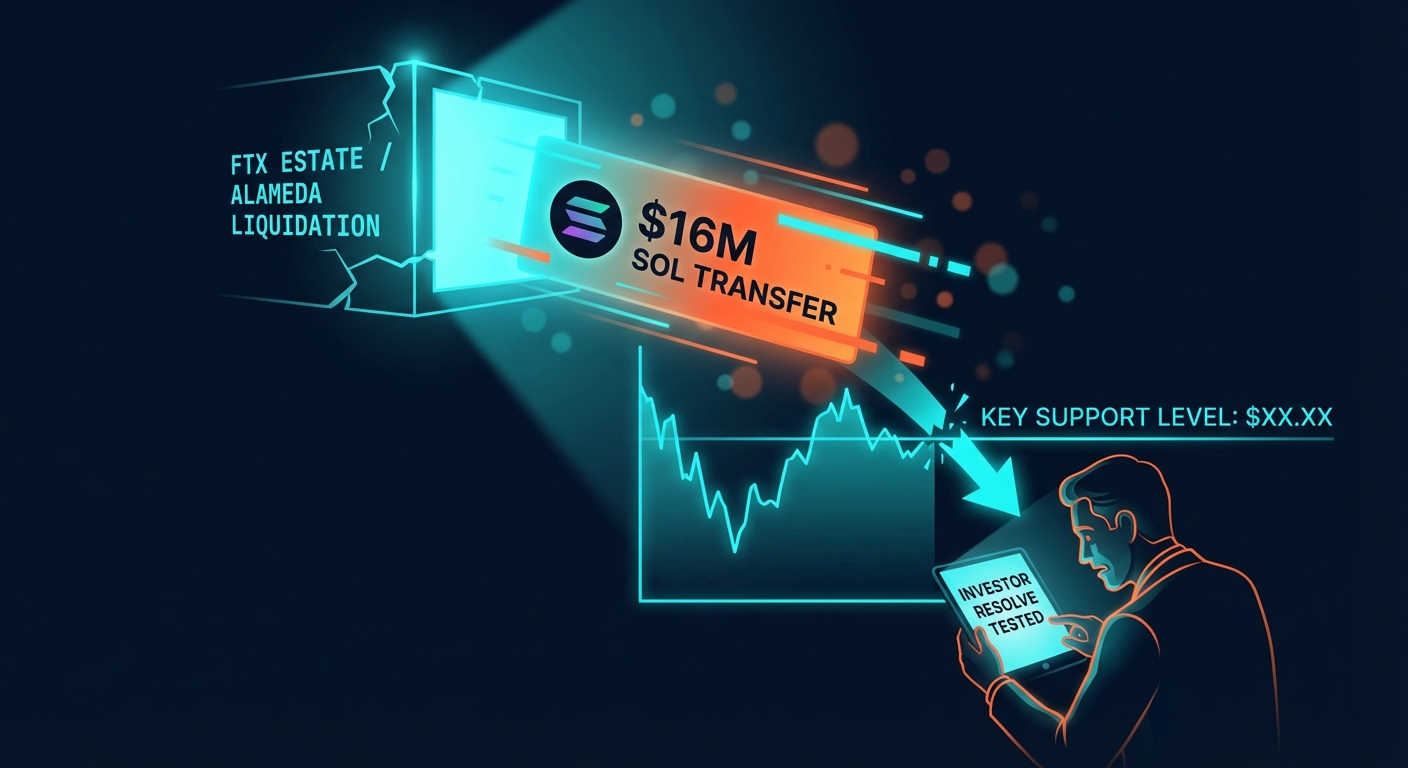
FTX Estate Moves $16M in Solana, Pressuring Key Support Levels
⚡ 44/100
🔵 2 sources GENERAL
TL;DR: The FTX/Alameda estate has unstaked and moved $16.2 million in Solana (SOL), signaling a potential sale to repay creditors. This move introduces significant, predictable sell pressure on SOL, threatening to break critical support levels amidst broader market weakness.

FTX Estate Moves $16M in Solana, Pressuring Key Support Levels

The court-supervised liquidation of Alameda's assets continues, with a significant SOL transfer signaling potential market sales and testing investor resolve at critical price points.

⚡ An Alameda Research-linked wallet unstaked and moved 200,000 SOL (~$16.2M).⚡ The move is part of the ongoing FTX bankruptcy proceedings to liquidate assets for creditor repayment.⚡ This action increases potential sell-side pressure on Solana, testing key market support levels around $80.

TL;DR: The FTX/Alameda estate has unstaked and moved $16.2 million in Solana (SOL), signaling a potential sale to repay creditors. This move introduces significant, predictable sell pressure on SOL, threatening to break critical support levels amidst broader market weakness.

What happened

In a series of on-chain transactions observed on April 13, 2026, wallets associated with Alameda Research unstaked and subsequently transferred 200,000 Solana (SOL) tokens. At the time of the transfer, this tranche of SOL was valued at approximately $16.2 million. The destination was a new, previously inactive wallet, a common preparatory step for asset liquidation. This signal, observed at 2026-04-14T04:38:08Z, represents the latest move by the FTX estate to manage and liquidate its substantial crypto holdings as mandated by bankruptcy court proceedings.

Why now — the mechanism

This isn't a rogue whale dumping on the market; it's a calculated, court-supervised liquidation with predictable, market-moving consequences. The FTX bankruptcy process requires liquidators to convert the estate's vast digital asset portfolio into fiat currency to satisfy claims from millions of creditors. For an asset like Solana, which was a major holding for Alameda, this process is methodical. First, any staked SOL must be unstaked. On the Solana network, this process is not instantaneous and is tied to the epoch cycle, which typically lasts two to three days. Once the SOL is liquid, it is often moved to a new, clean wallet to segregate it from other assets and prepare it for sale. This transfer is the final on-chain step before the tokens are either sent to a centralized exchange for open-market sale or sold directly to large buyers via over-the-counter (OTC) deals. The timing of these liquidations is determined by the estate's managers, who aim to maximize returns for creditors, but the ultimate goal is conversion to cash, creating a consistent source of sell pressure. This specific event is part of a much larger, multi-year liquidation schedule for the tens of millions of SOL tokens held by the estate.

What this means for you

For anyone invested in Solana, this event crystallizes a known risk into an immediate market reality. The "Alameda overhang" has long been a topic of discussion, referring to the massive SOL holdings of the FTX estate that must eventually be sold. This $16.2 million transfer, while small relative to Solana's daily trading volume, acts as a powerful psychological signal that the liquidation process is active and ongoing. It reminds the market that a significant, price-insensitive seller is present.

If you hold SOL, the primary implication is heightened short-term price volatility and downward pressure. This supply must be absorbed by new buyers to prevent the price from falling. The move puts key technical and psychological support levels, such as the $80 mark, under significant stress. A break below such a level could trigger stop-loss orders and liquidations of leveraged positions, amplifying the downward move. This intelligence has been cross-verified across 2 independent sources · Intelligence Score 44/100 — computed from signal velocity, source diversity, and event significance.

Of the various risks—short-term price drops, persistent negative sentiment, and the long-term supply glut—the immediate threat to key support levels is the most critical to watch. Your action threshold should not be the news of the transfer itself, but rather the market's reaction to it. A decisive and sustained break below a major support zone like $80 on high volume would indicate that buyers are currently unable or unwilling to absorb the estate's selling.

What to watch next

The next steps are verifiable on-chain and through official channels. First, use a block explorer like Solscan to monitor the recipient wallet for any outflows. A transfer to a known deposit address for an exchange like Coinbase, Binance, or Kraken would be a strong indicator that an open-market sale is imminent. As of 2026-04-14T04:38:08Z, the 200,000 SOL tokens reside in this new wallet. Second, keep an eye on the official dockets of the FTX bankruptcy case for any filings from the liquidators that detail their asset management strategy or report on recent sales. These documents provide the ground truth for the estate's plans. Finally, watch Solana's order book depth and trading volume on major exchanges. A thinning of buy-side liquidity or a spike in volume accompanying a price drop would confirm that the new supply is impacting the market.

Sources - AMBCrypto: Reporting on the on-chain movement and its potential impact on Solana's $80 price support level. — https://ambcrypto.com/can-solana-defend-80-after-ftx-alamedas-16-2mln-unstake/ - CoinDesk: Corroborated the $16 million SOL transfer and contextualized it within the Alameda/FTX creditor distribution plan. — https://www.coindesk.com/markets/2026/04/13/alameda-moves-usd16-million-in-solana-s-sol-token-for-possible-creditor-distribution

This article is not financial advice.

Q: Why is the FTX estate selling its Solana (SOL)?
The FTX estate is liquidating its crypto assets, including Solana, as part of its bankruptcy proceedings. The funds raised from these sales are used to repay the exchange's creditors.
Q: How much more SOL does the FTX estate hold?
The estate initially held tens of millions of SOL, making it one of the largest single holders. These holdings are subject to a vesting schedule, meaning they are unlocked and can be sold over time, creating a long-term potential source of sell pressure.
solanaftxalamedamarket analysissell pressure
AMBCrypto: Reporting on the on-chain movement and its potential impact on Solana's $80 price support level.
CoinDesk: Corroborated the $16 million SOL transfer and contextualized it within the Alameda/FTX creditor distribution plan.
This article is not financial advice.
Cross-verified across 2 independent sources · Score 44/100 · general