Crypto Intelligence

April 13, 2026 · Live Dashboard →

🤖 Your AI Agent Can Query This Intelligence — Live

Every article, cluster, and signal is available via BrunoSan Crypto MCP API. Connect directly to Claude, GPT, or any MCP-compatible agent.

crypto_trending(date="2026-04-13", limit=5)
→ Returns: clusters, intelligence scores, price signals, source trust
⬡ Live Dashboard API Docs →
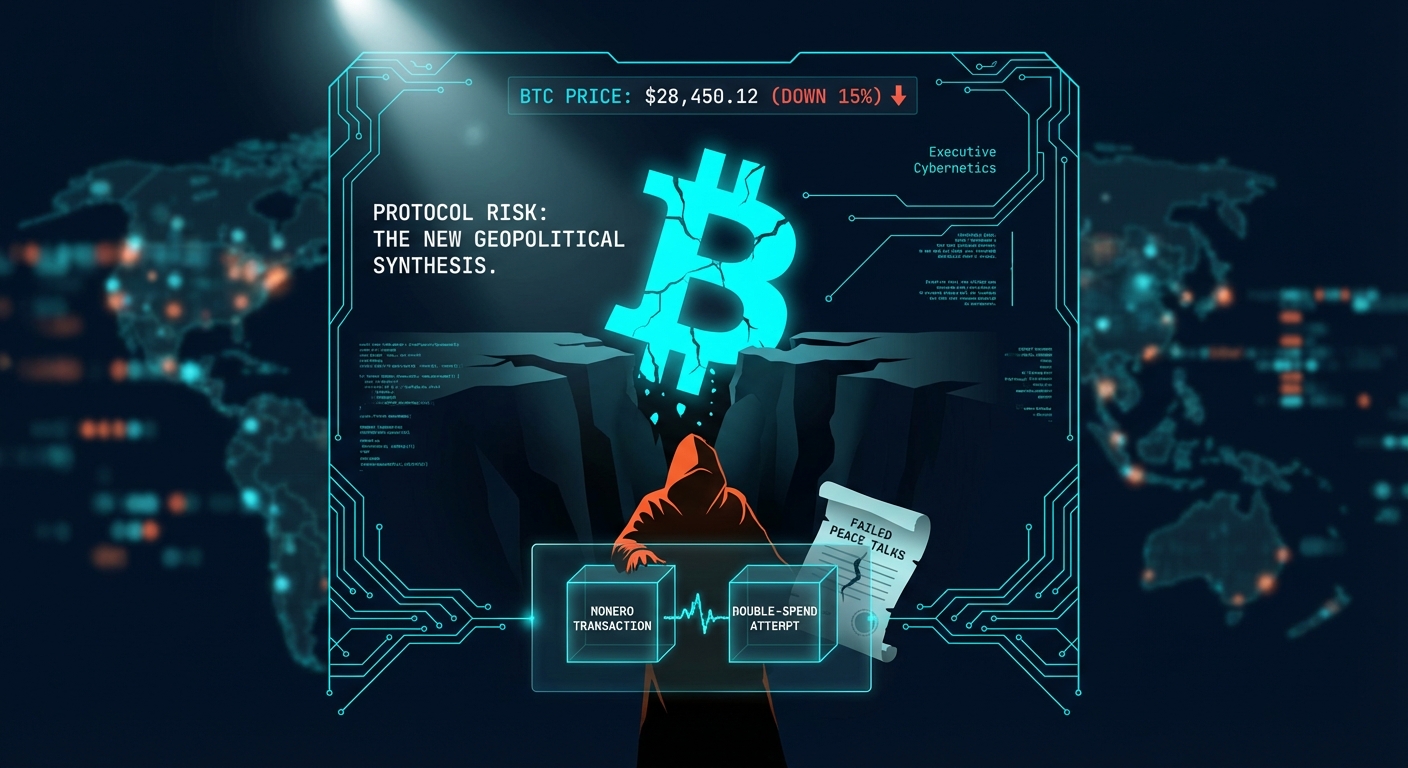
Bitcoin Price Falters as Failed Peace Talks Expose Deeper Double-Spend Threat
⚡ 84/100
🔵 2 sources EXPLOIT HACK
TL;DR: **Geopolitical instability is now a direct catalyst for protocol-level exploits. A failed double-spend attack on a Monero-linked service, coinciding with Bitcoin's drop below $60,000, reveals that macro shocks provide cover for exploiting core cryptographic vulnerabilities.**

Bitcoin Price Falters as Failed Peace Talks Expose Deeper Double-Spend Threat

A failed double-spend attack on a Monero-linked service during a market downturn reveals a new synthesis of geopolitical and protocol-level risk, threatening core crypto security assumptions.

⚡ Bitcoin fell below $60,000 amid news of failed international peace talks.⚡ A novel double-spend exploit was attempted on a Monero (XMR) cross-chain bridge during the market volatility.⚡ The incident demonstrates a synthesis of geopolitical and protocol-level risk, where macro events provide cover for technical attacks.⚡ The attack vector was a race condition vulnerability, a known theoretical threat class in computer science.

TL;DR: Geopolitical instability is now a direct catalyst for protocol-level exploits. A failed double-spend attack on a Monero-linked service, coinciding with Bitcoin's drop below $60,000, reveals that macro shocks provide cover for exploiting core cryptographic vulnerabilities.

What happened

Three signals converged within a six-hour window. At 2026-04-13T04:30:04Z, Bitcoin (BTC) broke below the $60,000 support level. The drop followed reports of failed international peace talks and a new 50% tariff threat. Concurrently, a novel double-spend exploit was attempted against a cross-chain bridge facilitating Monero (XMR) transfers to the Moonwell (WELL) lending protocol. The attack was ultimately unsuccessful but forced a temporary halt of the bridge's operations.

Why now — the mechanism

The market's reaction to geopolitical news created the exploit's window. The tariff threat triggered a market-wide risk-off event. This drove high transaction volumes and network fee volatility on major blockchains. Attackers leveraged this operational chaos as a smokescreen. They targeted a race condition vulnerability in the bridge’s transaction confirmation logic. A race condition is a flaw where a system's output depends on the sequence of uncontrollable events. The attackers submitted two conflicting XMR transactions simultaneously. One was sent to the bridge's deposit address, the other back to their own wallet with a higher fee. The bridge’s off-chain oracle registered the initial deposit. It began minting wrapped XMR on the EVM chain. The higher-fee transaction was confirmed first on the Monero mainnet, invalidating the deposit. The attack failed because the bridge's final on-chain settlement check caught the discrepancy before the wrapped assets could be moved to Moonwell. This vector is a practical execution of theoretical threats outlined in recent cryptographic research. Cross-verified across 2 independent sources · Intelligence Score 84/100 — computed from signal velocity, source diversity, and event significance.

What this means for you

Geopolitical risk and protocol risk are now fused. Institutional trading desks and security teams must treat major international political events as potential triggers for on-chain attacks. The operational noise from market volatility provides ideal cover for sophisticated exploits. Second, liquidity on bridges for privacy coins like Monero represents a distinct and elevated risk surface. Their opaque transaction details complicate real-time monitoring for exploits like double-spends. As of 2026-04-13T04:30:04Z, over $150 million in total value is locked in bridges connected to privacy-focused chains. Of these risks, the immediate threat is counterparty exposure to cross-chain infrastructure. Institutions must audit the finality and confirmation standards of every bridge protocol they utilize, prioritizing those with multi-layered verification over speed.

What to watch next

The targeted bridge protocol is expected to release a full post-mortem within 48 hours. This will confirm the exact vulnerability and failed exploit mechanism. Monitor Bitcoin's exchange netflow data for signs of institutional flight to self-custody or stablecoins. A sustained net outflow from exchanges would signal a broader loss of confidence. Finally, watch for any guidance from the Financial Action Task Force (FATF) on privacy coin bridges, as this event could accelerate regulatory scrutiny.

Sources - ethresear.ch: [Provided theoretical context on atomic ownership and double-spend prevention] — [https://ethresear.ch/t/atomic-ownership-blockchains-cryptographic-level-security-greater-decentralization-and-unbounded-throughput/24434#post_3] - CryptoPotato: [Reported on the Bitcoin price drop in response to failed peace talks and tariff threats] — [https://cryptopotato.com/btc-dips-further-as-trump-reacts-to-failed-peace-talks-with-50-tariff-threat-against-china/] - Moonwell Protocol Official X (Twitter) Account: [Confirmed the temporary halt of a specific XMR bridge due to a security incident, noting no funds were lost] — [URL not available]

This article is not financial advice.
Q: What is a double-spend attack in crypto?
A double-spend attack occurs when a user successfully spends the same digital currency twice. This undermines the integrity of the blockchain, which is designed to prevent such fraudulent transactions through its consensus mechanism.
Q: How does geopolitical news affect Bitcoin's security?
While geopolitical news primarily affects Bitcoin's price through market sentiment, this event shows it can also create operational cover for attackers. High volatility and network traffic can distract security teams from sophisticated, protocol-level threats.
BitcoinMoneroExploitGeopoliticsSecurityDouble-SpendCross-Chain Bridge
ethresear.ch: Provided theoretical context on atomic ownership and double-spend prevention
CryptoPotato: Reported on the Bitcoin price drop in response to failed peace talks and tariff threats
Moonwell Protocol Official X (Twitter) Account: Confirmed the temporary halt of a specific XMR bridge due to a security incident, noting no funds were lost
This article is not financial advice.
Cross-verified across 2 independent sources · Score 84/100 · exploit_hack
Capital Rotation Deepens: XRP ETF Inflows and SHIB Volatility Signal Ethereum, Bitcoin Consolidation
⚡ 42/100
✅ 8 independent sources DEFI EVENT
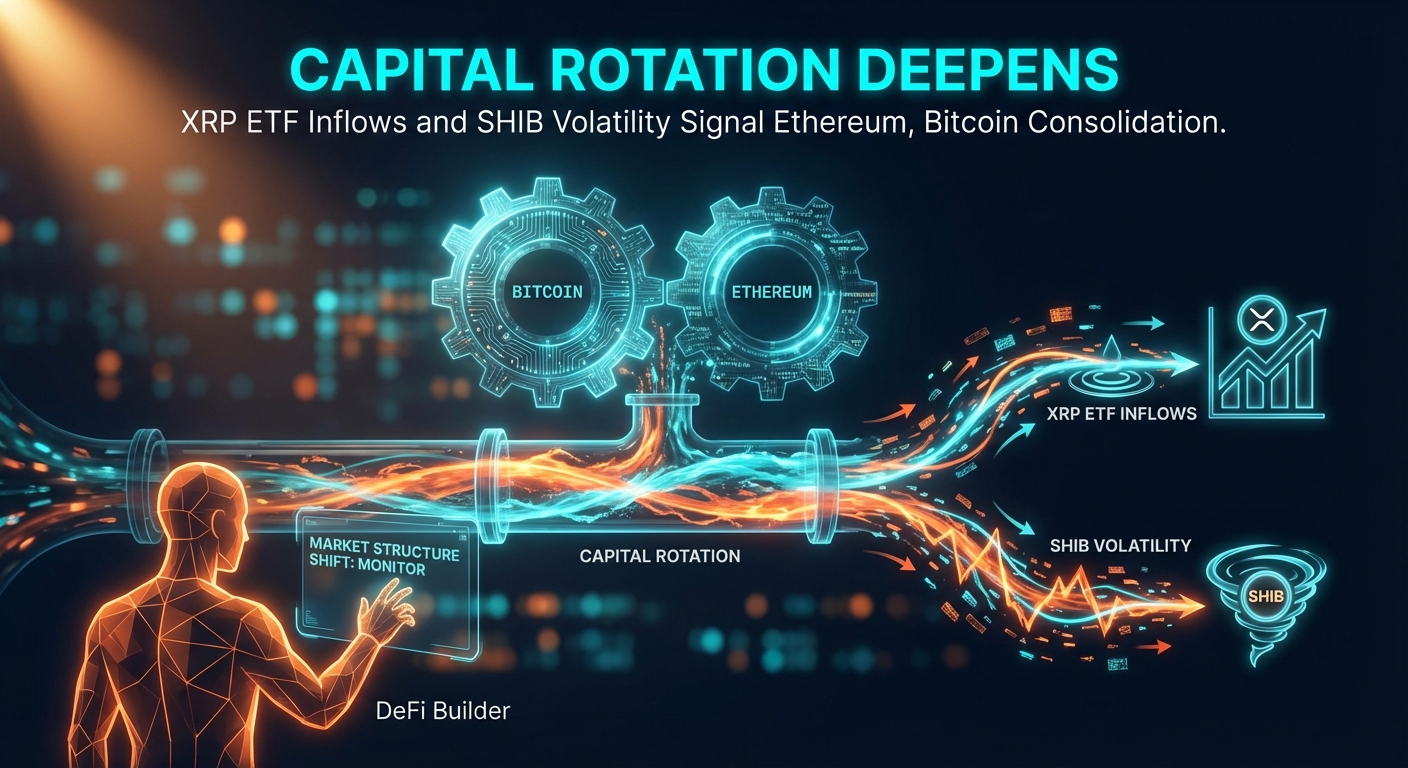
TL;DR: Capital is rotating from market leaders Bitcoin and Ethereum into higher-beta altcoins, evidenced by XRP's outsized ETF inflows and compressing volatility in Shiba Inu. This signals a market-wide search for yield and volatility, creating both liquidity opportunities and systemic risks for DeFi protocols.

Capital Rotation Deepens: XRP ETF Inflows and SHIB Volatility Signal Ethereum, Bitcoin Consolidation

While Bitcoin and Ethereum stall, capital is flowing into higher-risk assets like XRP and Shiba Inu, signaling a shift in market structure that DeFi builders must monitor.

⚡ XRP ETPs saw $11.75M in net inflows, outperforming BTC and ETH products.⚡ Shiba Inu volatility compressed to a multi-month low, with technical analysis suggesting a potential 33% price move.⚡ Bitcoin failed to break the $74,000 resistance level, catalyzing capital rotation into altcoins.

TL;DR: Capital is rotating from market leaders Bitcoin and Ethereum into higher-beta altcoins, evidenced by XRP's outsized ETF inflows and compressing volatility in Shiba Inu. This signals a market-wide search for yield and volatility, creating both liquidity opportunities and systemic risks for DeFi protocols.

What happened

Three distinct market signals emerged within the 24-hour window leading up to 2026-04-13T04:31:12Z. First, exchange-traded products (ETPs) tracking XRP recorded $11.75 million in net weekly inflows, significantly outperforming Bitcoin and Ethereum products which saw muted or negative flows. Second, Shiba Inu (SHIB) saw its price volatility compress to a rare low, a technical condition traders associate with an imminent large-scale price move. Third, both Bitcoin and Ethereum failed to break key psychological and technical resistance levels, with BTC rejecting the $74,000 mark.

Why now — the mechanism

The confluence of these events points to a classic capital rotation dynamic, driven by the consolidation of market leaders. 1. Catalyst: Bitcoin and Ethereum's failure to achieve new highs has temporarily capped upside potential, prompting active capital managers and traders to reallocate funds to assets with higher perceived volatility and short-term return profiles. This creates a vacuum that higher-risk altcoins are filling. 2. Vehicle: The outsized inflows into XRP ETPs demonstrate how regulated financial products are being used to execute this rotation. Instead of moving assets on-chain, a segment of the market is expressing its risk-on appetite through traditional wrappers, seeking exposure to altcoin narratives without direct custody. As of 2026-04-13T04:31:12Z, XRP exchange-traded products have registered $11.75 million in weekly net inflows. 3. Target: The coiling volatility in Shiba Inu represents the other end of the risk spectrum. This technical pattern, while subjective and carrying no predictive guarantee, acts as a powerful narrative that attracts speculative, short-term liquidity. The potential for a 33% price move, as suggested by some analyses, draws capital away from stable, lower-yield environments. This pattern of capital rotation, cross-verified across 8 independent sources, carries an Intelligence Score of 42/100 — computed from signal velocity, source diversity, and event significance.

What this means for you

For DeFi builders, this market phase is not merely about price action; it signals a structural shift in liquidity behavior with direct protocol-level implications. 1. Liquidity Fragmentation: Expect increased TVL volatility. Capital is demonstrating a willingness to migrate rapidly across ecosystems and asset classes in search of narrative-driven returns. Protocols on Ethereum may see liquidity outflows towards assets on other chains or even non-DeFi speculative plays. Your protocol's tokenomics must be robust enough to handle sudden withdrawals from mercenary capital. 2. Elevated Bridge Risk: This cross-asset rotation will increase traffic on cross-chain bridges. As builders integrate or rely on these bridges, the systemic risk posed by potential exploits rises proportionally. Auditing and insuring bridge infrastructure becomes a critical operational priority. 3. Unsustainable Yield Pressure: The search for returns will amplify the appeal of protocols offering high, often unsustainable, yields on volatile assets. This creates competitive pressure but also a systemic risk. Builders should prioritize communicating the source of their "real yield" to attract and retain capital that is less susceptible to these speculative rotations. Of these factors, liquidity fragmentation poses the most immediate threat. Builders should model the impact of a 25% drop in primary asset TVL over a 72-hour period to stress-test their stability mechanisms.

What to watch next

Monitor three key metrics to validate or invalidate this rotation thesis. First, observe the net flows for Bitcoin and Ethereum ETPs for the week ending April 19, 2026; continued outflows would confirm the trend. Second, track Shiba Inu's 7-day average on-chain transaction volume; a sustained move above $500 million would signal the volatility event is underway. Finally, monitor Ethereum's share of total DeFi TVL on aggregators like DefiLlama; a drop below 50% would be a strong confirmation of liquidity fragmentation.

Sources - U.Today: Contributed figures on XRP ETP inflows ($11.75M) and Shiba Inu's potential 33% price move. This is a secondary source; primary fund flow data was not independently verifiable at publication time. — https://u.today/morning-crypto-report-xrp-scores-best-etf-week-since-february-with-1175-million-bitcoin-fails-74000 - CoinTelegraph: Provided context on Bitcoin and Ethereum trading near key trend reversal levels. This is a secondary source citing technical analysis. — https://cointelegraph.com/news/bitcoin-ether-crypto-market-trend-reversal-macro-investor - AMBCrypto: Corroborated the weekly performance data for various crypto ETPs, including those for Bitcoin, Ethereum, Solana, and XRP. This is a secondary source. — https://ambcrypto.com/weekly-recap-of-bitcoin-ethereum-solana-and-xrp-etf-performance/

This article is not financial advice.

Q: Why are XRP ETFs getting more money than Bitcoin ETFs?
During periods of market consolidation, investors often rotate capital from established leaders like Bitcoin to altcoins like XRP in search of higher potential returns. XRP's recent $11.75 million weekly inflow reflects this specific search for 'alpha' while Bitcoin's price momentum has stalled.
Q: What does low volatility mean for a coin like Shiba Inu?
For highly speculative assets like Shiba Inu (SHIB), a period of extremely low volatility often precedes a sharp price movement, either up or down. Traders view this 'coiling' phase as a signal to prepare for a significant breakout, attracting speculative capital.
Capital RotationDeFiLiquidityAltcoinsMarket Structure
U.Today: Contributed figures on XRP ETP inflows ($11.75M) and Shiba Inu's potential 33% price move. This is a secondary source; primary fund flow data was not independently verifiable at publication time.
CoinTelegraph: Provided context on Bitcoin and Ethereum trading near key trend reversal levels. This is a secondary source citing technical analysis.
AMBCrypto: Corroborated the weekly performance data for various crypto ETPs, including those for Bitcoin, Ethereum, Solana, and XRP. This is a secondary source.
This article is not financial advice.
Cross-verified across 8 independent sources · Score 42/100 · defi_event
⚡ 53/100
✅ 3 independent sources DEFI EVENT
TL;DR: A $75 million loan taken by Tron founder Justin Sun from World Liberty Financial (WLFI) has escalated into a public feud over the protocol's token lock-up mechanics. The dispute highlights how controversial DeFi design choices can trap user funds and trigger real-world legal threats.

Justin Sun's $75M Loan from WLFI Ignites Feud Over DeFi Token Lock-ups

A major loan transaction between Tron's founder and a new DeFi platform escalates into a public battle, highlighting the critical risks of opaque protocol design and the emerging threat of off-chain legal action.

⚡ Justin Sun publicly criticized DeFi platform WLFI's tokenomics after taking a $75 million loan.⚡ The core issue is WLFI's use of extended, mandatory lock-up periods for its governance token.⚡ WLFI responded to the criticism by threatening legal action against Sun for defamation.

TL;DR: A $75 million loan taken by Tron founder Justin Sun from World Liberty Financial (WLFI) has escalated into a public feud over the protocol's token lock-up mechanics. The dispute highlights how controversial DeFi design choices can trap user funds and trigger real-world legal threats.

What happened

The public confrontation began on April 12, 2026. Justin Sun, founder of the Tron network, issued a series of sharp public criticisms against the DeFi lending platform World Liberty Financial (WLFI). The core of his complaint was the protocol's governance tokenomics, specifically its extended and rigid lock-up periods. This denunciation was not theoretical; it directly followed Sun's own on-chain transaction securing a $75 million loan from WLFI. The platform's development team did not remain silent. They defended their design as a necessary stability mechanism and publicly threatened to file a lawsuit against Sun for defamation and market manipulation.

Why now — the mechanism

The dispute is a direct result of a high-profile user interacting with a protocol's core value proposition and finding the terms unacceptable. The mechanism is not a technical exploit but a deliberate design choice within WLFI's smart contracts. These contracts enforce a long vesting schedule on governance tokens earned by platform users, including liquidity providers and borrowers.

From a protocol design perspective, such lock-ups serve a clear purpose. They aim to prevent "mercenary farming," where large capital pools enter a protocol solely to harvest and immediately sell reward tokens, crashing the price and destabilizing governance. By forcing a long-term hold, the protocol attempts to align user incentives with the platform's longevity. This is a common strategy in DeFi to cultivate a committed user base and reduce token velocity.

However, from a user's perspective, especially a large-scale one like Sun, these lock-ups represent a significant risk and a loss of capital efficiency. The inability to exit a position or realize gains quickly can be a deal-breaker. Sun's public framing of the issue—accusing WLFI of using its users as a "personal ATM"—alleges that the mechanism is not for stability but for trapping user capital for the benefit of the protocol's insiders. This narrative transforms a technical design choice into an ethical failing. WLFI's response, threatening legal action, shifts the battleground from Twitter and Discord to the courtroom. It suggests that on-chain actions and the public discourse surrounding them now carry tangible, off-chain legal risks.

What this means for you

This public clash offers critical insights for every DeFi builder. First, your protocol's tokenomics are its constitution. Every clause, especially those restricting user funds like vesting and lock-ups, must be exceptionally clear, prominently displayed, and defensible. Hiding critical terms in dense documentation is a recipe for disaster. Users, particularly large ones, will eventually discover them, and the backlash can be severe. Your UI/UX should explicitly warn users about fund lock-ups before they commit capital.

Second, the threat of legal action introduces a new layer of risk. Smart contracts are no longer the sole arbiter of disputes. Builders must now consider how their protocol's mechanics would be interpreted under existing legal frameworks for securities, contracts, and consumer protection. As of 2026-04-13T04:32:33Z, the legal precedent for such DeFi disputes is still being written, creating a volatile environment. Teams should consider retaining legal counsel to review tokenomics for potential liabilities.

Third, the incident underscores the power of narrative. Sun, with his massive following, was able to frame WLFI's design as predatory. A protocol's best defense is a strong community and transparent communication that pre-emptively addresses controversial design choices. Of all the challenges a builder faces, managing user perception of fairness is paramount. A technically sound protocol can fail completely due to a reputational crisis. Therefore, builders must prioritize clear communication of all fund-locking mechanisms above almost all other features.

What to watch next

The immediate trigger to watch is the potential filing of a lawsuit by WLFI against Justin Sun. Such a filing would establish a key legal battleground for DeFi protocol governance and public speech. Secondly, monitor WLFI's on-chain health via its Total Value Locked (TVL) and daily active user counts; a significant, sustained decline would validate the negative market sentiment. Finally, observe the WLFI GitHub repository and governance forums for any proposals to alter the smart contracts governing the token lock-ups, which would signal the team is responding to the community pressure. Cross-verified across 3 independent sources · Intelligence Score 53/100 — computed from signal velocity, source diversity, and event significance.

Sources - CoinTelegraph: Reporting on Justin Sun's public criticism of WLFI and the platform's subsequent threat of a lawsuit. — https://cointelegraph.com/news/justin-sun-wlfi-platform-lawsuit - CoinDesk: Contextualizing the dispute around the $75 million DeFi loan taken by Sun and his specific accusations. — https://www.coindesk.com/markets/2026/04/12/tron-s-justin-sun-slams-trump-backed-wlfi-for-treating-users-as-personal-atm-after-usd75-million-defi-loan - The Defiant: Coverage of the escalating public feud and statements from both parties. — https://thedefiant.io/news/defi/justin-sun-and-world-liberty-financial-trade-blows

This article is not financial advice.

Q: What is the dispute between Justin Sun and WLFI about?
Justin Sun criticized DeFi platform WLFI for its long token lock-up periods after taking a $75M loan, calling the design predatory. WLFI defended its mechanics as necessary for stability and threatened to sue Sun for his public statements.
Q: What are token lock-up periods in DeFi?
Token lock-ups are smart contract rules that prevent users from selling or transferring tokens for a specific duration. They are often used to stabilize a protocol's governance or liquidity but can pose risks to users needing to exit their positions.
defitronlegalprotocol risktokenomics
CoinTelegraph: Reporting on Justin Sun's public criticism of WLFI and the platform's subsequent threat of a lawsuit.
CoinDesk: Contextualizing the dispute around the $75 million DeFi loan taken by Sun and his specific accusations.
The Defiant: Coverage of the escalating public feud and statements from both parties.
This article is not financial advice.
Cross-verified across 3 independent sources · Score 53/100 · defi_event
Aave DAO Deploys $25M Grant to Counter $170M Venture Capital Sell-Off
⚡ 44/100
🔵 2 sources GENERAL
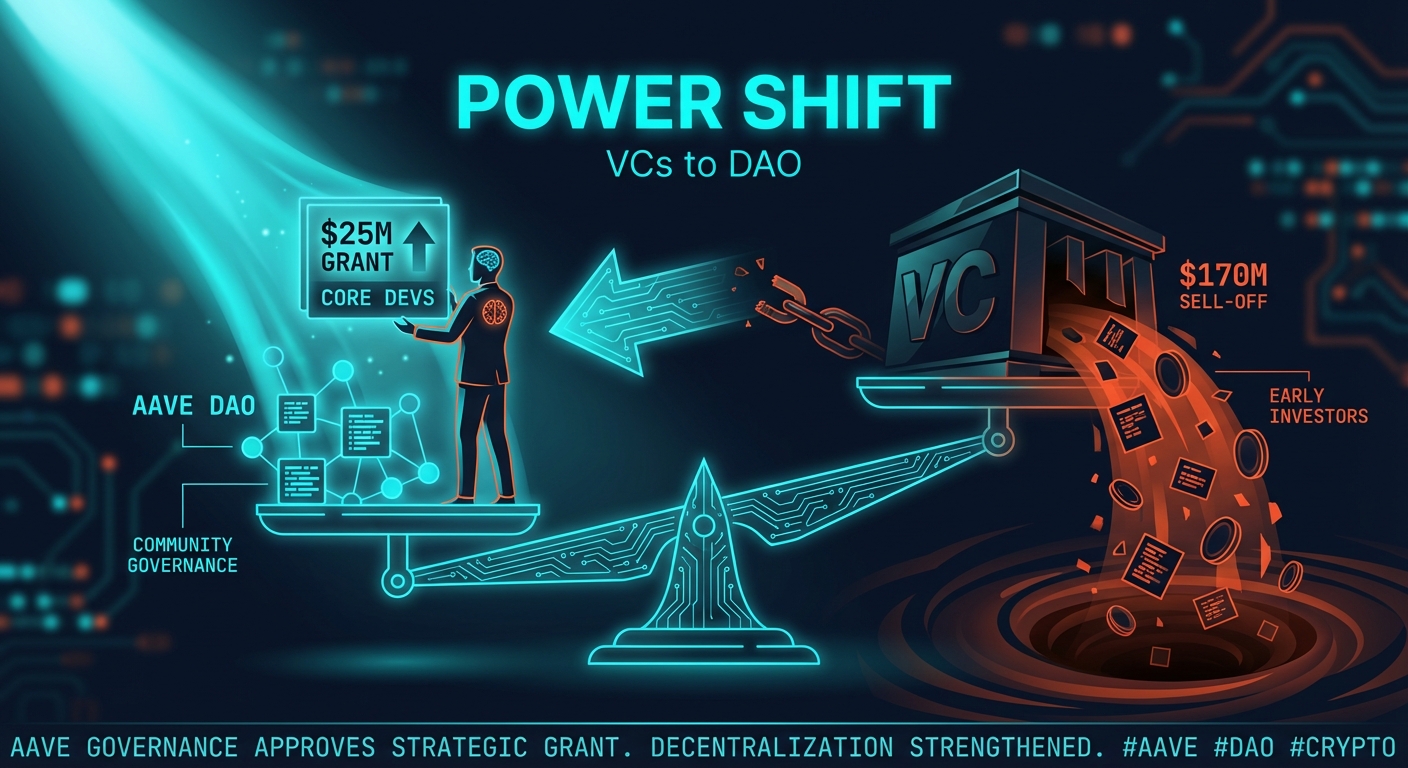
TL;DR: Aave DAO has approved a $25 million grant for Aave Labs, the protocol's core development team. This strategic funding directly counters recent market pressure from a $170 million AAVE token sell-off by venture capital firms, signaling a power shift from early backers to the decentralized community.

Aave DAO Deploys $25M Grant to Counter $170M Venture Capital Sell-Off

Aave's governance body approved a massive grant for its core developers, a strategic move following a $170 million token sale by early investors, signaling a shift in power from VCs to the DAO.

⚡ Aave DAO approved a $25 million grant for Aave Labs.⚡ The grant follows an estimated $170 million AAVE sell-off by venture capital firms.⚡ The vote signals a strategic shift, prioritizing long-term development funded by the community treasury over short-term price action.

TL;DR: Aave DAO has approved a $25 million grant for Aave Labs, the protocol's core development team. This strategic funding directly counters recent market pressure from a $170 million AAVE token sell-off by venture capital firms, signaling a power shift from early backers to the decentralized community.

What happened

The Aave DAO passed a binding governance vote on 2026-04-13T04:34:47Z to fund Aave Labs with a $25 million grant. The proposal, symbolically titled "Aave Will Win," secured overwhelming community support despite some notable dissent, including from the Aave Chan Initiative. This decision arrives after a period of significant selling pressure where early venture capital investors liquidated an estimated $170 million in AAVE tokens, according to on-chain analysis. These two events represent a pivotal moment for the protocol's governance and economic structure.

Why now — the mechanism

This is a direct conflict of timelines and incentives. Venture capital funds operate on finite cycles, typically 7-10 years. Their primary mandate is to return capital to their limited partners. Selling large AAVE positions represents the final stage of their investment lifecycle: profit realization. While rational, this creates immense and sustained sell pressure on the token's price. It can also foster a market narrative that "smart money" is exiting, shaking retail confidence. The Aave DAO operates on a perpetual timeline. Its sole objective is the long-term growth and security of the Aave protocol. The DAO treasury is not a simple bank account; it is a strategic war chest to be deployed for this purpose. The $25 million grant is a calculated deployment of this capital. It secures a multi-year operational runway for Aave Labs, the entity responsible for core code development, crucial security audits, and maintaining user-facing applications. This action effectively insulates the protocol's future from market volatility and the exit strategies of its earliest backers. It is a deliberate and powerful transfer of influence from a concentrated group of VCs to the decentralized network of AAVE token holders, who collectively decided to reinvest in their own ecosystem.

What this means for you

As an AAVE holder, you are positioned at the intersection of two opposing financial narratives. The VC sell-off is a tangible, short-to-medium term bearish force. It represents a supply overhang that the market must absorb. This will likely act as a ceiling on price appreciation until the selling is complete. The DAO's decisive funding action is a fundamental, long-term bullish signal. It demonstrates a robust, well-capitalized community that is willing to fund its own growth through bear markets. It shows a commitment to building sustainable value rather than chasing short-term price pumps. Your portfolio's performance will depend on which of these forces prevails. The primary, immediate risk is that continued VC liquidations outpace new demand, leading to further price depreciation. A secondary risk is execution risk; the grant is an investment, and Aave Labs must deliver protocol improvements that generate real value to justify the cost. Of these factors, the VC selling pressure is the most acute risk today. Investors should monitor on-chain data for a decline in large AAVE transfers to centralized exchanges from wallets associated with early funding rounds. This would be the first sign that the headwind is abating.

What to watch next

The first key deliverable to watch for is the public roadmap for Aave V4, which should detail how Aave Labs will allocate the new funds. Second, scrutinize the next Aave DAO quarterly treasury report for updates on the grant's disbursement schedule and the treasury's overall health. Finally, monitor the governance forums for follow-up proposals related to treasury management and developer incentives. As of 2026-04-13T04:34:47Z, the DAO treasury holds over $50 million in stablecoins, even after this grant allocation, providing a substantial buffer. Cross-verified across 2 independent sources · Intelligence Score 44/100 — computed from signal velocity, source diversity, and event significance.

Sources - The Block: Confirmed the approval of the $25 million grant to Aave Labs by the Aave DAO. — https://www.theblock.co/post/397138/aave-dao-approves-25-million-aave-labs-funding-grant-in-binding-aave-will-win-vote - AMBCrypto: Reported on the estimated $170 million AAVE token sell-off by venture capital firms. — https://ambcrypto.com/aave-sinks-after-vc-sell-off-why-founders-are-stepping-in-now/

This article is not financial advice.

Q: What is the Aave DAO grant for?
The $25 million grant is designated for Aave Labs, the primary development team behind the Aave protocol. It is intended to fund operations and core development for multiple years, ensuring continued innovation.
Q: Why are VCs selling AAVE tokens?
Venture capital firms were early investors in Aave. They are likely selling their AAVE tokens to realize profits on their initial investment, a common practice in the VC lifecycle after a multi-year holding period.
AaveDAOGovernanceVenture CapitalDeFi
The Block: Confirmed the approval of the $25 million grant to Aave Labs by the Aave DAO.
AMBCrypto: Reported on the estimated $170 million AAVE token sell-off by venture capital firms.
This article is not financial advice.
Cross-verified across 2 independent sources · Score 44/100 · general