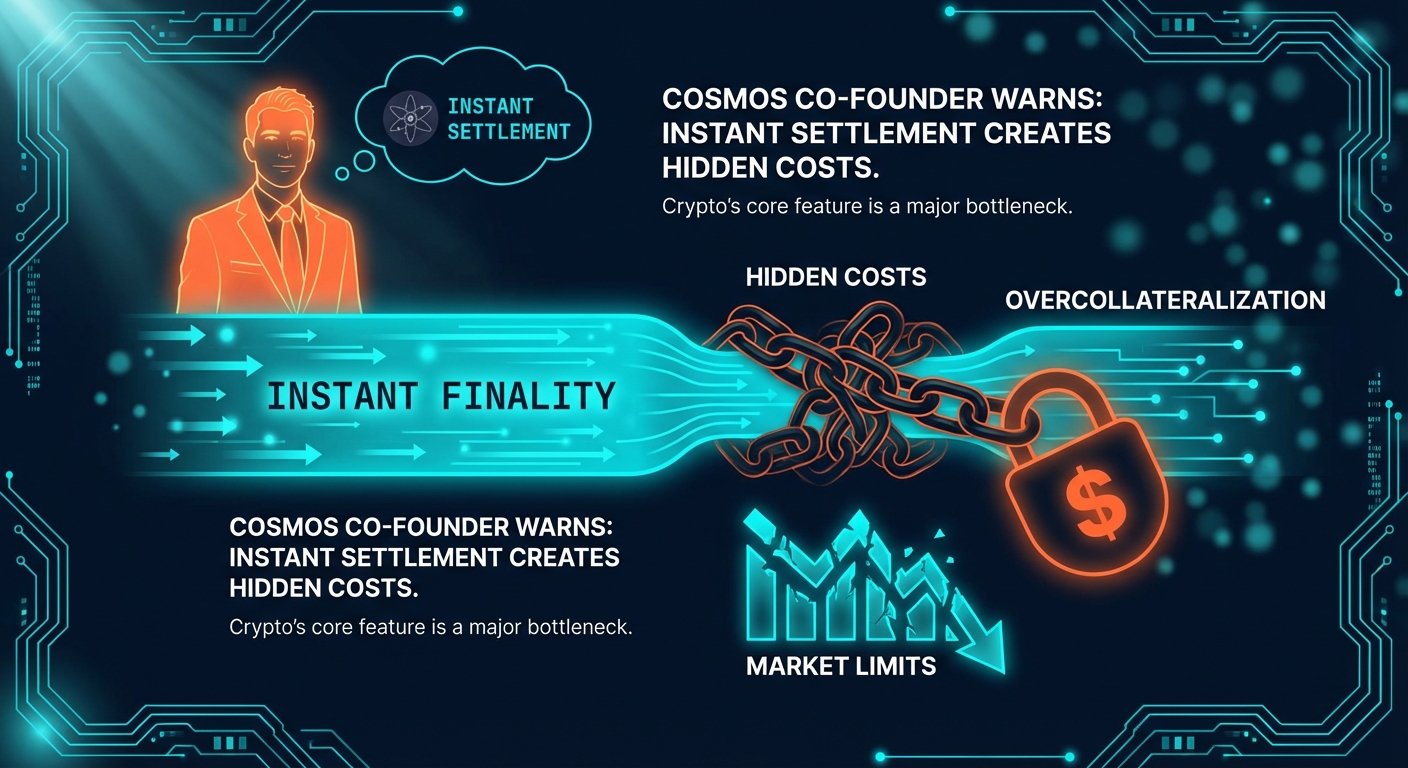
On April 9, 2026, comments from Cosmos co-founder Ethan Buchman, reported across multiple feeds, highlighted a critical trade-off in blockchain architecture. Buchman stated that the instant finality of crypto transactions, while a core benefit, creates significant capital efficiency problems. He argued this forces firms to lock up excess collateral to manage risk, ultimately constraining market growth.
Why now — the mechanism
The core of Buchman's argument lies in the fundamental difference between settlement in crypto and traditional finance (TradFi). Crypto operates on a model of atomic, or instant, settlement. When you execute a trade on a decentralized exchange, the assets are swapped and the transaction is finalized on-chain within seconds or minutes. There is no intermediary and no delay. This removes counterparty risk, a key innovation of blockchain technology.However, this immediacy comes at a cost. In TradFi, markets operate on a delayed settlement cycle, such as T+2 (trade date plus two business days). This delay allows a clearinghouse to sit between buyers and sellers, netting out obligations. A firm that bought 100 shares of a stock and sold 90 shares of the same stock in one day doesn't need capital for all 190 shares; it only needs to settle the net difference of 10 shares. This netting function dramatically reduces the amount of capital required to participate in the market. As of 2026-04-09T04:30:04Z, this distinction remains the primary structural difference between on-chain and traditional market capital requirements. Buchman's point is that crypto's instant settlement model eliminates this netting capability. Every single trade must be fully collateralized at the moment of execution. A high-frequency market maker, for example, must hold large inventories of every asset it trades on every venue, unable to use the proceeds from a sale to fund a purchase that happens seconds later. This is a state of forced overcollateralization, where capital is locked up and cannot be deployed elsewhere. Cross-verified across 2 independent sources · Intelligence Score 78/100 — computed from signal velocity, source diversity, and event significance.
What this means for you
For a retail investor, this is not an immediate price signal for ATOM but a crucial insight into the structural challenges facing the entire DeFi ecosystem. The capital inefficiency described by Buchman directly impacts market makers and liquidity providers. When their costs are higher due to trapped capital, they compensate by offering wider spreads on decentralized exchanges, meaning retail users get slightly worse prices on their trades. This friction can also limit the size and depth of liquidity pools, making the market more susceptible to slippage on large orders.From a portfolio perspective, this framework helps identify protocols solving fundamental problems. Projects focused on undercollateralized lending, DeFi credit markets, or novel settlement layers are directly addressing the bottleneck Buchman highlights. Of the many risks in DeFi, this structural inefficiency is a persistent headwind to scalability. Therefore, understanding which projects offer viable solutions provides a more robust long-term investment thesis than chasing short-term yield trends. Always remember that innovation in this area is experimental and carries its own set of technical risks.
What to watch next
Monitor the development of protocols aiming to create more capital-efficient market structures, particularly within the Cosmos ecosystem where the Inter-Blockchain Communication (IBC) protocol makes cross-chain capital movement a core focus. Watch for governance proposals on the Cosmos Hub or other major chains that discuss the implementation of netting mechanisms or dedicated settlement layers. Finally, pay attention to commentary from other core developers and market structure experts on the topic of post-trade settlement for digital assets, as this will be a key area of innovation.Sources - CoinTelegraph: Reporting on comments made by Cosmos co-founder Ethan Buchman regarding capital efficiency and instant settlement — https://cointelegraph.com/news/instant-settlement-strains-crypto-capital-efficiency-ethan-buchman
This article is not financial advice.