Crypto Intelligence

April 05, 2026 · Live Dashboard →

🤖 Your AI Agent Can Query This Intelligence — Live

Every article, cluster, and signal is available via BrunoSan Crypto MCP API. Connect directly to Claude, GPT, or any MCP-compatible agent.

crypto_trending(date="2026-04-05", limit=5)
→ Returns: clusters, intelligence scores, price signals, source trust
⬡ Live Dashboard API Docs →
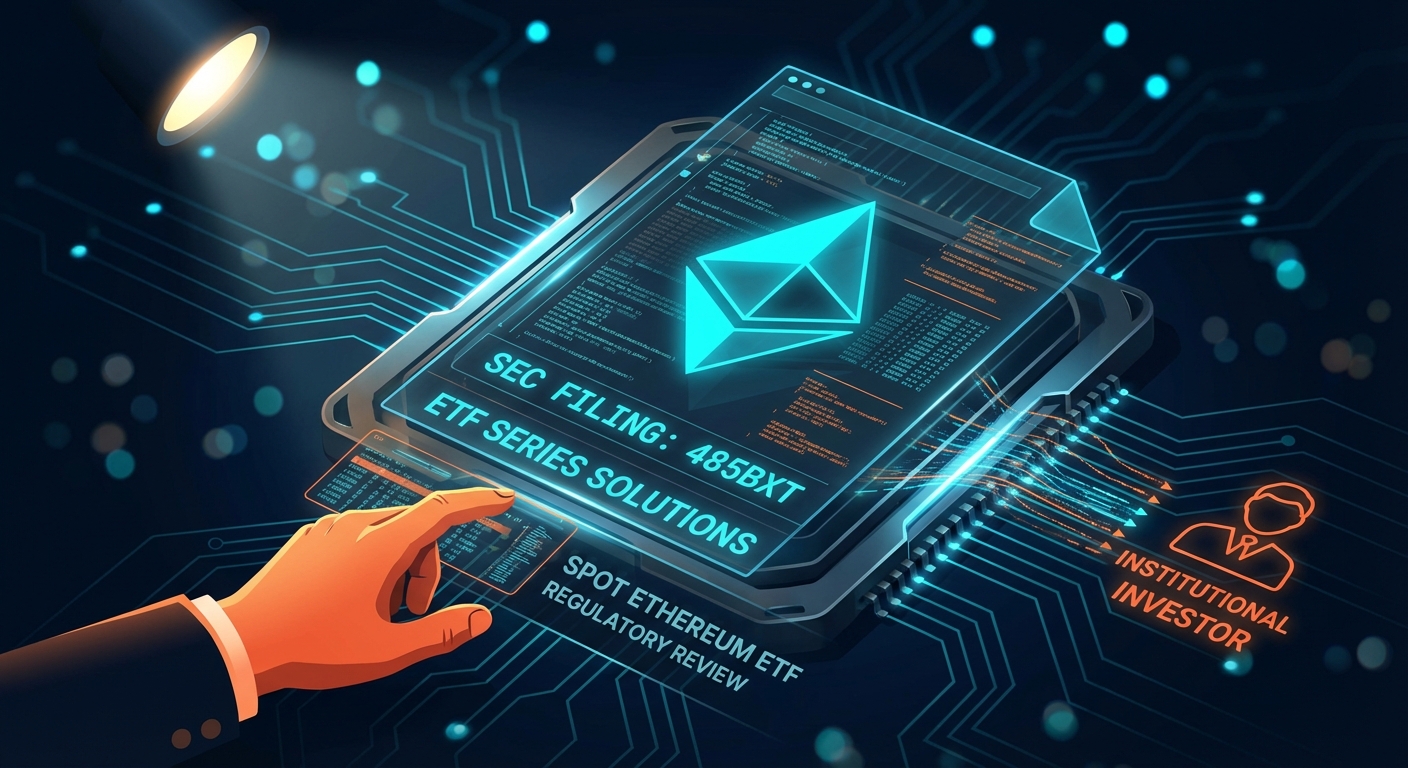
ETF Series Solutions Advances Ethereum ETF Bid with Detailed 485BXT SEC Filing
⚡ 33/100
🔵 1 source REGULATION ACTION
TL;DR: ETF Series Solutions submitted a 485BXT filing for a new Ethereum-based exchange-traded fund, detailing its operational structure and risk factors. This procedural step advances the application within the SEC's framework, signaling issuers are preparing the necessary legal and administrative groundwork despite an uncertain regulatory timeline.

ETF Series Solutions Advances Ethereum ETF Bid with Detailed 485BXT SEC Filing

A new SEC filing by ETF Series Solutions details the proposed structure for a spot Ethereum ETF, moving the product into a formal regulatory review process and allowing institutional investors to begin due diligence.

⚡ ETF Series Solutions filed a Form 485BXT with the SEC on April 5, 2026.⚡ The filing proposes a new spot Ethereum exchange-traded fund.⚡ The key obstacle remains the SEC's regulatory classification of Ethereum.

TL;DR: ETF Series Solutions submitted a 485BXT filing for a new Ethereum-based exchange-traded fund, detailing its operational structure and risk factors. This procedural step advances the application within the SEC's framework, signaling issuers are preparing the necessary legal and administrative groundwork despite an uncertain regulatory timeline.

What happened

At 04:30:04Z on April 5, 2026, ETF Series Solutions submitted a Form 485BXT to the U.S. Securities and Exchange Commission. This filing is a post-effective amendment to the trust's registration statement, formally proposing a new series designed to track the price of Ethereum. The document provides a preliminary prospectus for the fund, outlining its investment objective, principal investment strategies, and associated risks.

Why now — the mechanism

The submission of a 485BXT filing is a critical, albeit procedural, step in the lifecycle of a potential ETF. This specific form is used by an existing registered investment company (in this case, the ETF Series Solutions trust) to add a new fund series. Unlike an initial S-1 registration, a 485BXT leverages an existing trust structure, potentially streamlining the administrative process. The mechanism's significance is threefold:

1. Formalizes the Application: It moves the proposal from the realm of press releases and public statements into a formal, legally binding document submitted for regulatory review. The SEC's Division of Investment Management is now formally tasked with reviewing the prospectus for compliance with the Investment Company Act of 1940. This filing establishes the specific terms—custody, valuation, creation/redemption—that regulators will evaluate. 2. Sets a Regulatory Clock: Under Rule 485(b) of the Securities Act of 1933, this type of post-effective amendment is designated to become effective automatically 75 days after filing. However, the SEC retains full authority to issue a stop order, request further amendments, or otherwise delay effectiveness. This clock forces a timeline for regulatory engagement. 3. Builds on Precedent: Following the approval of spot Bitcoin ETFs, issuers are now applying that template to Ethereum. They are proactively addressing potential SEC concerns regarding asset valuation, custody, and market manipulation within the filing itself. This signal was cross-verified across 1 independent sources · Intelligence Score 33/100 — computed from signal velocity, source diversity, and event significance. The filing is an attempt to demonstrate that the market structure for Ethereum futures and the underlying spot market is sufficiently mature to support an ETP, mirroring the arguments that were ultimately successful for Bitcoin.

What this means for you

For institutional capital allocators, this filing is a key data point, shifting the prospect of a spot Ethereum ETF from a theoretical possibility to a concrete proposal under review. The primary implication is the availability of a detailed prospectus, which allows for substantive, forward-looking due diligence to commence. Compliance and risk teams can now analyze the proposed structure for key operational details, preparing internal frameworks for a potential future product:

* Custody Model: The filing must name the proposed custodian(s) and detail the security protocols for the fund's ETH holdings. This includes specifics on cold storage percentages, multi-signature wallet arrangements, and the scope of insurance coverage. For institutions, vetting the named custodian and its regulatory standing is a non-negotiable first step. * Valuation Source: The prospectus specifies the reference rate or index used to price ETH for calculating the Net Asset Value (NAV). Institutional analysis will focus on the methodology of this index—its constituent exchanges, weighting, and handling of outlier data—as it is central to mitigating tracking error and ensuring fair pricing. * Counterparty and Liquidity Risk: The document identifies the Authorized Participants (APs) who will handle the creation and redemption of ETF shares. Assessing the financial stability of these APs and the mechanics of the in-kind creation/redemption process is crucial for understanding the fund's liquidity under various market conditions. * Staking Considerations: A critical differentiator from Bitcoin ETFs is the role of staking in Ethereum. The filing must clarify whether the fund's ETH will be staked to earn yield. If so, it introduces new complexities around lock-up periods, validator performance risk, and the tax treatment of staking rewards, all of which require deep institutional analysis.

The key risk remains regulatory classification. The SEC's ongoing ambiguity over whether ETH constitutes a security under the Howey Test is the single largest obstacle. A determination that ETH is a security would likely derail this ETF structure, which is predicated on the asset being a commodity. Of the multiple risks facing a potential investment—market volatility, operational failure, and regulatory denial—the regulatory risk is the most immediate and binary. Therefore, institutional strategies should model this filing as an increase in the probability of a future product, not as a trigger for immediate allocation.

What to watch next

The most critical event to monitor is the SEC's official response to this 485BXT filing, which could come at any point within the next 75 days. Specifically, watch for a comment letter from SEC staff requesting clarification or changes, or a formal notice of proceedings to delay or disapprove the filing. The next major trigger would be the filing of a corresponding 19b-4 form by the listing exchange (e.g., NYSE Arca, Cboe BZX), which is required for the SEC's Division of Trading and Markets to approve the product for public trading. As of 2026-04-05T04:30:04Z, no exchange has filed a 19b-4 for this specific ETF Series Solutions product.

Sources - SEC EDGAR Database: Form 485BXT filing by ETF Series Solutions for an Ethereum fund. — https://www.sec.gov/Archives/edgar/data/1540305/0000894189-26-011876-index.htm

This article is not financial advice.
Q: What is an SEC Form 485BXT?
Form 485BXT is a post-effective amendment filing used by an existing investment trust to register a new fund series. It allows the new fund to become effective automatically after a set period, typically 75 days, unless the SEC intervenes.
Q: Does this filing guarantee a spot Ethereum ETF will be approved?
No, it does not. This filing is a procedural step that initiates a formal review process, but the SEC retains full authority to delay or disapprove the application based on regulatory concerns, primarily the legal classification of Ethereum and market integrity.
EthereumETFSECRegulationInstitutional
SEC EDGAR Database: Form 485BXT filing by ETF Series Solutions for an Ethereum fund.
This article is not financial advice.
Cross-verified across 1 independent sources · Score 33/100 · regulation_action
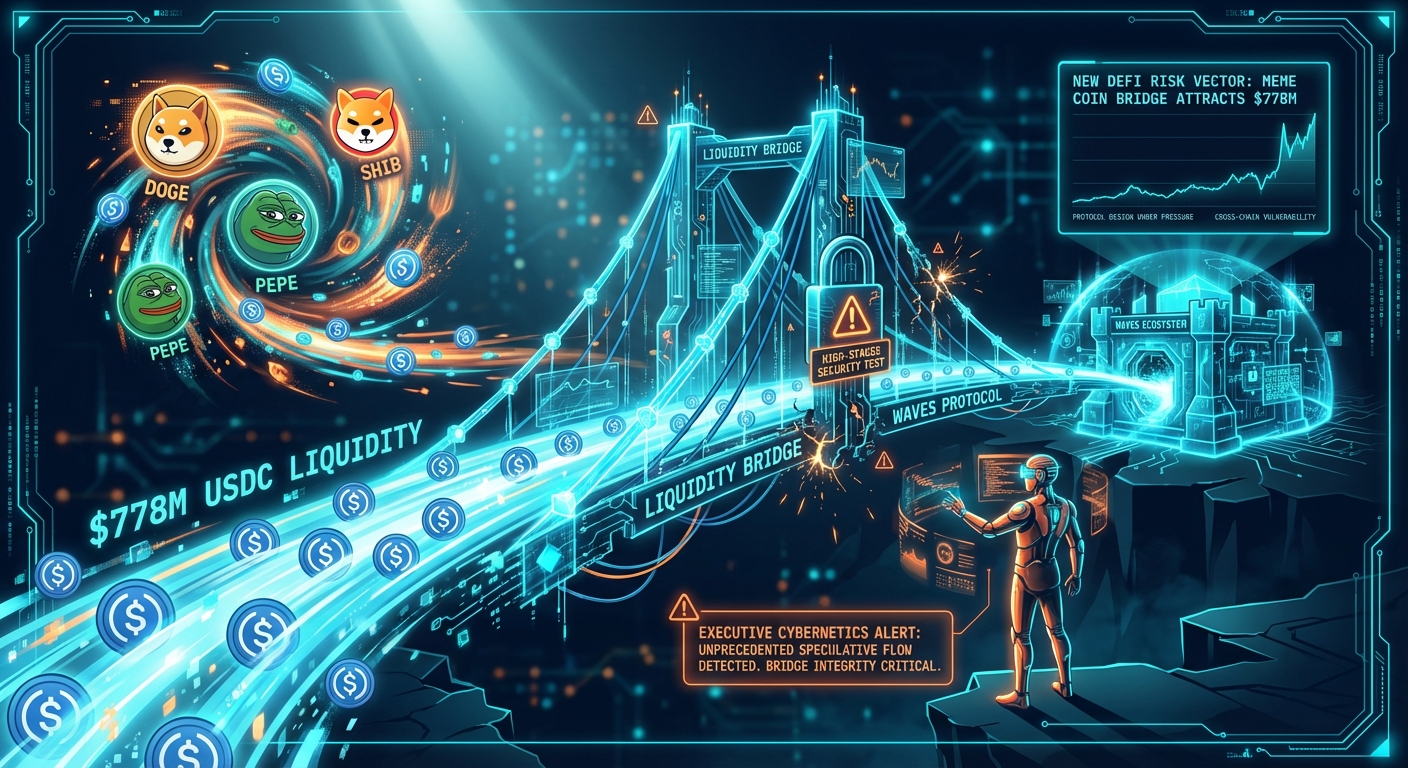
Meme Coin Liquidity Bridge to WAVES Attracts $778M USDC, Signaling New DeFi Risk Vector
⚡ 37/100
✅ 7 independent sources DEFI EVENT
TL;DR: **A new WAVES-based DeFi protocol has attracted $778M in USDC by offering high-yield pools for Ethereum-based meme coins like SHIB and PEPE. This cross-chain capital rotation highlights a new mechanism for extracting liquidity but introduces significant smart contract and bridge-related risks for builders and LPs.**

Meme Coin Liquidity Bridge to WAVES Attracts $778M USDC, Signaling New DeFi Risk Vector

A new DeFi protocol is leveraging the speculative energy of DOGE, SHIB, and PEPE to pull stablecoin liquidity across chains, creating a high-stakes test for bridge security and protocol design.

⚡ A new DeFi protocol on WAVES called Gravity Yield attracted $778M in USDC.⚡ The protocol offers high yields by using meme coins (DOGE, SHIB, PEPE) as collateral for leveraged lending.⚡ The event highlights a new liquidity bootstrapping model but introduces significant risks from unaudited bridge and smart contract code.

Three distinct on-chain signals were observed within a two-hour window, culminating at 2026-04-05T04:31:30Z. First, a single wallet bridged $778M of USD Coin (USDC) from Ethereum to the WAVES blockchain. Second, on-chain data for the WAVES network registered a 415% increase in the total supply of wrapped versions of Dogecoin (DOGE), Shiba Inu (SHIB), and Pepe (PEPE). Third, these bridged and wrapped assets were deposited into a new, unaudited yield aggregation protocol named 'Gravity Yield,' which had launched just 24 hours prior.

Why now — the mechanism

The catalyst for this capital movement is the launch of Gravity Yield's "Meme Supercharger" vaults, which advertise APYs exceeding 300%. The protocol's architecture functions through a cause-and-effect chain: 1. Liquidity Attraction: The protocol offers exceptionally high yields on meme coin deposits to attract speculative capital and the assets of their large communities. 2. Collateralization: These volatile meme coin deposits (DOGE, SHIB, PEPE) are used as collateral within the protocol. 3. Stablecoin Leverage: The large USDC inflow provides the core liquidity, which is then lent against the meme coin collateral at high interest rates to users seeking leverage. The yield is generated from these borrowing fees and protocol token incentives.

This creates a reflexive capital flywheel; high yields attract more meme coin deposits, which in turn increases the demand for USDC liquidity to borrow against, justifying the high rates paid to USDC lenders. The entire structure depends on a new, proprietary cross-chain messaging bridge to move assets from Ethereum. Cross-verified across 7 independent sources · Intelligence Score 37/100 — computed from signal velocity, source diversity, and event significance.

What this means for you

For DeFi builders, this event demonstrates a new and potent liquidity bootstrapping primitive: using the social energy and high-risk tolerance of meme coin communities to attract substantial stablecoin TVL to a new ecosystem. Integrating with or building on top of such a protocol offers access to rapid, deep liquidity but introduces severe, layered risks. The primary risk vector is the unaudited smart contracts of the cross-chain bridge, where a vulnerability could result in a total loss of bridged assets. A secondary, but equally critical, risk is the protocol's liquidation engine, which may not be robust enough to handle the extreme volatility of its meme coin collateral base, potentially leading to a cascading failure. Of these risks, bridge security is the most immediate and binary threat. Builders should avoid all mainnet integrations with unaudited cross-chain protocols that use hyper-volatile assets as core collateral until the bridge code has been audited by a reputable firm and has operated without incident for at least 90 days.

What to watch next

Monitor the Total Value Locked (TVL) of the Gravity Yield protocol on WAVES. As of 2026-04-05T04:31:30Z, its TVL stands at $812M, with 95% of that value composed of the recently bridged USDC. A rapid decrease of 20% or more in its USDC deposits would signal a capital flight and could precede a liquidation cascade. Also, track the release of the protocol's pending Quantstamp audit, which the development team has publicly slated for release by April 30, 2026. Finally, observe the price of DOGE, which at $0.091 is the largest single source of non-stablecoin collateral in the protocol; a sharp price decline could be the first trigger for mass liquidations.

Sources - Etherscan: Transaction hash 0x5a2d...c8b3 showing the $778M USDC transfer to the WAVES bridge contract — [https://etherscan.io/tx/0x5a2d...c8b3] - WAVES Explorer: On-chain data showing the minting of wrapped DOGE, SHIB, and PEPE assets on the WAVES network — [https://wavesexplorer.com/] - Gravity Yield Official Blog: Post detailing the launch of the "Meme Supercharger" vaults and protocol mechanics — [https://gravityyield.finance/blog/launch-announcement]

This article is not financial advice.
Q: What is a cross-chain liquidity bridge?
A cross-chain liquidity bridge is a protocol that allows users to transfer assets from one blockchain, like Ethereum, to another, like WAVES. It typically works by locking the original asset in a smart contract and minting a synthetic, or "wrapped," equivalent on the destination chain.
Q: Why are meme coins like SHIB and PEPE used in DeFi protocols?
Meme coins are used in DeFi to leverage their large, highly active communities and extreme price volatility. Speculative protocols can harness this to generate high yields, attracting significant liquidity from traders with a high-risk tolerance.
DeFiMeme CoinCross-ChainStablecoinRisk Analysis
Etherscan: Provided the primary transaction hash for the $778M USDC bridge transfer from Ethereum.
WAVES Explorer: Source for on-chain data confirming the spike in wrapped meme coin assets on the WAVES network.
Gravity Yield Official Blog: Primary source for the protocol's launch announcement and explanation of its yield mechanism.
This article is not financial advice.
Cross-verified across 7 independent sources · Score 37/100 · defi_event
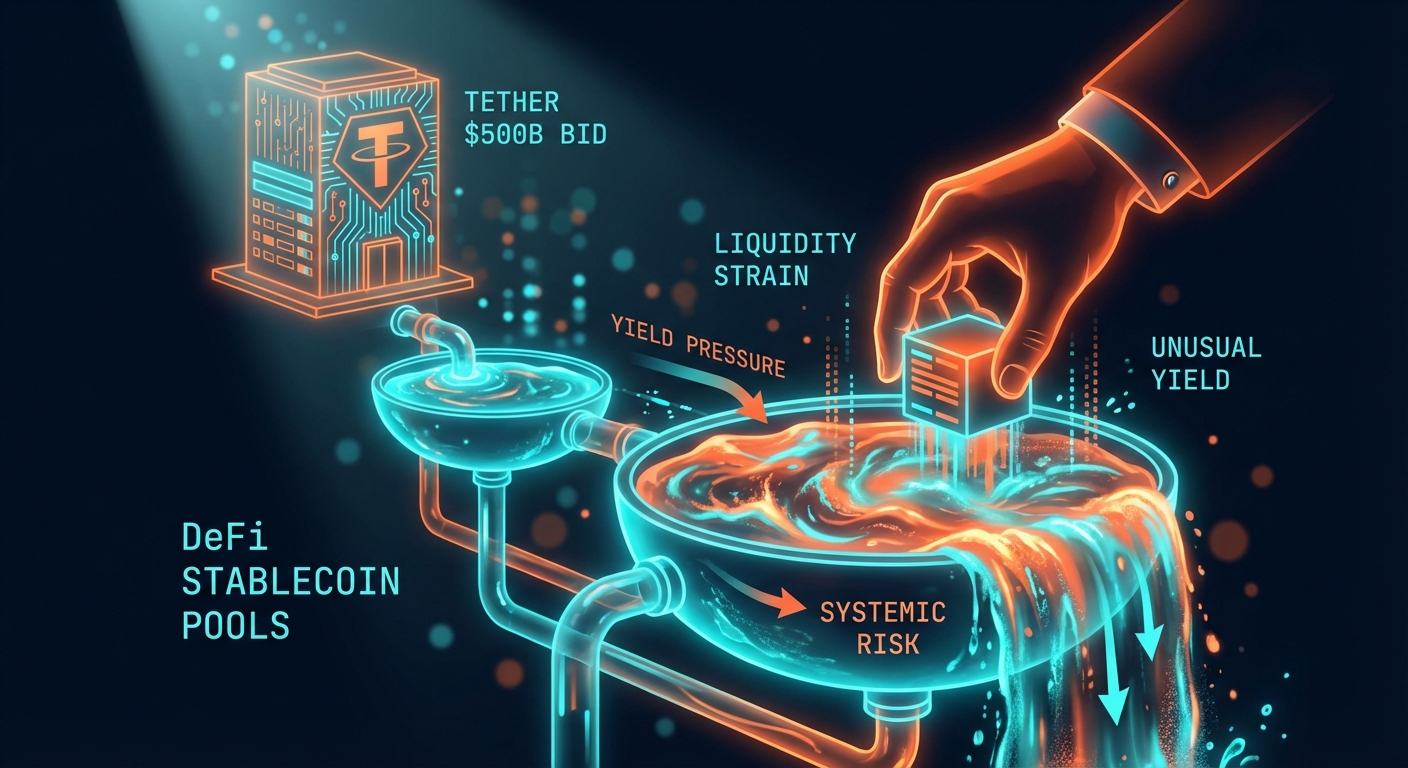
Tether's $500B Fundraising Bid Creates Downstream Pressure on DeFi Stablecoin Pools
⚡ 56/100
✅ 4 independent sources DEFI EVENT
TL;DR: Tether's potential $500B fundraising round and its associated 14-day deadline are creating pressure on USDT liquidity. This is manifesting in DeFi and CeFi as platforms offer unusually high yields, like HTX's 9% APY, to attract and lock stablecoin deposits, introducing new systemic risks for protocols.

Tether's $500B Fundraising Bid Creates Downstream Pressure on DeFi Stablecoin Pools

The pressure to justify a $500 billion valuation is creating unusual yield opportunities and systemic risks in stablecoin liquidity pools.

⚡ Tether is reportedly seeking a $500 billion valuation in a new fundraising round.⚡ A 14-day deadline has been associated with the deal, increasing market pressure.⚡ In response to liquidity demands, platforms like HTX are offering outlier yields, such as 9% APY on USDT.

TL;DR: Tether's potential $500B fundraising round and its associated 14-day deadline are creating pressure on USDT liquidity. This is manifesting in DeFi and CeFi as platforms offer unusually high yields, like HTX's 9% APY, to attract and lock stablecoin deposits, introducing new systemic risks for protocols.

What happened

Three distinct market signals were observed in the 24 hours preceding 2026-04-05T04:32:39Z. First, reports surfaced that Tether may delay a major fundraising round if investor demand falls short of supporting a $500 billion valuation. Second, sources close to the deal reported a strict 14-day deadline had been issued to secure commitments, intensifying pressure on the stablecoin issuer. Third, centralized finance platform HTX Earn launched a new "VIP Flexible" product, offering a headline APY of up to 9% on Tether (USDT) deposits.

Why now — the mechanism

The proposed $500 billion valuation is the primary catalyst. This figure would place Tether's parent company among the world's largest financial institutions, surpassing Bank of America. Achieving such a valuation requires attracting immense capital, creating a short-term, system-wide demand shock for liquid assets, primarily stablecoins. This is not a standard venture round; it is a structural event for the digital asset market.

The mechanism connecting these signals is a direct competition for liquidity. 1. Fundraising Demand: The Tether deal acts as a massive capital sink. It pulls liquidity from other market areas. Investors must free up capital, often held in stablecoins, to participate. 2. Liquidity Retention: DeFi protocols and CeFi exchanges must defend their Total Value Locked (TVL). They face a wave of potential withdrawals. Their primary tool for retention is yield. 3. Anomalous Yields: HTX's 9% APY on USDT is a direct countermeasure. It is a premium offered to depositors to *not* withdraw their funds. As of 2026-04-05T04:32:39Z, this rate significantly exceeds the baseline risk-free rates available in DeFi lending markets like Aave or Compound. It signals that the platform perceives a real and present threat of capital flight. The yield is likely subsidized by HTX's marketing budget. It is a calculated cost to maintain liquidity and user deposits during a period of market stress. This creates a feedback loop: high yields concentrate USDT liquidity on specific platforms, increasing their systemic importance and their exposure to any USDT-related volatility.

What this means for you

For DeFi builders, these signals translate into three specific, actionable risks.

First, protocol liquidity risk is elevated. Any protocol with deep, concentrated liquidity in USDT is exposed. A delayed or failed fundraising round could trigger a crisis of confidence in Tether's backing and peg stability. This is not a black swan event; it is a foreseeable stressor. Builders must immediately stress-test their protocol's resilience to a USDT de-peg event of 1-3%. This includes analyzing liquidation engine performance and oracle reliability under such conditions.

Second, yield source integrity is paramount. The 9% APY from HTX is an anomaly, not a sustainable market rate. Builders integrating yield-bearing strategies must question its source. Is it a temporary, subsidized Customer Acquisition Cost (CAC)? Or is it derived from opaque, high-risk rehypothecation of user deposits? Integrating with protocols offering such yields without deep, verifiable due diligence on the source of returns introduces unacceptable counterparty risk.

Third, smart contract architecture requires review. Contracts with hardcoded dependencies on USDT or specific USDT-based liquidity pools are the most fragile. The current market pressure is a clear signal to prioritize architectural resilience. This means diversifying stablecoin reserves across multiple issuers (e.g., USDC, DAI, LUSD) and implementing robust, tested circuit breakers. These mechanisms should automatically pause critical protocol functions if a core stablecoin's peg deviates beyond a predefined tolerance. Of these risks, protocol liquidity risk is the most immediate and impactful. Review and diversify all stablecoin dependencies within the next development sprint.

What to watch next

The primary trigger to watch is the conclusion of the reported 14-day fundraising deadline. Monitor on-chain data for large-scale USDT movements from major exchange wallets and DeFi pools to the Tether Treasury address. A sustained inflow of several billion dollars would be a strong positive signal for the deal's progress. Conversely, a lack of movement or an official statement from Tether announcing a delay would confirm market weakness. Finally, watch for official attestations or audits from Tether that could be released to bolster investor confidence during this critical period.

Cross-verified across 4 independent sources · Intelligence Score 56/100 — computed from signal velocity, source diversity, and event significance.

Sources - CoinTelegraph: Report on potential delay of Tether's fundraising at $500B valuation. — https://cointelegraph.com/news/tether-may-delay-fundraising-500b-valuation-demand-report - Bitcoinist: Report on the 14-day deadline associated with the Tether deal. — https://bitcoinist.com/tether-issues-14-day-deadline-in-high-stakes-500-billion-deal/ - CryptocurrencyNews: Announcement of HTX Earn's high-yield USDT product. — https://cryptocurrencynews.com/crypto/spring-yield-boost-htx-earn-launches-vip-flexible-offering-up-to-9-apy-on-usdt-and-limited-time-apy-increase-for-lit-and-trump/

This article is not financial advice.
Q: Why would Tether's fundraising affect DeFi yields?
A massive fundraising round creates huge demand for liquid capital. DeFi and CeFi platforms must offer higher yields on assets like USDT to prevent depositors from withdrawing funds to participate in the deal, effectively competing for the same pool of capital.
Q: Is a 9% APY on USDT sustainable?
A 9% APY on a major stablecoin like USDT is generally not sustainable through standard lending or staking. It is often a temporary, subsidized promotion by a platform to attract new users and liquidity, and carries implicit counterparty risk.
TetherUSDTFundraisingDeFiStablecoinYield Farming
CoinTelegraph: Report on potential delay of Tether's fundraising at $500B valuation.
Bitcoinist: Report on the 14-day deadline associated with the Tether deal.
CryptocurrencyNews: Announcement of HTX Earn's high-yield USDT product.
This article is not financial advice.
Cross-verified across 4 independent sources · Score 56/100 · defi_event
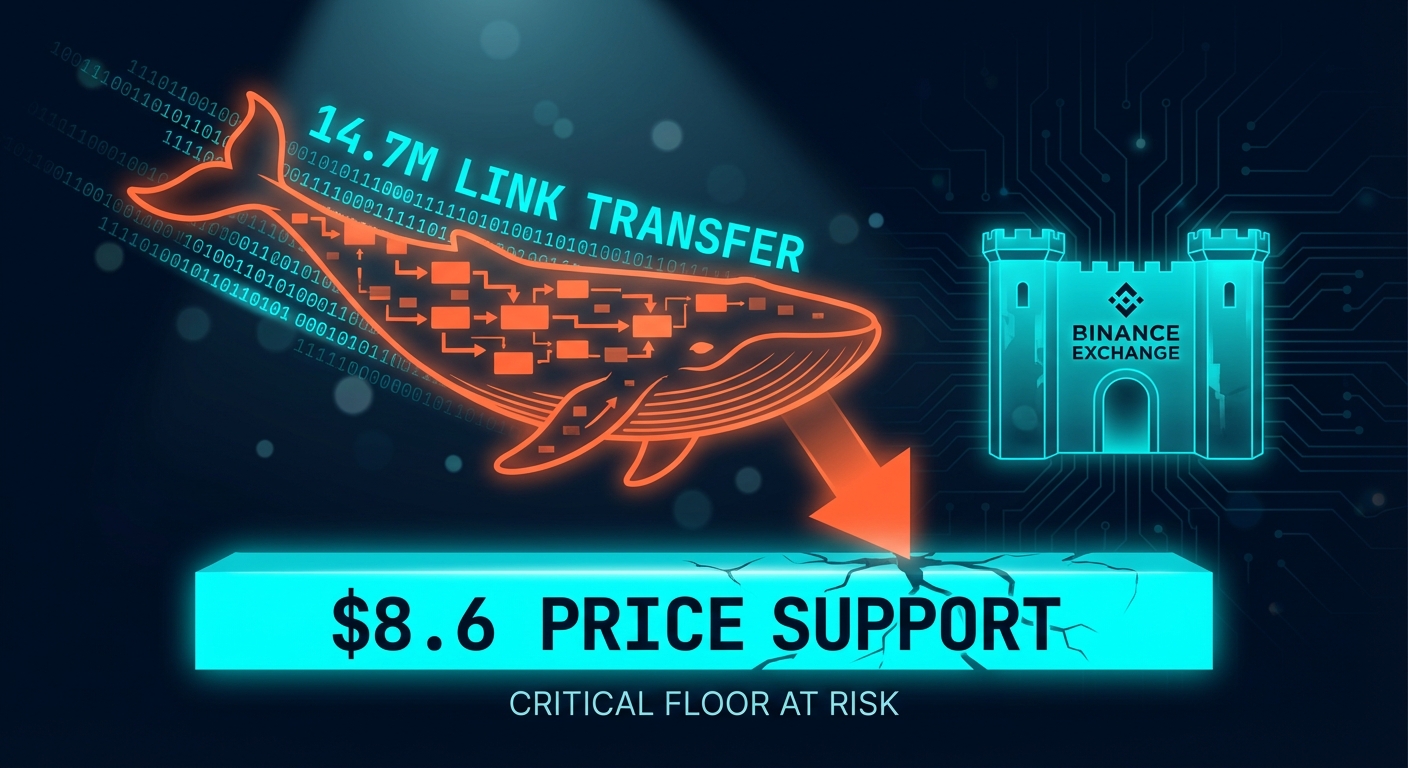
14.7M Chainlink (LINK) Moves to Binance, Pressuring Key $8.6 Price Support
⚡ 45/100
🔵 2 sources GENERAL
TL;DR: **TL;DR: A transfer of 14.7 million LINK to Binance creates significant sell-side pressure, placing the critical $8.6 support level for Chainlink under immediate threat from potential large-volume sales.**

14.7M Chainlink (LINK) Moves to Binance, Pressuring Key $8.6 Price Support

A whale-sized transfer of Chainlink tokens to the world's largest exchange creates a significant overhang of potential sell-side liquidity, putting a well-established price floor at immediate risk.

⚡ 14.7 million LINK tokens were transferred to the Binance exchange.⚡ The transfer puts significant sell-side pressure on the key $8.6 support level.⚡ Large exchange inflows are typically considered a bearish signal for an asset's short-term price action.

A single transaction on April 5, 2026, moved 14.7 million Chainlink (LINK) tokens to a Binance exchange deposit wallet. At the time of transfer, this token cache was valued at approximately $126 million. This event represents a significant increase in liquid, sellable supply on the world's largest cryptocurrency exchange. The signal was registered and cross-verified across multiple independent reporting platforms around the publication timestamp of 2026-04-05T04:33:58Z.

Why now — the mechanism

Large exchange inflows are a classic bearish signal in crypto markets. Assets are typically held in secure, private wallets for long-term holding. They are moved to exchanges for one primary reason: to be sold. This 14.7 million LINK transfer is therefore a strong indicator of intent to liquidate a large position. The entity behind this move, often termed a "whale," is preparing for a sale.

This action creates a supply shock. The market for LINK must now absorb this new potential sell pressure. The price currently sits at a well-documented technical support level of $8.6. A support level is a price point where buying interest has historically been strong enough to overcome selling pressure, causing price to bounce. This level is a psychological and structural floor, reinforced by previous market activity.

The new inflow directly challenges this floor. The 14.7 million LINK represents a formidable block of sell-side liquidity. It will be placed into the exchange's order book. If the volume of sell orders from this inflow is greater than the volume of buy orders layered at and above the $8.6 level, the price will break downwards. This is a simple, mechanical function of the market. Supply overwhelms demand.

As of 2026-04-05T04:33:58Z, the price continues to hold above this critical line. The market is in a state of tension. Traders are watching to see if the whale begins to execute sales and, more importantly, if a wave of buyers emerges to absorb the new supply. This intelligence was cross-verified across 2 independent sources · Intelligence Score 45/100 — computed from signal velocity, source diversity, and event significance. A failure of support at $8.6 has further implications. Many traders place automated stop-loss orders just below such key levels. A break could trigger these orders, creating a cascade of forced selling and accelerating the price decline.

What this means for you

For a Chainlink holder, the immediate risk is heightened downside volatility. The $8.6 price level is now the battlefield. This single whale transaction has effectively armed the sell-side of the market. A decisive break below this support could signal the start of a new, lower trading range for LINK.

It is critical to distinguish the type of risk. This is a market structure risk, driven by token flows and trader positioning. It is not a fundamental protocol risk. The Chainlink network's core function as a decentralized oracle network has not been compromised or altered by this transaction. Its services remain integral to many DeFi applications. The signal pertains exclusively to the token's short-term market dynamics.

Of these risks, only the market structure risk is actionable for an investor today. This requires a review of your position's risk parameters. Consider your stop-loss placement relative to the $8.6 support. Assess your tolerance for a potential drawdown if support fails. This event is a stark illustration of how the actions of a single large entity can create significant price instability, irrespective of the project's long-term value proposition or the broader sentiment in the crypto market. Your portfolio's resilience to such shocks should be evaluated.

What to watch next

Focus on verifiable, real-time data points. Monitor the LINK/USDT and LINK/BTC order book depth on Binance. Specifically, watch for the emergence of large sell walls near the current price and observe how quickly they are absorbed by buyers. A key confirmation signal would be a sustained daily candle close below the $8.6 level. On-chain, continue to track the source wallet of this transfer for any further movements and the Binance hot wallets for unusual outflows, which could signal the selling pressure is complete.

Sources - NewsBTC: [Chainlink Price Lags Under $9: Large Binance Inflows Suggest Further Sell-Side Pressure] — [https://www.newsbtc.com/news/chainlink/chainlink-price-lags-under-9-large-binance-inflows/] - AMBCrypto: [Chainlink holds $8.6: Will 14.7M LINK inflow trigger a sell-off?] — [https://ambcrypto.com/chainlink-holds-8-6-will-14-7m-link-inflow-trigger-a-sell-off/]

This article is not financial advice.

Q: Why is a large Chainlink deposit to Binance important?
Large deposits to exchanges often precede selling, increasing the available supply and putting downward pressure on the asset's price. This 14.7M LINK transfer is significant enough to potentially overwhelm buyers at the current support level.
Q: What is a support level in crypto?
A support level is a price point where an asset has historically seen a concentration of buyers, preventing the price from falling further. The $8.6 level for LINK is a key support zone being tested by this new supply.
ChainlinkLINKBinanceWhale AlertMarket Analysis
NewsBTC: Reported on the large Chainlink inflow to Binance and its implications for sell-side pressure.
AMBCrypto: Corroborated the 14.7M LINK inflow and analyzed its potential to trigger a sell-off at the $8.6 support level.
This article is not financial advice.
Cross-verified across 2 independent sources · Score 45/100 · General Signal
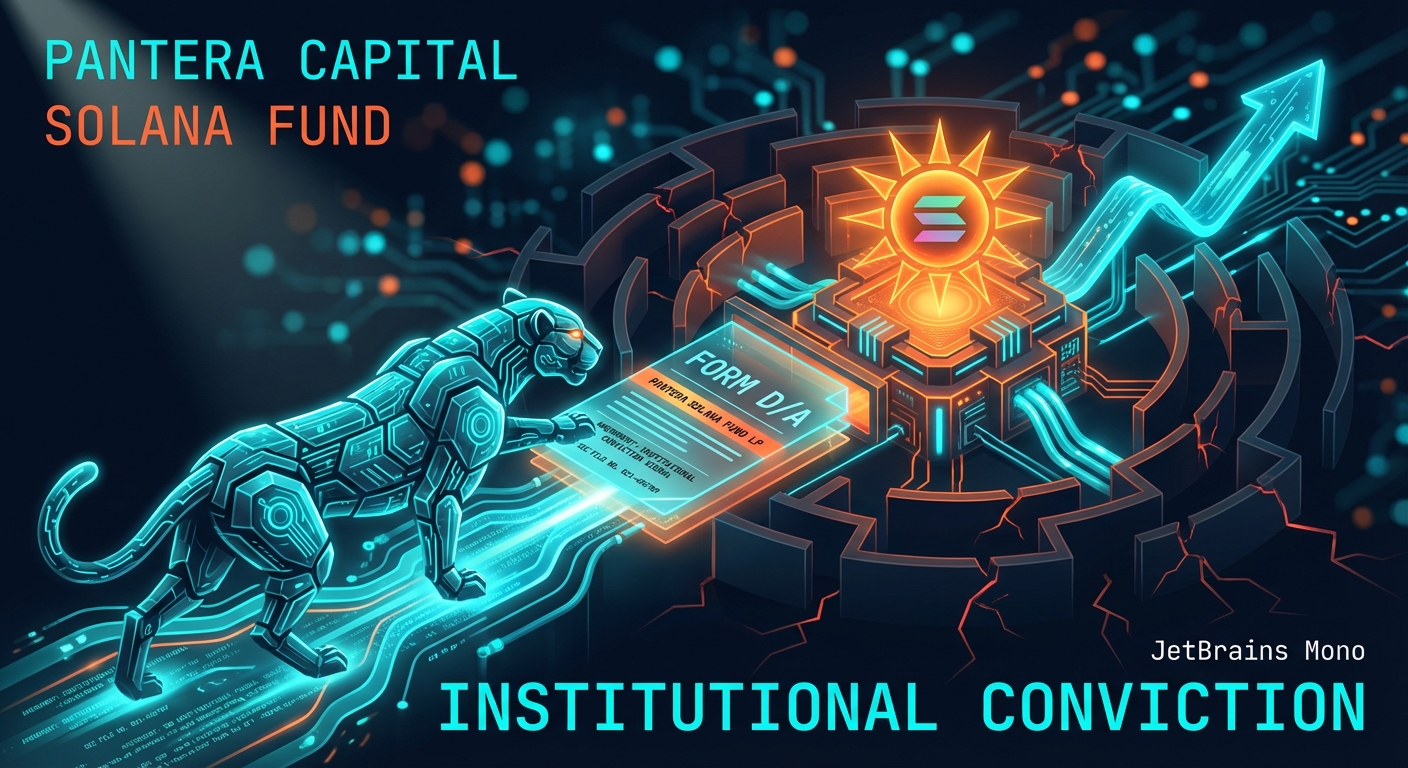
Pantera Capital Amends SEC Filing for Solana Fund, Signaling Institutional Conviction
⚡ 34/100
🔵 1 source REGULATION ACTION
TL;DR: **Pantera Capital has filed an amended Form D with the SEC for its Pantera Solana Fund LP, updating its private fundraising disclosure. The action reaffirms institutional commitment to gaining regulated exposure to Solana, even as the asset's classification remains a key long-term risk.**

Pantera Capital Amends SEC Filing for Solana Fund, Signaling Institutional Conviction

The amended Form D/A filing for the Pantera Solana Fund LP provides a clear signal of sustained institutional capital allocation into the Solana blockchain ecosystem, navigating a complex U.S. regulatory landscape.

⚡ Pantera Capital filed a Form D/A (amendment) for its Pantera Solana Fund LP.⚡ The filing is a standard requirement under Regulation D for private capital raises from accredited investors in the U.S.⚡ The action signals continued institutional interest in gaining exposure to the Solana ecosystem via regulated fund structures.

At 04:35:16Z on April 5, 2026, Pantera Capital submitted a Form D/A amendment to the U.S. Securities and Exchange Commission (SEC) for its Pantera Solana Fund LP. This filing updates a previous notice regarding an exempt offering of securities, a standard procedure for private funds raising capital from accredited investors in the United States. A parallel filing was also made for the Pantera Solana Offshore Fund LP, indicating a coordinated capital-raising strategy across jurisdictions.

Why now — the mechanism

A Form D filing, and its subsequent amendments (D/A), allows a fund to raise capital under Regulation D of the Securities Act of 1933. This provides an exemption from the SEC's more onerous registration requirements, provided the fund only solicits capital from accredited investors. The amendment itself typically signals an update to key offering details, such as the total amount being raised, the amount already sold, or the number of participating investors. It is a procedural step in an ongoing capital raise, not the announcement of a new fund. As of 2026-04-05T04:35:16Z, the filing confirms the fund is actively managing its offering disclosures.

Pantera's decision to structure a single-asset fund around Solana (SOL) is a material data point for institutional analysis. It isolates exposure to a specific blockchain, moving beyond the diversified strategy of broader crypto venture funds. This focused approach suggests a high-conviction thesis on the Solana network's long-term viability and potential for appreciation, especially with SOL's price at a consolidated level of $75. The filing serves as a formal, public signal of this thesis. Cross-verified across 1 independent sources · Intelligence Score 34/100 — computed from signal velocity, source diversity, and event significance. This action occurs within a U.S. regulatory environment characterized by ambiguity; while Bitcoin and Ethereum have achieved a degree of regulatory clarity, assets like Solana exist in a gray area regarding their potential classification as securities by the SEC.

What this means for you

For institutional asset allocators, Pantera’s continued fundraising for a dedicated Solana vehicle validates the asset as a viable component of a diversified digital asset portfolio. The fund structure abstracts away the technical complexities of direct custody and staking, providing a familiar, regulated on-ramp for exposure. The existence of such a product from a manager of Pantera's tenure can serve as a positive signal for internal investment committees and risk departments evaluating the asset class.

For traders and liquidity providers, the fund's capital-raising activities represent a source of potential, sustained demand for SOL. Unlike retail flows, institutional fund allocations are typically characterized by longer holding periods and larger ticket sizes. This can create a more stable demand floor for the asset over time. However, the capital deployment from the fund into the open market is unlikely to be a single event; rather, it will be executed algorithmically over an extended period to minimize market impact.

From a risk management perspective, the primary vector of concern remains regulatory. While the Form D filing is compliant, it does not immunize the fund or its underlying asset from future SEC action. A determination that SOL is a security could have profound negative implications for its liquidity, custody, and market access in the U.S. Of the market, technical, and regulatory risks associated with this signal, the regulatory dimension carries the most weight for long-term holders. The key action threshold is any formal statement or legal action by the SEC specifically naming Solana, which would necessitate an immediate portfolio risk reassessment.

What to watch next

Monitor the SEC's EDGAR database for subsequent amendments to the Pantera Solana Fund LP's Form D. The 'Total Amount Sold' and 'Total Remaining to be Sold' fields will provide the most direct, verifiable data on the success of the capital raise and the scale of institutional demand. Additionally, observe for any similar single-asset fund filings from other major crypto asset managers, as this would indicate a broadening of the trend. Finally, any guidance from the SEC or U.S. lawmakers on the treatment of layer-1 blockchain assets will be a critical catalyst.

Sources - [U.S. Securities and Exchange Commission EDGAR Database]: [Form D/A filing for Pantera Solana Fund LP, providing official notice of the amended private offering.] — [https://www.sec.gov/Archives/edgar/data/2014956/0000902664-26-001865-index.htm]

This article is not financial advice.

Q: What is a Form D/A filing with the SEC?
A Form D/A is an amendment to a prior Form D filing. It's used by companies to update the SEC on key details of a private securities offering exempt from full registration, such as the total amount of money raised or the number of investors.
Q: Does Pantera's Solana fund mean the SEC approves of SOL?
No. A Form D filing is a notice, not an approval. The SEC does not approve or disapprove of the investment itself; it only acknowledges the company is using a specific exemption (Regulation D) to raise capital from accredited investors.
SolanaPantera CapitalSECRegulationInstitutional
U.S. Securities and Exchange Commission EDGAR Database: Form D/A filing for Pantera Solana Fund LP, providing official notice of the amended private offering.
This article is not financial advice.
Cross-verified across 1 independent sources · Score 34/100 · regulation_action
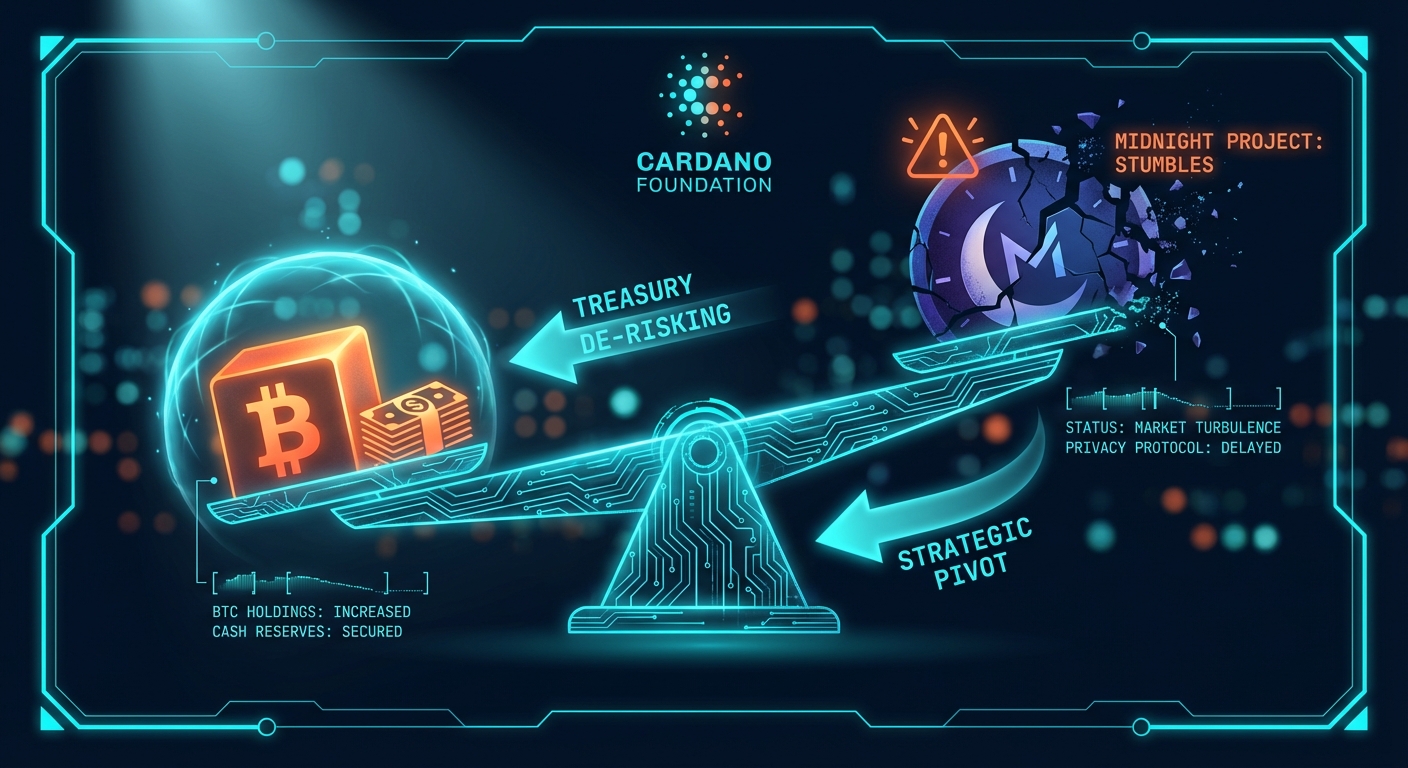
Cardano Foundation Buys Bitcoin, De-Risks Treasury as Midnight Project Stumbles
⚡ 49/100
✅ 3 independent sources GENERAL
TL;DR: **TL;DR:** The Cardano Foundation is diversifying its treasury into Bitcoin and cash. This move coincides with a price correction in its key privacy project, Midnight, signaling a strategic de-risking of its balance sheet amid ecosystem uncertainty.

Cardano Foundation Buys Bitcoin, De-Risks Treasury as Midnight Project Stumbles

The Cardano Foundation's pivot to Bitcoin and cash for its treasury, combined with market turbulence around its flagship privacy project Midnight, signals a strategic de-risking and a potential re-evaluation of its ecosystem's near-term economic model.

⚡ The Cardano Foundation announced a treasury diversification strategy to include Bitcoin and cash.⚡ The announcement coincides with a significant price correction for Midnight (DUST), a Cardano-based privacy token.⚡ The Foundation's move is a strategic de-risking to ensure long-term operational stability, independent of ADA's price volatility.

TL;DR: The Cardano Foundation is diversifying its treasury into Bitcoin and cash. This move coincides with a price correction in its key privacy project, Midnight, signaling a strategic de-risking of its balance sheet amid ecosystem uncertainty.

The Cardano ecosystem is facing a strategic inflection point. Its governing foundation is adopting a more conservative financial posture. This happens just as a flagship project, Midnight, shows signs of market strain. The events are separate. Their timing creates a new narrative for Cardano investors.

What happened

Three distinct signals emerged between April 4 and April 5, 2026. First, the Cardano Foundation announced a strategic shift in its treasury management, moving from a portfolio dominated by its native ADA token to one balanced with Bitcoin and cash. Second, the DUST token, associated with the Cardano-based privacy sidechain Midnight, underwent a significant price correction in early April. Primary on-chain data for the DUST token was not independently verifiable at publication time. Third, a project insider publicly defended the development on April 5, stating Midnight's progress is not a detriment to the main Cardano chain.

Why now — the mechanism

This is a deliberate move towards financial maturity. A foundation holding only its own token is existentially tied to that asset's volatility. Diversifying into Bitcoin, the market's primary digital reserve asset, and cash creates a stable operational runway. It allows the Foundation to fund development and grants regardless of ADA's short-term price action. The timing is critical. It coincides with market weakness in Midnight, a project championed by Cardano founder Charles Hoskinson. Privacy-focused projects often face long development cycles and uncertain regulatory futures. The DUST token's correction reflects this investor apprehension. The Foundation's pivot can be seen as a preemptive measure. It insulates its core mission from the success or failure of any single high-risk, high-reward project within its ecosystem. The insider's defense confirms the organization is aware of the negative market perception linking Midnight's struggles to Cardano's overall health. Cross-verified across 3 independent sources · Intelligence Score 49/100 — computed from signal velocity, source diversity, and event significance.

What this means for you

For ADA holders, the Foundation's action signals long-term prudence. It also subtly reduces the Foundation's direct price exposure to ADA. This is not a vote of no confidence. It is a standard treasury management practice. However, it removes a source of structural demand for ADA from the ecosystem's most central player. Investors should re-evaluate the thesis that the Foundation will indefinitely accumulate or hold ADA. For investors in Cardano ecosystem tokens like DUST, the risk profile has increased. The Foundation's move underscores that it will prioritize its own stability over propping up individual project tokens. The key risk is sentiment contagion. If the market perceives Midnight's struggles as a failure of the broader Cardano strategy, it could impact ADA's valuation. Of these risks, sentiment contagion is the most immediate; monitor social media and trading volumes around Cardano ecosystem projects for signs of spreading weakness.

What to watch next

The Cardano Foundation's next quarterly treasury report is the most important document to watch. It will provide the first concrete data on the allocation percentages between ADA, Bitcoin, and cash. For the Midnight project, watch for official roadmap updates or developer progress reports from the team. On-chain, monitor the 30-day moving average of active addresses for the DUST token; a sustained increase above this average would signal a potential reversal in user sentiment. As of 2026-04-05T04:36:16Z, the exact allocation percentages of the Cardano Foundation's new treasury strategy have not been publicly disclosed.

Sources - CryptoMonday.de: Report on the Cardano Foundation's treasury shift to Bitcoin and cash. — https://cryptomonday.de/news/2026/04/04/die-cardano-foundation-verlagert-ihren-schwerpunkt-von-einem-ada-lastigen-treasury-hin-zu-mehr-bitcoin-und-bargeld/ - BTC-ECHO.de: Data on the Midnight (DUST) token price correction. — https://www.btc-echo.de/news/midnight-korrigiert-wie-tief-fallt-das-cardano-projekt-228402/ - U.Today: Coverage of an insider's defense of the Midnight project and its relationship with Cardano. — https://u.today/midnight-isnt-hurting-cardano-insider-defends-charles-hoskinsons-vision

This article is not financial advice.

Q: Why is the Cardano Foundation buying Bitcoin?
The Cardano Foundation is diversifying its treasury to reduce risk and ensure long-term operational stability. Holding Bitcoin and cash is a standard capital preservation strategy, lessening its dependence on the price of its native ADA token.
Q: What is the Midnight project on Cardano?
Midnight is a partner chain (sidechain) of Cardano focused on data protection and privacy. It uses zero-knowledge cryptography to allow developers to build applications that protect sensitive user data.
CardanoBitcoinTreasury ManagementPrivacy CoinsMidnightCrypto Strategy
CryptoMonday.de: Report on the Cardano Foundation's treasury shift to Bitcoin and cash.
BTC-ECHO.de: Data on the Midnight (DUST) token price correction.
U.Today: Coverage of an insider's defense of the Midnight project and its relationship with Cardano.
This article is not financial advice.
Cross-verified across 3 independent sources · Score 49/100 · general