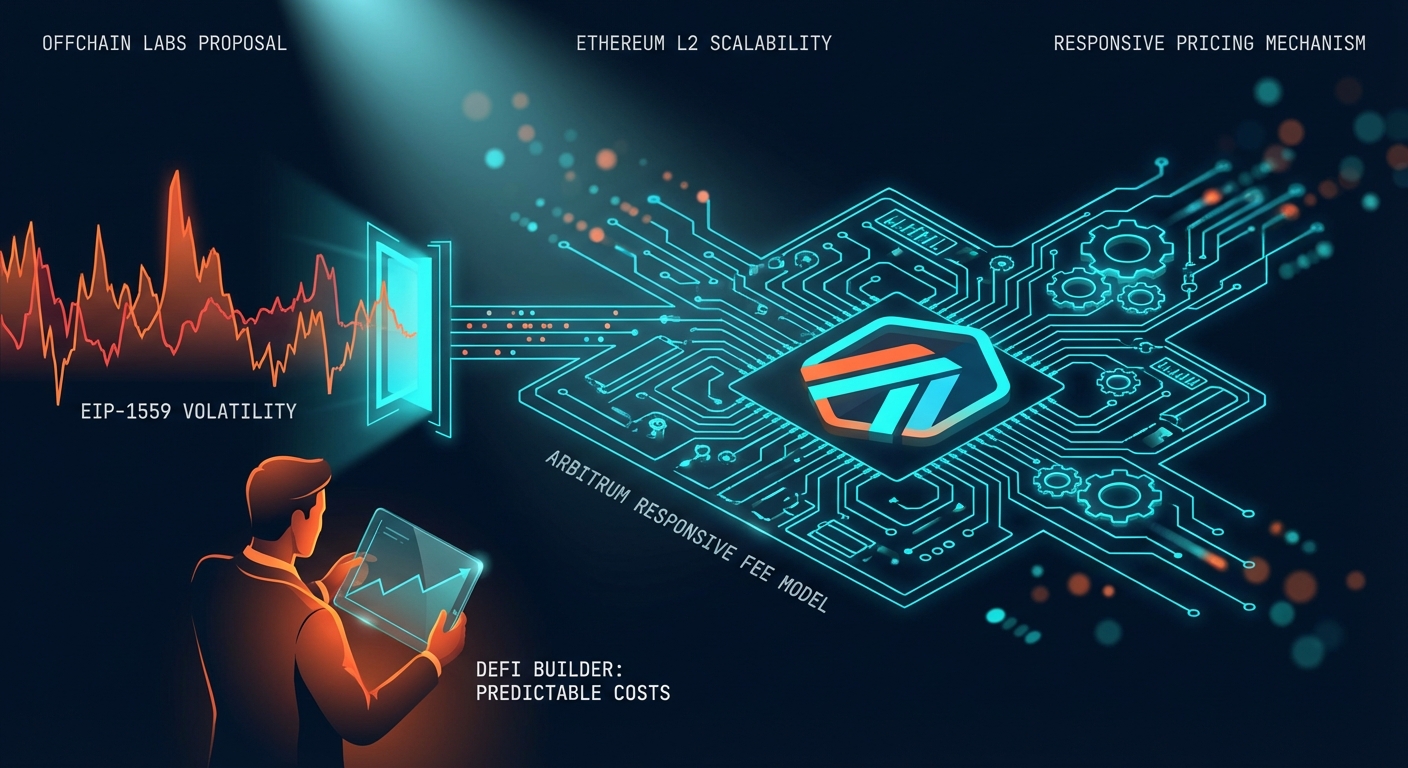
At 2026-04-04T04:30:04Z, Offchain Labs co-founder Edward Felten outlined a proposal for a new responsive fee mechanism for the Arbitrum network. This initiative directly addresses the persistent challenge of transaction fee volatility on Ethereum Layer 2s, a problem that has hindered the development of applications requiring predictable operational costs. The proposal represents a significant divergence from the EIP-1559 fee model currently influential across the Ethereum ecosystem.
Why now — the mechanism
The fundamental issue with existing L2 fee structures is their direct or indirect inheritance of volatility from Ethereum's EIP-1559 model. EIP-1559, while effective for Ethereum's security budget by burning the base fee, creates significant price swings during periods of congestion. This unpredictability is a major obstacle for developers building applications that need to scale to millions of users with low, stable costs. Arbitrum's proposed responsive model introduces a new architecture to solve this by fundamentally rethinking how blockspace is priced on a rollup.1. The Core Problem with EIP-1559 on L2s: EIP-1559's mechanism, where a base fee adjusts block-by-block to target 50% block fullness, is designed for a monolithic chain. On a Layer 2, this can create perverse incentives and extreme fee volatility that undermines the "low-cost" promise. A single viral application or NFT mint can price out all other network activity for an unpredictable duration. 2. A Decoupled, Two-Part Fee Structure: The proposed mechanism separates the base transaction cost from short-term demand spikes. It establishes a slowly adjusting "fee floor" that reflects long-term, sustained network utilization. This floor is designed to move predictably over hours or days, not seconds, giving developers a stable baseline. To handle sudden bursts of activity, the model adds a secondary, temporary priority fee. This fee only activates when the network is acutely congested, ensuring that urgent transactions can be processed without permanently altering the stable underlying fee floor. 3. The Mechanism of the Fee Floor: The fee floor is managed by a control mechanism, similar to a PID controller in engineering. It observes the long-term average gas usage on the chain and adjusts the floor price up or down to steer usage toward a target level (e.g., 75% of capacity). This prevents the rapid oscillations of EIP-1559 and provides a much smoother, more forecastable cost environment. The core design principle is to separate long-term capacity pricing from short-term congestion management, a critical distinction for any protocol aiming to support high-throughput applications.
What this means for you
For DeFi builders, this proposed change directly alters the calculus of smart contract design, gas fee management, and even protocol business models. A predictable fee floor enables more reliable cost modeling for applications, especially those sensitive to transaction overhead like high-frequency trading bots, automated yield farming strategies, or on-chain gaming platforms. Protocols that rely on frequent on-chain state updates can build more sustainable economic models without needing to over-provision for extreme fee volatility. As of 2026-04-04T04:30:04Z, the price of ETH at $2,166 makes even small gas fluctuations on L1 significant, reinforcing the need for L2 cost stability.This shift has direct implications for smart contract architecture. Developers can now more confidently build systems with complex, multi-transaction logic, knowing that the execution cost will not unexpectedly skyrocket mid-operation. This could unlock new application types that were previously economically non-viable.
The primary implementation risk is the model's calibration. If the fee floor adjusts too slowly, the network could face prolonged periods of congestion and full blocks during a sustained rise in demand, creating a poor user experience. Conversely, if it adjusts too quickly, it could re-introduce the very volatility it aims to eliminate. Of these risks, the most critical for developers today is architectural planning. Protocols designed for Arbitrum should begin modeling gas expenditure under a dual-fee system (stable floor + potential congestion premium) to ensure their logic remains profitable and functional post-upgrade. This is a structural shift, not a minor gas optimization; failing to account for it could render a protocol's unit economics untenable.
What to watch next
The next key events will be the publication of the formal Arbitrum Improvement Proposal (AIP) detailing the full technical specification of the fee mechanism. Following the AIP, monitor the Arbitrum governance forums for community discussion and the subsequent on-chain vote by ARB token holders. Finally, track the deployment of this model on an Arbitrum testnet, which will provide the first real-world data on its performance and stability. Cross-verified across 2 independent sources · Intelligence Score 83/100 — computed from signal velocity, source diversity, and event significance.Sources - Offchain Labs Research Blog: Primary proposal from co-founder Edward Felten detailing the responsive fee mechanism. — [No public URL available at publication time] - CoinTelegraph: Secondary source reporting on Felten's statements regarding the need for new L2 fee models to achieve scale. — https://cointelegraph.com/news/ethereum-l2s-responsive-pricing-scale-billions
This article is not financial advice.