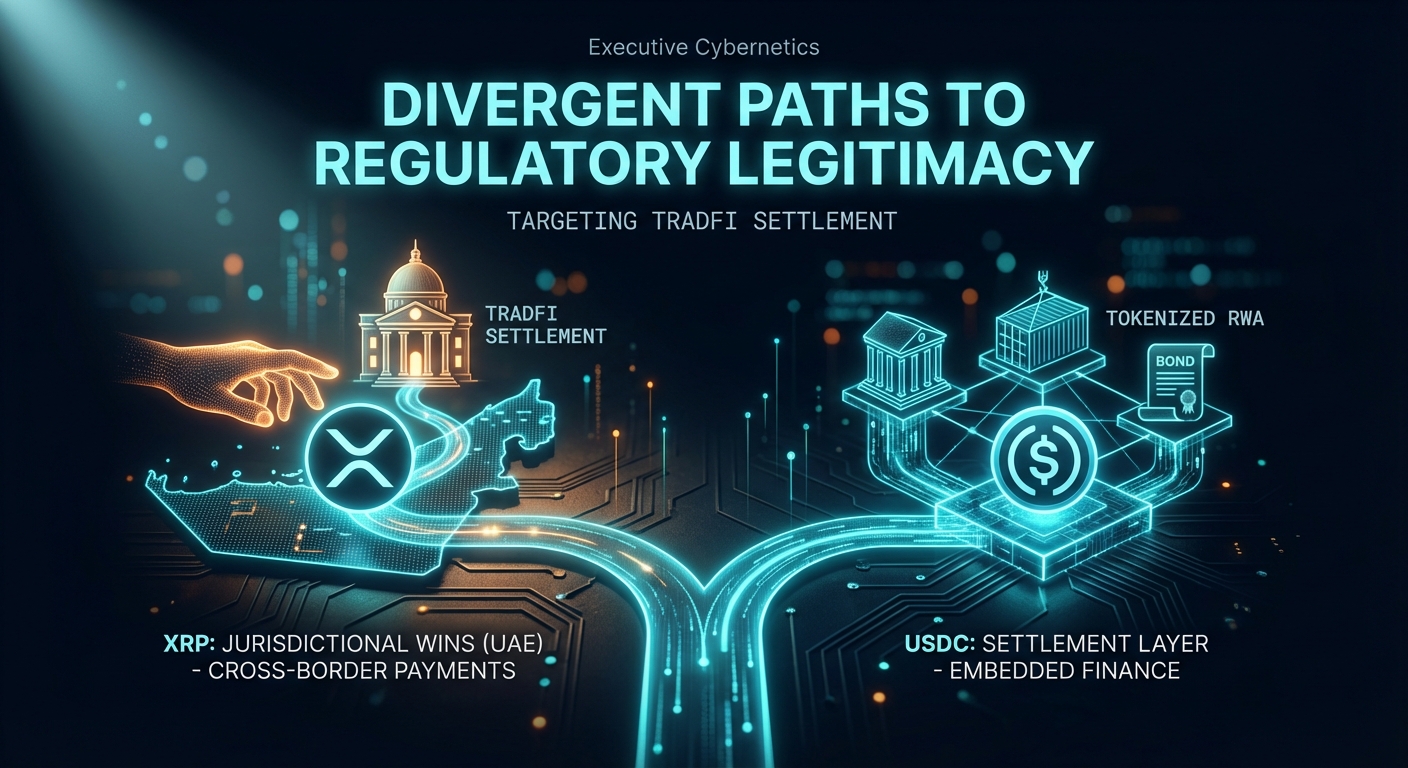
While XRP secures jurisdictional wins for cross-border payments in the UAE, Circle's USDC is embedding itself as the settlement layer for tokenized real-world assets, revealing a new, fragmented strategy for institutional crypto adoption.
TL;DR: XRP's regulatory approval in the UAE and Circle's USDC integration into the Pharos RealFi network signal a strategic divergence in digital asset adoption; major players are now prioritizing jurisdiction-specific compliance and real-world settlement over a monolithic global approach.
What happened
Three distinct signals related to institutional adoption and regulatory strategy were observed within a 24-hour window ending 2026-03-31T04:33:16Z. First, the XRP ecosystem secured regulatory approval within the United Arab Emirates (UAE), clearing a path for its use in the country's financial markets. Second, Circle announced a partnership with Pharos Network to integrate USD Coin (USDC) as the primary settlement asset for its upcoming mainnet focused on Real-World Finance (RealFi). Third, Ripple's CEO publicly framed the company's focus on a $13 trillion opportunity in traditional finance, reinforcing the strategic pivot towards established markets. As of 2026-03-31T04:33:16Z, XRP was trading at approximately $1.36.
Why now — the mechanism
The convergence of these events illustrates a critical evolution in digital asset strategy, driven by a fragmented global regulatory environment. Instead of pursuing a single, universal standard for compliance, leading protocols are now executing tailored, jurisdiction-specific strategies to achieve legitimacy and utility. This marks a departure from the sector's earlier, more confrontational stance towards regulators.
1. XRP's Jurisdictional Arbitrage: Following a prolonged and costly legal battle with the U.S. Securities and Exchange Commission (SEC), Ripple is actively seeking favorable legal frameworks elsewhere. The UAE approval is a direct outcome of this strategy. It establishes a regulated corridor for financial institutions to use XRP-based products like On-Demand Liquidity (ODL) for cross-border payments, effectively bypassing U.S. legal ambiguity. This approach treats regulatory clarity not as a global constant but as a regional competitive advantage.
2. USDC's Infrastructure Play: Circle's strategy with USDC is different but complementary. By integrating with platforms like Pharos Network, Circle is embedding USDC as a core settlement layer for the tokenization of real-world assets (RWAs). This positions USDC less as a speculative instrument and more as a foundational piece of financial market infrastructure, aiming for compliance and integration within existing frameworks rather than seeking bespoke approvals for a novel use case. The goal is to become the default digital dollar for a regulated, on-chain financial system.
These parallel efforts demonstrate that the path to institutional adoption is not monolithic. The analysis was cross-verified across 4 independent sources · Intelligence Score 52/100 — computed from signal velocity, source diversity, and event significance. The underlying mechanism is a strategic calculation: capture specific, high-value markets with clear regulations now, rather than waiting for uncertain, global consensus later.
What this means for you
For institutional investors, this strategic fragmentation requires a more granular approach to asset analysis and portfolio construction. The primary implication is that an asset's value proposition is now intrinsically linked to its jurisdictional standing. An asset may be utility-focused in one G20 country while remaining purely speculative in another, directly impacting its risk profile and liquidity sources. This divergence will likely lead to liquidity fragmentation, with trading volumes for assets like XRP potentially shifting towards exchanges domiciled in newly approved regions like the UAE.
Furthermore, the evolution of USDC into a RealFi settlement layer signals a maturation of the stablecoin market beyond a simple on-ramp for DeFi. Its utility will increasingly be measured by its integration with regulated, tokenized asset markets. Of these factors, jurisdictional risk is the most immediately actionable. Investors should model counterparty and regulatory risk for any asset representing more than 5% of their digital asset portfolio, focusing on its legal status in the domicile of the primary exchanges where it is traded.
What to watch next
The next verifiable trigger for this thesis will be the announcement of the first major UAE-based financial institution to publicly adopt XRP for payment settlement under the new framework. For USDC, watch for the announcement of the first tokenized RWA to use the Pharos Network for settlement. Finally, monitor any forthcoming guidance from the U.S. SEC or CFTC that explicitly references the regulatory treatment of digital assets that have already gained approval in other major financial jurisdictions, as this will signal either harmonization or continued fragmentation.
Sources - NewsBTC: Reporting on Ripple CEO's commentary regarding the $13 trillion TradFi opportunity — https://www.newsbtc.com/news/ripple/ripple-ceo-13-trillion-opportunity/ - NewsBTC: Coverage of XRP ecosystem's regulatory approval in the UAE market — https://www.newsbtc.com/xrp-news/xrp-enters-uae-market/ - Cryptocurrency News: Details on the Pharos Network and Circle partnership to integrate USDC for a RealFi settlement layer — https://cryptocurrencynews.com/crypto/pharos-network-and-circle-to-bring-usdc-and-cctp-to-upcoming-mainnet-powering-a-realfi-settlement-layer/ - Binance Announcements: Corroborating signal of broad ecosystem support and marketing for USDC — https://www.binance.com/en/support/announcement/07e6ac67060f4767bc5bdde24bbfc03f
This article is not financial advice.
This article is not financial advice.