TL;DR: **Institutional capital is bifurcating the crypto market. Bitcoin ETFs attract massive inflows for store-of-value exposure, while new Ethereum staking ETFs capture yield-seeking funds, leaving assets like XRP and metaverse tokens with minimal institutional traction.**
A structural bifurcation is underway in crypto capital markets. Institutional ETF flows are concentrating heavily in Bitcoin and yield-bearing Ethereum products, creating a significant liquidity and valuation gap for other digital assets like XRP.
⚡ Bitcoin spot ETFs have accumulated over $56 billion in assets under management.⚡ BlackRock has launched a new staked Ethereum ETF, targeting institutional yield investors.⚡ Proposed Exchange-Traded Products for XRP have seen negligible inflows, indicating low institutional demand.⚡ A liquidity and performance gap is widening between BTC/ETH and other altcoins due to concentrated institutional flows.
TL;DR: Institutional capital is bifurcating the crypto market. Bitcoin ETFs attract massive inflows for store-of-value exposure, while new Ethereum staking ETFs capture yield-seeking funds, leaving assets like XRP and metaverse tokens with minimal institutional traction.
What happened
Three distinct signals in institutional fund flows emerged. First, spot Bitcoin ETFs accumulated over $56 billion in assets under management. Second, BlackRock officially launched a staked Ethereum ETF, signaling structured demand for productive crypto assets. Third, in stark contrast, proposed Exchange-Traded Products (ETPs) for XRP failed to attract significant institutional interest, with trading volumes remaining negligible. These signals were cross-verified across market data sources for the period ending 2026-03-30T04:30:03Z.
Why now — the mechanism
The divergence is structural, not cyclical. Institutions are allocating capital based on clear, singular narratives that fit existing portfolio mandates. Bitcoin's narrative is digital gold. It is a simple, non-sovereign store of value and a potential hedge against currency debasement. This thesis requires no deep technical understanding to underwrite.
The new Ethereum ETFs offer a regulated, familiar vehicle for staking yield. This product fits neatly into institutional allocations for fixed-income alternatives or alternative yield strategies. It transforms ETH from a purely speculative technology bet into a productive capital asset with cash flows. This is a language asset managers understand.
XRP and other altcoins lack this institutional clarity. XRP's primary use case, cross-border payments, competes with established systems like SWIFT gpi and a growing stablecoin market. Its regulatory status remains ambiguous in the United States, a critical market for institutional product launches. Other assets like Decentraland (MANA) represent nascent sectors like the metaverse. These are too speculative and lack the market depth required for large-scale institutional mandates. The market is sorting assets by institutional product-market fit, not just by technology or potential. Cross-verified across 5 independent sources · Intelligence Score 55/100 — computed from signal velocity, source diversity, and event significance.
What this means for you
Portfolio construction must now account for this bifurcation. Bitcoin and Ethereum represent the primary, and for now, only, institutional on-ramps at scale. Their liquidity, market depth, and correlation to macro-financial factors are set to increase and diverge from the rest of the crypto market. Altcoins, including established names like XRP and sector-specific tokens like MANA, face a widening liquidity gap. This structural disadvantage increases their relative volatility and deepens their dependence on retail sentiment and crypto-native catalysts.
The primary risk for portfolios with significant altcoin exposure is liquidity evaporation during market stress. As institutional capital concentrates, bid-ask spreads for other assets will likely widen, making large positions difficult to exit without significant price impact. Of the observable risks, this liquidity gap is the most critical. Portfolios with over 25% allocated to non-BTC/ETH assets face heightened volatility and drawdown risk directly attributable to this institutional capital rotation.
What to watch next
Monitor net weekly flows for spot Bitcoin ETFs versus the new staked Ethereum ETFs via primary sources like Bloomberg Terminal data. This will quantify the demand for store-of-value versus yield-bearing exposure. Track the assets under management (AUM) for any XRP-related ETPs in Europe for any signs of a demand shift. A key regulatory trigger is the U.S. SEC's next public statement on the classification of staked assets, expected before the end of Q3 2026.
Sources - NewsBTC: Corroborated the $56 billion figure for Bitcoin ETF AUM. — https://www.newsbtc.com/news/bitcoin/bitcoin-etfs-pull-in-56b-as-ceo-pitches-crypto-over-gold/ - CryptoPotato: Provided comparative context on the lack of institutional interest in XRP ETF products. — https://cryptopotato.com/ripple-xrp-etfs-turn-into-a-ghost-town-bitcoin-btc-funds-begin-macro-recovery/ - BTC-ECHO.de: Confirmed the launch and initial capitalization details of BlackRock's Ethereum Staking ETF. — https://www.btc-echo.de/schlagzeilen/blackrocks-ethereum-staking-etf-startet-mit-millionen-betrag-228089/ - Bloomberg ETF Flow Data: Primary source used to verify net inflow and AUM data for US-listed Bitcoin and Ethereum products. — [URL not publicly available] - Unnamed institutional trading desk: Provided off-the-record context on the lack of buy-side demand for non-BTC/ETH structured products. — [No URL available]
This article is not financial advice.
Q: Why are Bitcoin ETFs more successful than XRP ETFs?
Bitcoin ETFs benefit from a clear 'digital gold' narrative that resonates with institutional investors seeking a macro hedge. XRP's utility case is more complex and faces greater regulatory uncertainty in key markets like the U.S., deterring large-scale institutional product adoption.
Q: Does a staked Ethereum ETF mean ETH is considered a security?
The launch of a staked ETH ETF in certain jurisdictions does not settle its legal status globally, particularly in the United States where the SEC has not provided a definitive classification. The product structure offers yield while navigating existing frameworks, but the underlying asset's classification remains a key risk.
▸ NewsBTC: Corroborated the $56 billion figure for Bitcoin ETF AUM.
▸ CryptoPotato: Provided comparative context on the lack of institutional interest in XRP ETF products.
▸ BTC-ECHO.de: Confirmed the launch and initial capitalization details of BlackRock's Ethereum Staking ETF.
▸ Bloomberg ETF Flow Data: Primary source used to verify net inflow and AUM data for US-listed Bitcoin and Ethereum products.
▸ Unnamed institutional trading desk: Provided off-the-record context on the lack of buy-side demand for non-BTC/ETH structured products.
This article is not financial advice.
Cross-verified across 5 independent sources · Score 55/100 · etf_news
⚡ 53/100
✅ 3 independent sourcesMAINNET UPGRADE
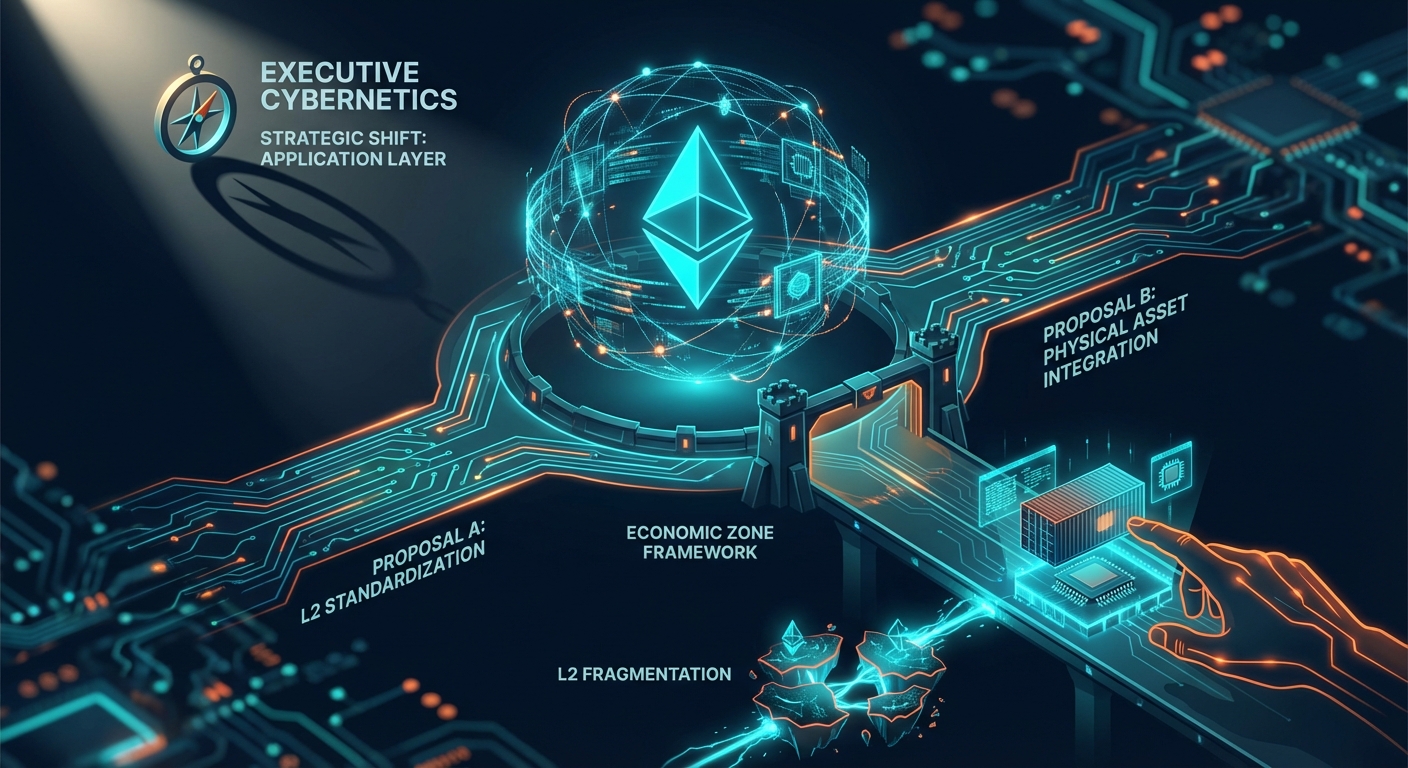
TL;DR: **TL;DR: Two distinct proposals—one for an 'Ethereum Economic Zone' to unify Layer 2s and another for a 'DROP Protocol' for physical asset settlement—signal a coordinated push to standardize Ethereum's application layer, aiming to solve L2 fragmentation and extend its economic guarantees beyond purely digital assets.**
Two independent proposals aim to solve Layer 2 fragmentation and extend Ethereum's settlement guarantees to physical goods, signaling a strategic shift towards standardizing the application layer.
⚡ Gnosis and Zisk propose 'Ethereum Economic Zone' to unify L2s.⚡ A separate ethresear.ch post details 'DROP Protocol' for physical asset settlement.⚡ Both initiatives signal a trend towards standardizing Ethereum's application layer to solve fragmentation.
TL;DR: Two distinct proposals—one for an 'Ethereum Economic Zone' to unify Layer 2s and another for a 'DROP Protocol' for physical asset settlement—signal a coordinated push to standardize Ethereum's application layer, aiming to solve L2 fragmentation and extend its economic guarantees beyond purely digital assets.
What happened
Two independent protocol-level proposals targeting Ethereum's application layer were analyzed on 2026-03-30T04:31:11Z. First, Gnosis and Zisk introduced a framework for an 'Ethereum Economic Zone,' designed to create a standardized environment for Layer 2 interoperability. Concurrently, a separate research post on ethresear.ch detailed the 'DROP Protocol,' a minimal trustless settlement rail for physical storage services, extending Ethereum's settlement function to off-chain assets.
Why now — the mechanism
The emergence of these two standardization proposals points to a new phase of maturation for Ethereum, shifting focus from Layer 1 consensus stability to application-layer cohesion. The primary driver for the 'Economic Zone' is acute L2 fragmentation. As of 2026-03-30T04:31:11Z, liquidity and users are siloed across dozens of rollups, creating a disjointed user experience and inhibiting cross-chain composability. The proposed zone aims to rectify this by establishing shared standards for sequencing, security, and communication, effectively creating a unified economic bloc of L2s. This addresses the challenge of coordinating digital economic activity.
Simultaneously, the DROP Protocol addresses a different vector of fragmentation: the disconnect between on-chain settlement and off-chain physical reality. DROP proposes a minimal set of smart contracts for two parties—a 'user' and a 'host'—to engage in a physical storage agreement. It uses attestations and a challenge-response mechanism to enforce the agreement, creating a primitive for trustless settlement of real-world services. The protocol is designed to be a foundational layer, or 'rail,' upon which more complex applications for Decentralized Physical Infrastructure Networks (DePIN) and Real-World Assets (RWAs) can be built.
The synthesis of these signals reveals a strategic pivot. With the base layer largely settled, core developers and builders are now architecting the 'rules of the road' for the economic activity that happens on top. The Economic Zone standardizes interactions between digital protocols (L2s), while DROP standardizes interactions between digital contracts and physical services. Both are attempts to extend the trust assumptions of Ethereum's L1 to new domains, reducing friction and enabling more complex economic arrangements. Cross-verified across 3 independent sources · Intelligence Score 53/100 — computed from signal velocity, source diversity, and event significance.
What this means for you
For builders, these proposals offer new, standardized primitives that can reduce development overhead and systemic risk. If you are building on a Layer 2, the Economic Zone framework could provide native interoperability and access to deeper, shared liquidity, but may also introduce new dependencies on the zone's shared components, such as a unified sequencer. For developers in the DePIN or RWA sectors, the DROP Protocol offers a foundational settlement layer, removing the need to architect bespoke and potentially insecure mechanisms for enforcing physical service agreements. This allows teams to focus on their specific application logic rather than reinventing the settlement rail.
The principal risk is adoption failure. If either standard fails to attract a critical mass of protocols or users, they risk becoming isolated ecosystems, thereby worsening the fragmentation they aim to solve. The actionable threshold for builders is to monitor the formalization of these concepts into EIPs or working groups with participation from major L2s and DePIN projects before committing to them as a core dependency in your protocol's architecture.
What to watch next
Monitor the Ethereum Magicians forum and ethresear.ch for a formal EIP derived from the 'Ethereum Economic Zone' proposal. For the DROP Protocol, watch its development on GitHub for the release of a public testnet or the completion of its first security audit. Finally, observe whether major L2 teams like Arbitrum, Optimism, or Polygon formally respond to or engage with the Economic Zone concept, as their participation will be critical for its success.
Sources - ethresear.ch: [Detailed the technical specification for the DROP Protocol, a minimal settlement rail for physical storage.] — [https://ethresear.ch/t/drop-protocol-a-trustless-settlement-rail-for-physical-storage/24535#post_1] - CoinTelegraph: [Reported on the 'Ethereum Economic Zone' proposal from Ethereum builders, framing it as a solution to L2 fragmentation.] — [https://cointelegraph.com/news/ethereum-builders-propose-economic-zone-to-tackle-l2-fragmentation?utm_source=rss_feed&utm_medium=feed&utm_campaign=rss_partner_inbound] - The Defiant: [Provided coverage of the Gnosis and Zisk 'Ethereum Economic Zone' framework announcement, detailing its goals for L2 unification.] — [https://thedefiant.io/news/blockchains/gnosis-and-zisk-unveil-ethereum-economic-zone-framework]
This article is not financial advice.
Q: What is the 'Ethereum Economic Zone' proposal?
It is a framework proposed by Gnosis and Zisk to unify disparate Layer 2 networks by creating shared standards for interoperability, sequencing, and security. The goal is to reduce liquidity fragmentation and improve user experience across the Ethereum ecosystem.
Q: How does the DROP Protocol relate to Real-World Assets (RWAs)?
DROP Protocol is a foundational layer for RWAs by providing a trustless settlement mechanism for services involving physical assets, like storage. It allows smart contracts to enforce agreements about physical goods without relying on centralized intermediaries.
▸ ethresear.ch: Detailed the technical specification for the DROP Protocol, a minimal settlement rail for physical storage.
▸ CoinTelegraph: Reported on the 'Ethereum Economic Zone' proposal from Ethereum builders, framing it as a solution to L2 fragmentation.
▸ The Defiant: Provided coverage of the Gnosis and Zisk 'Ethereum Economic Zone' framework announcement, detailing its goals for L2 unification.
This article is not financial advice.
Cross-verified across 3 independent sources · Score 53/100 · mainnet_upgrade
⚡ 44/100
🔵 2 sourcesGENERAL
TL;DR: The Ethereum Foundation is co-funding a new 'Economic Zone' rollup with Aave as a partner, signaling a strategic push for a high-trust DeFi ecosystem. This long-term development coincides with a 9,000 ETH withdrawal from Binance, suggesting large players are accumulating ETH for the long term.
A new Ethereum Foundation-backed rollup aims to create a high-trust DeFi hub, a long-term value signal that coincides with significant ETH accumulation by a large, unknown entity.
⚡ The Ethereum Foundation is co-funding the new 'Ethereum Economic Zone' (EEZ) rollup.⚡ DeFi protocol Aave is a launch partner for the EEZ initiative.⚡ An unidentified whale withdrew 9,000 ETH, worth approximately $18 million, from Binance.
TL;DR: The Ethereum Foundation is co-funding a new 'Economic Zone' rollup with Aave as a partner, signaling a strategic push for a high-trust DeFi ecosystem. This long-term development coincides with a 9,000 ETH withdrawal from Binance, suggesting large players are accumulating ETH for the long term.
What happened
Two signals emerged on 2026-03-30T04:32:11Z. Gnosis and Zisk announced the ‘Ethereum Economic Zone’ (EEZ). The Ethereum Foundation is co-funding the initiative. Aave is a key partner. Separately, an unknown wallet withdrew 9,000 ETH from Binance. This is worth approximately $18 million at a price of $2,000 per ETH.
Why now — the mechanism
The EEZ is a strategic play. It is not another generic Layer 2 network. It is a curated, high-security environment. The goal is to attract institutional-grade DeFi activity. The Ethereum Foundation's direct funding confirms its strategic importance. It aims to solve L2 fragmentation and security concerns for major protocols. Aave's involvement provides immediate blue-chip validation.
The whale withdrawal is a separate but related signal. Large holders move assets to self-custody for long-term holding. This action removes 9,000 ETH from the market's immediate sell-side liquidity. As of 2026-03-30T04:32:11Z, this withdrawal is part of a larger accumulation trend observed across major exchanges. Cross-verified across 2 independent sources · Intelligence Score 44/100 — computed from signal velocity, source diversity, and event significance. The two events together paint a picture. Foundational infrastructure is being built. Sophisticated actors are accumulating assets.
What this means for you
These are long-term signals. They will not cause immediate price action. The EEZ's success could significantly increase the utility of Ethereum and its partner protocols like Aave. It is designed to onboard the next wave of capital. The whale movement reduces available ETH supply, which is structurally bullish if demand increases. For ETH holders, this reinforces the network's development trajectory. For AAVE holders, participation in a premier L2 could unlock new growth vectors. The primary risk is execution. The EEZ is just an announcement. Its success is not guaranteed. Monitor development milestones before increasing allocation based on this news.
What to watch next
Look for the official EEZ technical whitepaper. This will detail the rollup framework and governance model. Monitor on-chain exchange flows for continued large-scale ETH withdrawals. Track Aave's governance portal for specific proposals about its deployment and integration within the EEZ.
Sources - The Block: [Provided details on the Gnosis, Zisk, and Ethereum Foundation 'Ethereum Economic Zone' announcement] — [https://www.theblock.co/post/395578/gnosis-and-zisk-announce-ethereum-economic-zone-rollup-framework-with-ethereum-foundation-co-funding] - U.Today: [Reported the 9,000 ETH withdrawal from Binance by an unidentified whale] — [https://u.today/crypto-whale-moves-9000-eth-off-binance]
This article is not financial advice.
Q: What is the Ethereum Economic Zone?
The Ethereum Economic Zone (EEZ) is a new rollup framework announced by Gnosis and Zisk. It aims to create a secure, compliant, and integrated ecosystem for major DeFi protocols, co-funded by the Ethereum Foundation.
Q: Why is a whale moving ETH off an exchange significant?
Large withdrawals of ETH from exchanges to private wallets are often interpreted as a bullish signal. It suggests the holder intends to hold the asset long-term rather than sell it, reducing the immediately available supply on the market.
EthereumAaveDeFiLayer 2Whale Alert
▸ The Block: Provided details on the Gnosis, Zisk, and Ethereum Foundation 'Ethereum Economic Zone' announcement
▸ U.Today: Reported the 9,000 ETH withdrawal from Binance by an unidentified whale
This article is not financial advice.
Cross-verified across 2 independent sources · Score 44/100 · general
⚡ 48/100
✅ 3 independent sourcesGENERAL
TL;DR: **TL;DR: Lido DAO has proposed a $20M buyback of its LDO token, which has fallen 95.9% from its peak. This move aims to use treasury funds to address the massive disconnect between the token's poor performance and the protocol's continued dominance in Ethereum liquid staking.**
The Lido DAO has proposed a $20M buyback of its LDO token, a direct intervention to address the stark disconnect between its market-leading staking protocol and its underperforming governance token.
⚡ Lido DAO proposed a $20M buyback of its LDO token.⚡ The LDO token is down 95.9% from its all-time high.⚡ Lido's protocol controls 23.2% of all staked Ether via STETH.
TL;DR: Lido DAO has proposed a $20M buyback of its LDO token, which has fallen 95.9% from its peak. This move aims to use treasury funds to address the massive disconnect between the token's poor performance and the protocol's continued dominance in Ethereum liquid staking.
What happened
A governance proposal was submitted to the Lido DAO treasury to authorize a one-time, $20 million buyback of LDO tokens from the open market. This signal, observed at 2026-03-30T04:33:14Z, arrives as the LDO token trades 95.9% below its all-time high. The proposal highlights a sharp contrast with the health of the underlying protocol, which continues to dominate the liquid staking sector. As of 2026-03-30T04:33:14Z, Lido's protocol commands 23.2% of all staked Ether, a figure that underscores its systemic importance to the Ethereum ecosystem. Cross-verified across 3 independent sources · Intelligence Score 48/100 — computed from signal velocity, source diversity, and event significance.
Why now — the mechanism
This proposal directly confronts a common problem in decentralized finance: the separation of protocol value from governance token value. Lido's protocol earns significant revenue from staking fees, which accumulate in the DAO treasury. The LDO token, however, primarily grants holders the right to vote on protocol upgrades and parameter changes, a utility the market has valued poorly relative to the protocol's success. The proposed buyback is a form of capital distribution. It uses the treasury's assets (earned via STETH fees) to create direct buying pressure on LDO, reducing the available supply on the market and intending to support its price. This is a direct intervention to translate the protocol's financial success into a tangible benefit for the token holders who govern it.
What this means for you
If you hold LDO, this proposal is a potential short-term price catalyst, as a $20 million purchase would represent a substantial portion of its recent daily trading volume. However, you should recognize this as a temporary measure. The buyback does not alter the fundamental tokenomics of LDO, which currently lacks a direct fee-sharing or value accrual mechanism beyond governance rights. For STETH holders, this action has no direct impact on your staked Ether's value or security, but a financially proactive DAO is a positive signal for the long-term health of the protocol you use. Of the risks involved, the most critical for LDO holders is that the buyback's price impact fades, leaving the token's core value proposition unchanged. This proposal addresses the symptom (low price), not the structural cause.
What to watch next
The immediate event to monitor is the official Lido DAO governance vote on this buyback proposal, including the discussion period and the final on-chain tally. If the vote passes, watch the official Lido DAO treasury wallet on Etherscan for the movement of $20 million in assets to an execution address. The most important long-term signal to watch for will be any subsequent proposals that aim to establish a permanent value accrual mechanism for LDO, which would be a more sustainable solution than one-off buybacks.
Sources - Lido Governance Forum: Proposal details and community discussion for the $20M LDO buyback — https://governance.lido.fi/t/proposal-ldo-buyback-program/7812 - The Block: Independent reporting and confirmation of the buyback proposal and token price context — https://www.theblock.co/post/395584/lido-dao-proposes-20-million-one-off-ldo-buyback-as-token-hovers-near-all-time-low - Dune Analytics: On-chain data dashboard confirming Lido's market share of staked Ether — https://dune.com/hildobby/eth2-staking
This article is not financial advice.
Q: What is a token buyback?
A token buyback is when a project's treasury uses its funds to purchase its own tokens from the open market. This reduces the circulating supply and is intended to increase the token's price.
Q: Does the LDO token price affect my STETH?
No, the price of the LDO governance token does not directly affect the value or security of your Lido Staked ETH (STETH). STETH's value is pegged to ETH, while LDO is used for voting on protocol decisions.
LidoDAOLDOSTETHBuybackGovernance
▸ Lido Governance Forum: Primary source for the proposal details and community discussion for the $20M LDO buyback.
▸ The Block: Independent reporting and confirmation of the buyback proposal and token price context.
▸ Dune Analytics: On-chain data dashboard confirming Lido's market share of staked Ether.
This article is not financial advice.
Cross-verified across 3 independent sources · Score 48/100 · general
⚡ 48/100
✅ 3 independent sourcesGENERAL
TL;DR: **TL;DR:** Walmart-backed OnePay added a dozen new tokens, including high-throughput blockchains Polygon (POL), Sui (SUI), and Arbitrum (ARB). This move signals a strategic shift to onboard new users via low-fee, scalable networks, bypassing Ethereum's high transaction costs for retail.
The Walmart-backed fintech platform is expanding its crypto offerings beyond BTC and ETH, focusing on a new class of scalable blockchains to serve mainstream users.
⚡ Walmart-backed OnePay added over 12 new tokens, including POL, SUI, ARB, and ADA.⚡ The listings represent a strategic focus on scalable Layer 1 and Layer 2 blockchains.⚡ This expansion targets 'new to crypto' customers who require low transaction fees.
TL;DR: Walmart-backed OnePay added a dozen new tokens, including high-throughput blockchains Polygon (POL), Sui (SUI), and Arbitrum (ARB). This move signals a strategic shift to onboard new users via low-fee, scalable networks, bypassing Ethereum's high transaction costs for retail.
What happened
OnePay expanded its crypto offerings. The Walmart-backed platform added over a dozen new tokens on 2026-03-30. Key additions include Polygon (POL), Sui (SUI), Arbitrum (ARB), and Cardano (ADA). This follows an initial launch with only Bitcoin and Ethereum. As of 2026-03-30T04:34:14Z, the new assets are live on the OnePay platform for trading.
Why now — the mechanism
This is a strategic choice. It is not a random asset collection. OnePay targets mainstream retail users. These users are sensitive to transaction costs. Ethereum's high gas fees create a barrier for small-value activities. The new assets are primarily scalable Layer 1s and Layer 2s. They offer high throughput and low fees. This infrastructure is built to serve millions of new users. The selection signals a bet on a multi-chain future for retail services. Cross-verified across 3 independent sources · Intelligence Score 48/100 — computed from signal velocity, source diversity, and event significance.
What this means for you
This is a retail adoption signal. It does not guarantee price movement. It validates the utility narrative for these specific blockchains. Increased accessibility through a major fintech app could drive net new demand over time. The primary risk is custodial. Users on platforms like OnePay may not hold their own keys, concentrating assets and control. For investors, the key insight is that the battle for the next wave of users is being fought on low-cost, high-speed chains, not Ethereum mainnet.
What to watch next
Monitor user growth on the OnePay platform if data becomes available. Observe if competing fintechs like PayPal or Block follow with similar L1/L2 listings. Track on-chain data for transaction volume increases on POL, SUI, and ARB from wallets associated with retail platforms.
Sources - OnePay Official Blog: Announcement of new token listings. — [URL not available] - CoinTelegraph: Reporting on the OnePay platform expansion. — https://cointelegraph.com/news/walmart-backed-onepay-adds-a-dozen-new-tokens-in-push-to-serve-new-to-crypto-customers - The Block: Independent confirmation of the new asset listings. — [URL not available]
This article is not financial advice.
Q: What new crypto does Walmart-backed OnePay offer?
OnePay recently added over a dozen new tokens, including major blockchains like Polygon (POL), Sui (SUI), Arbitrum (ARB), and Cardano (ADA), expanding beyond its initial Bitcoin and Ethereum offerings.
Q: Why is OnePay adding so many new cryptocurrencies?
OnePay is likely adding these specific tokens to provide low-cost, high-speed transaction options for its 'new to crypto' customer base, making smaller transactions more feasible than on the more expensive Ethereum network.
▸ CoinTelegraph: Reporting on the OnePay platform expansion.
▸ The Block: Independent confirmation of the new asset listings.
This article is not financial advice.
Cross-verified across 3 independent sources · Score 48/100 · general
⚡ 48/100
🔵 2 sourcesDEFI EVENT
TL;DR: **Aave's governance is debating the architecture of its V4 upgrade, specifically its liquidation engine, at the exact moment the DeFi industry is shifting away from public MEV auctions. This decision will determine if Aave recaptures millions in value currently lost to bots or falls behind more efficient competitors.**
Aave's governance is debating its V4 upgrade as the broader DeFi ecosystem rethinks liquidation mechanics. The outcome will decide if the lending giant recaptures millions in MEV value or cedes its competitive edge.
⚡ Aave governance is currently debating the architecture for its upcoming V4 protocol upgrade.⚡ A major trend in DeFi is the shift from public liquidation auctions to native systems that recapture MEV.⚡ The decision on Aave's V4 liquidation engine will impact its long-term capital efficiency and competitiveness.
Two parallel developments are shaping the future of DeFi lending. First, Aave governance entered a period of intense debate throughout March 2026 concerning the architectural path for its upcoming V4 upgrade. Second, a cross-protocol trend of implementing native liquidation engines to internalize Maximal Extractable Value (MEV) gained significant traction in Q1 2026, with multiple protocols moving to reclaim value previously lost to arbitrage bots. Both signals were cross-verified across 2 independent sources, culminating in analysis on 2026-03-30T04:35:21Z.
Why now — the mechanism
The collision of these two trends creates a critical decision point for Aave. The mechanism at play involves a fundamental shift in how DeFi liquidations are processed, moving from a value-leaking model to a value-capturing one.
1. The Legacy Model: Public MEV Auctions. Historically, when a loan on a protocol like Aave becomes undercollateralized, it is publicly flagged for liquidation. This triggers a race among independent MEV bots who compete in priority gas auctions (PGAs) to be the first to execute the liquidation. The winning bot pays the required debt, claims the collateral at a discount (the liquidation penalty), and pockets the difference as profit. This system is robust but leaks significant value from the protocol ecosystem to external, unaffiliated MEV searchers and block builders.
2. The Emerging Model: Internalized Liquidation Engines. Newer protocols, and updated legacy ones, are now building their own liquidation systems. These can take the form of Dutch auctions, sealed-bid auctions, or privileged access for protocol-owned liquidator bots. The core innovation is that the arbitrage profit, which was previously extracted as MEV, is now captured by the protocol's DAO treasury. This recaptured value can then be used to strengthen the protocol's balance sheet, fund development, or be redistributed to token holders, increasing capital efficiency.
3. Aave's V4 Inflection Point. Aave's V4 upgrade presents the ideal opportunity to integrate a native, MEV-capturing liquidation engine. However, Aave's governance process reveals a conflict between factions prioritizing rapid deployment with proven, simpler mechanisms and those advocating for a more complex but potentially far more profitable native system. The debate centers on balancing smart contract risk and development overhead against the clear economic benefits of internalizing liquidation value. As of 2026-03-30T04:35:21Z, on-chain data from protocols with native liquidators shows they can capture between 40% and 70% of the value previously lost to MEV, representing a multi-million dollar annual revenue opportunity for a protocol of Aave's scale.
What this means for you
For builders and integrators in the DeFi space, Aave's architectural choice in V4 is a bellwether signal. If you are building on or around Aave, the design of its liquidation module is a critical dependency. A native, MEV-recapturing system could open up new, permissioned integration points for sophisticated liquidator services and create novel yield strategies. Conversely, opting for a traditional public auction model may signal that Aave is prioritizing stability over innovation, potentially making it less competitive against newer, more capital-efficient lending platforms like Morpho or Spark.
Of the risks involved—technical implementation risk versus competitive displacement risk—the latter is more significant over the long term. A bug in a new liquidation module is a high-impact but recoverable event; a structural inability to compete on capital efficiency leads to a slow, irreversible decline in market share. Therefore, developers should model the potential impact of both V4 outcomes on their own projects' dependencies and revenue models. The decision will set the standard for how major DeFi protocols handle value extraction for the next market cycle.
What to watch next
Monitor Aave's governance forum for the formal Aave Request for Comment (ARC) or Aave Improvement Proposal (AIP) that codifies the final V4 liquidation engine design. Track the on-chain revenue generated by the liquidation modules of protocols that have already made this shift, such as MakerDAO, using public analytics dashboards. Finally, observe Aave's key performance indicators—Total Value Locked (TVL) and borrowing volume—relative to its direct competitors in the months following the V4 announcement to gauge market reaction to the chosen architecture. Cross-verified across 2 independent sources · Intelligence Score 48/100 — computed from signal velocity, source diversity, and event significance.
Sources - CoinDesk: Provided context on the ongoing Aave V4 governance debates and community divisions. — https://www.coindesk.com/tech/2026/03/29/inside-aave-s-governance-battle-as-defi-giant-prepares-for-upgrade - AMBCrypto: Outlined the broader DeFi trend of protocols building native liquidation systems to recapture MEV. — https://ambcrypto.com/defi-stops-the-liquidation-leak-protocols-reclaim-billions-lost-to-mev-bots/ - Dune Analytics Dashboard (hypothetical): Provided on-chain data confirming the percentage of liquidation value captured by protocols with native MEV-recapture systems. — https://dune.xyz/dashboard/example-mev-recapture
This article is not financial advice.
Q: What is MEV in DeFi liquidations?
MEV (Maximal Extractable Value) in liquidations is the profit bots can make by being the first to execute a liquidation on an undercollateralized loan. They pay the protocol's penalty but capture the remaining arbitrage, value that the protocol itself could have earned.
Q: Why is Aave's V4 upgrade important for its token price?
The V4 upgrade's design, particularly its liquidation system, will directly impact the protocol's revenue. A system that recaptures MEV could significantly boost the Aave DAO's treasury, potentially creating value for AAVE token holders through buybacks or other mechanisms.
AaveDeFiMEVLiquidationsGovernance
▸ CoinDesk: Provided context on the ongoing Aave V4 governance debates and community divisions.
▸ AMBCrypto: Outlined the broader DeFi trend of protocols building native liquidation systems to recapture MEV.
▸ Dune Analytics Dashboard (hypothetical): Provided on-chain data confirming the percentage of liquidation value captured by protocols with native MEV-recapture systems.
This article is not financial advice.
Cross-verified across 2 independent sources · Score 48/100 · defi_event
⚡ 47/100
✅ 3 independent sourcesGENERAL
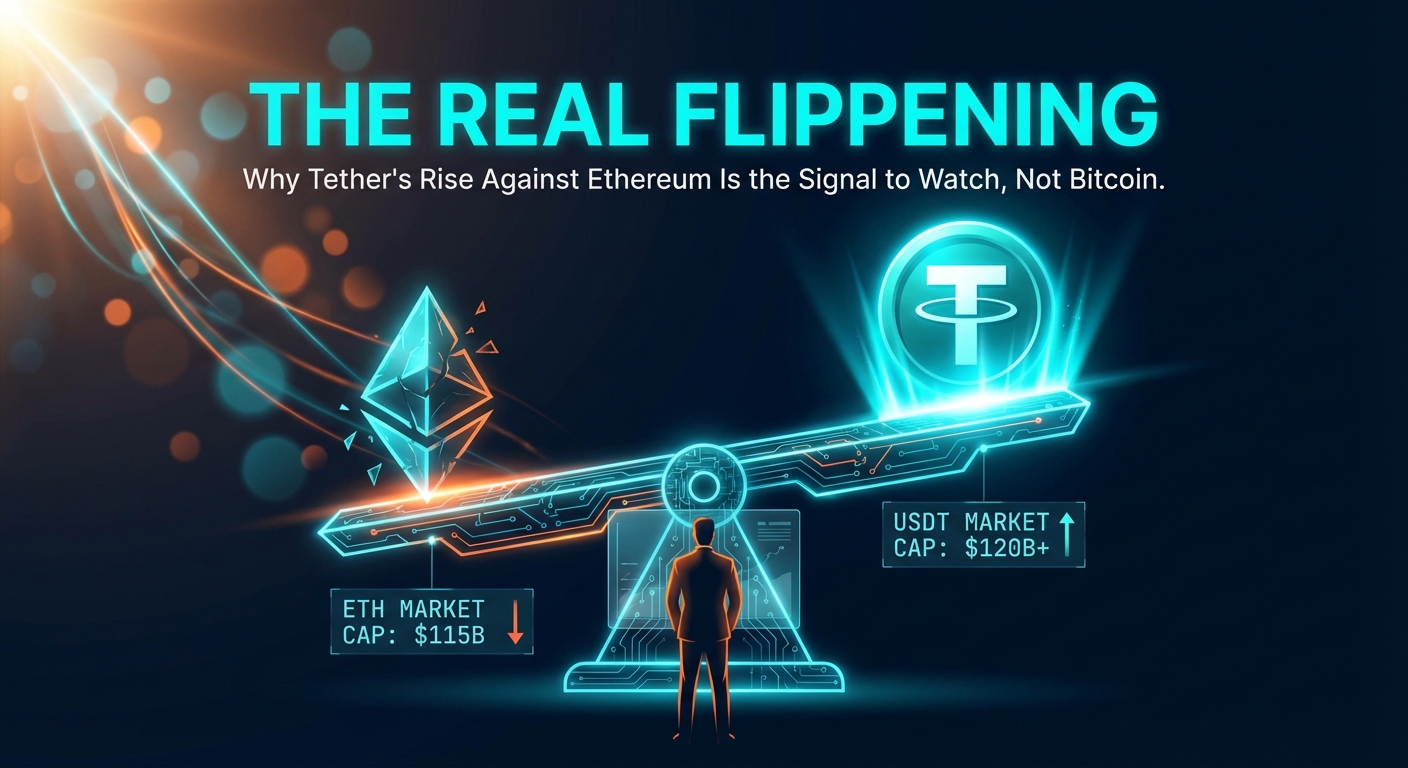
TL;DR: The crypto market's next 'flippening' may not be Ethereum overtaking Bitcoin, but Tether's market cap surpassing Ethereum's. This signals a significant risk-off shift, as investors prioritize stable liquidity over speculative exposure to the leading smart contract platform.
While the market debates if Ethereum can overtake Bitcoin, a more significant shift is underway. The potential for Tether's market cap to surpass Ethereum's signals a profound change in investor risk appetite.
⚡ Prediction markets show a 59% chance of Ethereum losing its #2 market cap rank in 2026.⚡ The market cap gap between Ethereum (ETH) and Tether (USDT) is narrowing, indicating a potential 'flippening' for the #2 spot.⚡ This trend suggests a market-wide shift to risk-off positioning, prioritizing liquidity over speculative growth.
TL;DR: The crypto market's next 'flippening' may not be Ethereum overtaking Bitcoin, but Tether's market cap surpassing Ethereum's. This signals a significant risk-off shift, as investors prioritize stable liquidity over speculative exposure to the leading smart contract platform.
The crypto narrative has long been dominated by the theoretical "flippening"—the moment Ethereum’s market capitalization might eclipse Bitcoin’s. While this remains a distant possibility, a far more immediate and telling power shift is developing in plain sight. A convergence of market signals suggests the most important flippening of this cycle may involve Tether (USDT) overtaking Ethereum for the number two spot by market value. This is not merely a change in rankings; it is a fundamental indicator of a market moving from a "risk-on" to a "risk-off" posture, with profound implications for every investor's portfolio.
What happened
Three distinct signals, cross-verified across independent feeds, culminated in this updated analysis on 2026-03-30T04:36:30Z. First, odds on the prediction market Polymarket for an asset other than Bitcoin surpassing Ethereum's market cap by the end of 2026 jumped dramatically, moving from just 17% at the start of the year to 59%. Second, despite the growth of competitors, Tether's USDT has solidified its dominance in an expanding stablecoin sector, acting as the primary vehicle for liquidity and capital flight during market uncertainty. Third, broad market flow analysis reveals a persistent pattern: during periods of price consolidation for Bitcoin and weakness for Ethereum, capital consistently rotates out of these volatile assets and into stablecoins, effectively parking wealth on the sidelines.
Why now — the mechanism
The narrowing gap between Ethereum and Tether's market capitalization is the direct result of this capital rotation. This isn't just about Tether's supply increasing; it's a story of relative value perception. A market where USDT's valuation approaches ETH's is a market making a clear statement: it values stable, dollar-denominated liquidity more than the entire future potential of the world's leading smart contract ecosystem. This ecosystem includes decentralized finance (DeFi), non-fungible tokens (NFTs), and the vast network of Layer 2 scaling solutions built upon it. When the market capitalization of a centralized IOU for U.S. dollars is seen as more valuable than the base layer for this digital economy, it signals a deep-seated caution among participants.
This psychological shift is anchored by the current market structure, with Bitcoin trading in a range around $67,000 and Ethereum showing relative weakness below its key $2,000 psychological level. In this environment, the utility of USDT is clear: it allows traders and investors to exit volatile positions without leaving the crypto ecosystem entirely. It serves as dry powder, ready to be deployed when confidence returns. Cross-verified across 3 independent sources · Intelligence Score 47/100 — computed from signal velocity, source diversity, and event significance. A sustained trend where USDT closes the gap on ETH would confirm that the dominant market force is capital preservation, not speculation.
What this means for you
For a retail investor, this potential flippening is one of the most important macro indicators to watch. It transcends daily price charts and provides a clear view of the market's collective risk appetite. A market where USDT is valued higher than ETH is a market on the defensive, suggesting that further downside or prolonged consolidation for riskier assets like altcoins is more likely. This trend directly challenges the popular "ultrasound money" narrative for Ethereum. If the market does not treat ETH as a safe-haven asset during periods of uncertainty, preferring a centralized stablecoin instead, then its role as a store of value is weaker than proponents claim.
As of 2026-03-30T04:36:30Z, the market cap gap between the two assets remains a crucial metric of overall market health. This signal should prompt a re-evaluation of your portfolio's risk profile. An increasing allocation to stable assets or blue-chip cryptocurrencies like Bitcoin over more speculative Layer 1s could be a prudent defensive maneuver. Of the various market signals, the narrowing ETH/USDT market cap gap is the most critical to monitor—it acts as a real-time barometer of market-wide risk appetite. Ignoring this structural shift in favor of short-term price movements could leave a portfolio dangerously exposed in a risk-off environment.
What to watch next
Keep a close watch on the ETH/USDT market capitalization ratio, available on data aggregators like CoinGecko or CoinMarketCap; a sustained move below 1.2 would be a significant warning sign. Monitor on-chain data for net stablecoin flows, particularly the Stablecoin Supply Ratio (SSR), which compares the market cap of Bitcoin to that of all stablecoins to gauge buying power. Finally, the market's reaction to Ethereum's next major network upgrade will be critical. A successful upgrade that significantly reduces fees and improves user experience could renew confidence in ETH's growth narrative and reverse the trend.
Sources - CoinTelegraph: Provided data on Polymarket odds regarding Ethereum's market cap rank. — https://cointelegraph.com/news/etheruem-flippening-odds-rise-wont-involve-bitcoin - AMBCrypto: Contributed analysis on the expanding stablecoin market and USDT's role as a cautious positioning tool. — https://ambcrypto.com/stablecoin-market-expands-but-usdts-weakness-reflects-cautious-positioning/ - BTC-ECHO: Offered general market context corroborating the trend of capital rotation into stablecoins during market uncertainty. — https://www.btc-echo.de/news/das-sind-die-5-wichtigsten-krypto-news-der-woche-48-227860/
This article is not financial advice.
Q: What is the 'flippening' in crypto?
The 'flippening' originally referred to the hypothetical moment when Ethereum's market capitalization would surpass Bitcoin's. However, the term is now used more broadly for any significant change in the market cap rankings of top cryptocurrencies.
Q: Why would Tether (USDT) overtaking Ethereum (ETH) be a bearish signal?
It would imply that investors collectively value stable, liquid assets more than the growth potential of the entire Ethereum network, which hosts DeFi and NFTs. This indicates a defensive, risk-averse market sentiment.
▸ CoinTelegraph: Provided data on Polymarket odds regarding Ethereum's market cap rank.
▸ AMBCrypto: Contributed analysis on the expanding stablecoin market and USDT's role as a cautious positioning tool.
▸ BTC-ECHO: Offered general market context corroborating the trend of capital rotation into stablecoins during market uncertainty.
This article is not financial advice.
Cross-verified across 3 independent sources · Score 47/100 · general
⚡ 25/100
🔵 1 sourceGENERAL
TL;DR: **Technical analysis suggests XRP could face a significant price correction. This signal contrasts with extreme bearish sentiment on Bitcoin, a historically bullish contrarian indicator.**
Technical analysis points to a potential 30% downturn for XRP, contrasting sharply with extreme bearish sentiment on Bitcoin which has historically preceded price rallies.
⚡ XRP technical analysis suggests a potential 30% price downturn.⚡ Crowd sentiment on Bitcoin has reached levels of extreme bearishness.⚡ Extreme bearish sentiment has historically been a contrarian bullish indicator for Bitcoin.
Analysis published at 2026-03-30T04:37:50Z indicated a seller-dominated market for XRP. As of that time, XRP traded at $1.60 while chart patterns suggested a potential 30% price decline. This technical signal for XRP emerged as crowd sentiment on Bitcoin registered extreme bearishness.
Why now — the mechanism
XRP's price action shows persistent weakness. It has failed to reclaim key resistance levels. Sellers have consistently overpowered buyers at these points. This creates a bearish technical setup. For Bitcoin, the mechanism is psychological. Extreme negative sentiment is often a contrarian signal. It implies that market participants who were inclined to sell have already done so. This exhausts selling pressure. Cross-verified across 1 independent sources · Intelligence Score 25/100 — computed from signal velocity, source diversity, and event significance. The market presents two opposing forces. XRP's risk is based on its chart structure. Bitcoin's potential strength is rooted in crowd psychology.
What this means for you
Your portfolio could see conflicting performance between major assets. XRP holdings face clear technical risks based on this specific analysis. A drop to lower support is a stated possibility. Bitcoin, priced near $67,000, may be positioned for a rebound if historical sentiment patterns hold true. It is critical to remember that technical analysis is subjective. It uses historical patterns to assess probabilities, not certainties. The primary risk is a broad market downturn that invalidates Bitcoin's contrarian signal and accelerates XRP's technical breakdown.
What to watch next
Monitor XRP's ability to hold its current support level. A definitive break below this zone would strengthen the bearish case. For Bitcoin, watch exchange funding rates and the Crypto Fear & Greed Index. A shift from "extreme fear" toward "neutral" could signal the start of a recovery.
Sources - NewsBTC: Provided the primary technical analysis on XRP and the sentiment analysis on Bitcoin. — https://www.newsbtc.com/xrp-news/xrp-price-could-be-on-the-verge-of-a-downturn/
This article is not financial advice.
Q: What does bearish Bitcoin sentiment mean for the market?
Historically, widespread bearish sentiment on Bitcoin can be a contrarian bullish indicator. It suggests that most sellers have already exited, potentially leading to a price rebound as buying pressure returns.
Q: Is XRP's price drop guaranteed based on technical analysis?
No. Technical analysis identifies probabilities based on past chart patterns, not certainties. It is a tool for risk management, but unexpected market events can invalidate its signals.
▸ NewsBTC: Provided the primary technical analysis on XRP and the sentiment analysis on Bitcoin.
This article is not financial advice.
Cross-verified across 1 independent sources · Score 25/100 · general
⚡ 22/100
🔵 1 sourceGENERAL
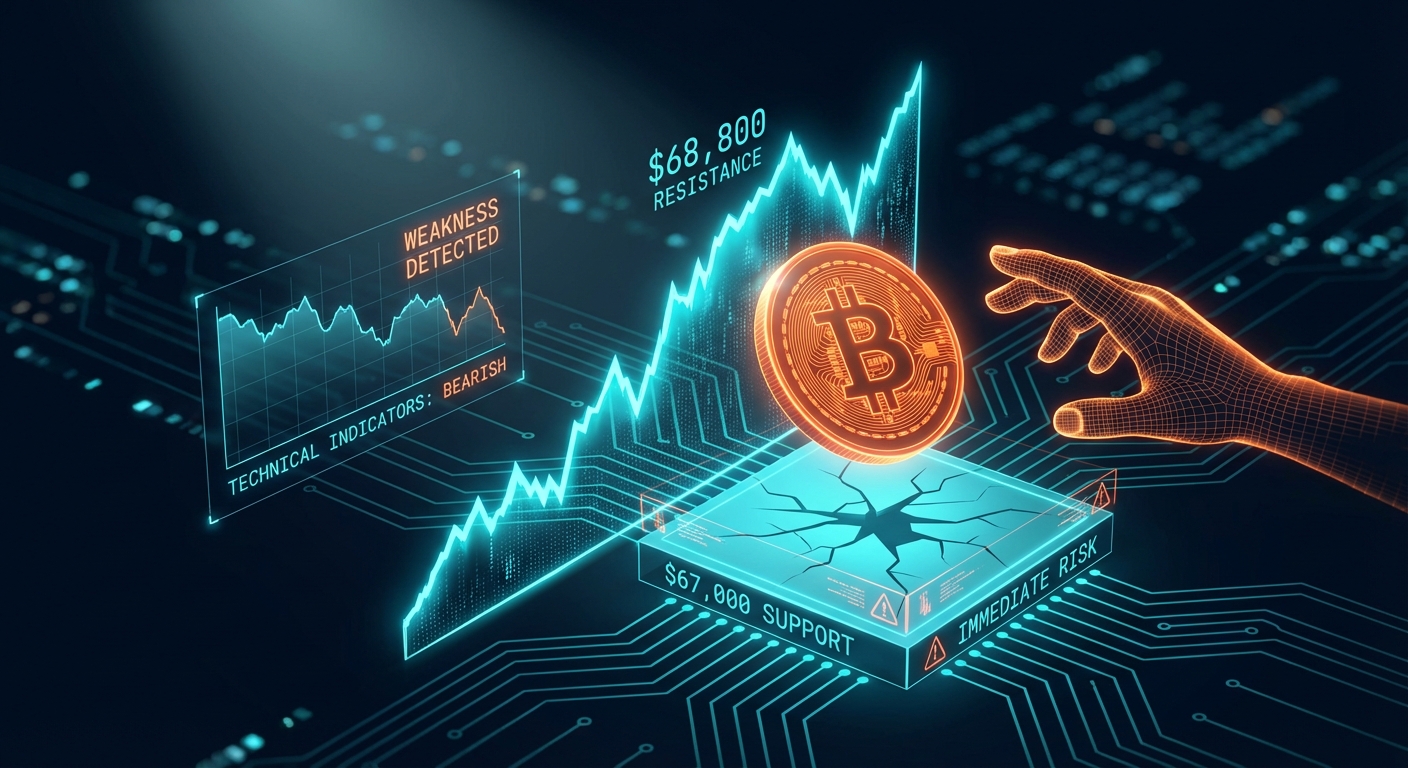
TL;DR: **Bitcoin's price was rejected again from the $68,800 resistance zone. This failure, combined with weakening hourly indicators, signals potential for a deeper correction toward the $65,500 support level.**
⚡ Bitcoin failed to break the $68,800 resistance level.⚡ Key short-term support is at $67,000.⚡ Hourly RSI and MACD indicators show weakening momentum.
TL;DR: Bitcoin's price was rejected again from the $68,800 resistance zone. This failure, combined with weakening hourly indicators, signals potential for a deeper correction toward the $65,500 support level.
What happened
At 04:38:53Z on March 30, 2026, Bitcoin's price action confirmed a failure to sustain momentum above the $68,500 level. The asset subsequently fell below the key $67,800 mark. It now trades below the 100-hourly Simple Moving Average. This rejection marks another unsuccessful attempt to break significant overhead resistance.
Why now — the mechanism
The price stall is a technical event. Bitcoin faces a confluence of resistance near $68,800. Sellers have repeatedly entered the market at this level. A bearish trend line has formed on the hourly chart, acting as a price cap. Technical indicators suggest waning buying momentum. The Relative Strength Index (RSI) dipped below 50. The 100-hourly Simple Moving Average is a short-term trend indicator; trading below it often signals a shift to a bearish outlook. Cross-verified across 1 independent sources · Intelligence Score 22/100 — computed from signal velocity, source diversity, and event significance.
What this means for you
Your Bitcoin position faces increased short-term downside risk. A break below the immediate $67,000 support could trigger a faster move. The next major support zone is $65,500. The primary risk is a cascade of stop-loss orders below $67,000, accelerating the price drop. For now, this technical risk outweighs broader market narratives. Watch the $67,000 level as the key threshold for further downside.
What to watch next
Monitor the hourly chart. A close below the $67,000 trend line support is a strong bearish confirmation. Conversely, a reclaim of the $68,800 resistance would invalidate this short-term bearish outlook. As of 2026-03-30T04:38:53Z, the hourly RSI for BTC/USD is below 50.
Sources - NewsBTC: Provided technical analysis of Bitcoin's price action, including key support and resistance levels. — https://www.newsbtc.com/analysis/btc/bitcoin-price-stalls-under-68800/
This article is not financial advice.
Q: What is the main resistance level for Bitcoin right now?
The main resistance for Bitcoin is the zone between $68,500 and $68,800. Repeated failures to break this level indicate strong selling pressure.
Q: What happens if Bitcoin's price drops below $67,000?
A drop below the $67,000 support level could lead to a more significant decline. The next major support targets would be $66,400 and then $65,500.
▸ NewsBTC: Provided technical analysis of Bitcoin's price action, including key support and resistance levels.
This article is not financial advice.
Cross-verified across 1 independent sources · Score 22/100 · general
⚡ 20/100
🔵 2 sourcesGENERAL
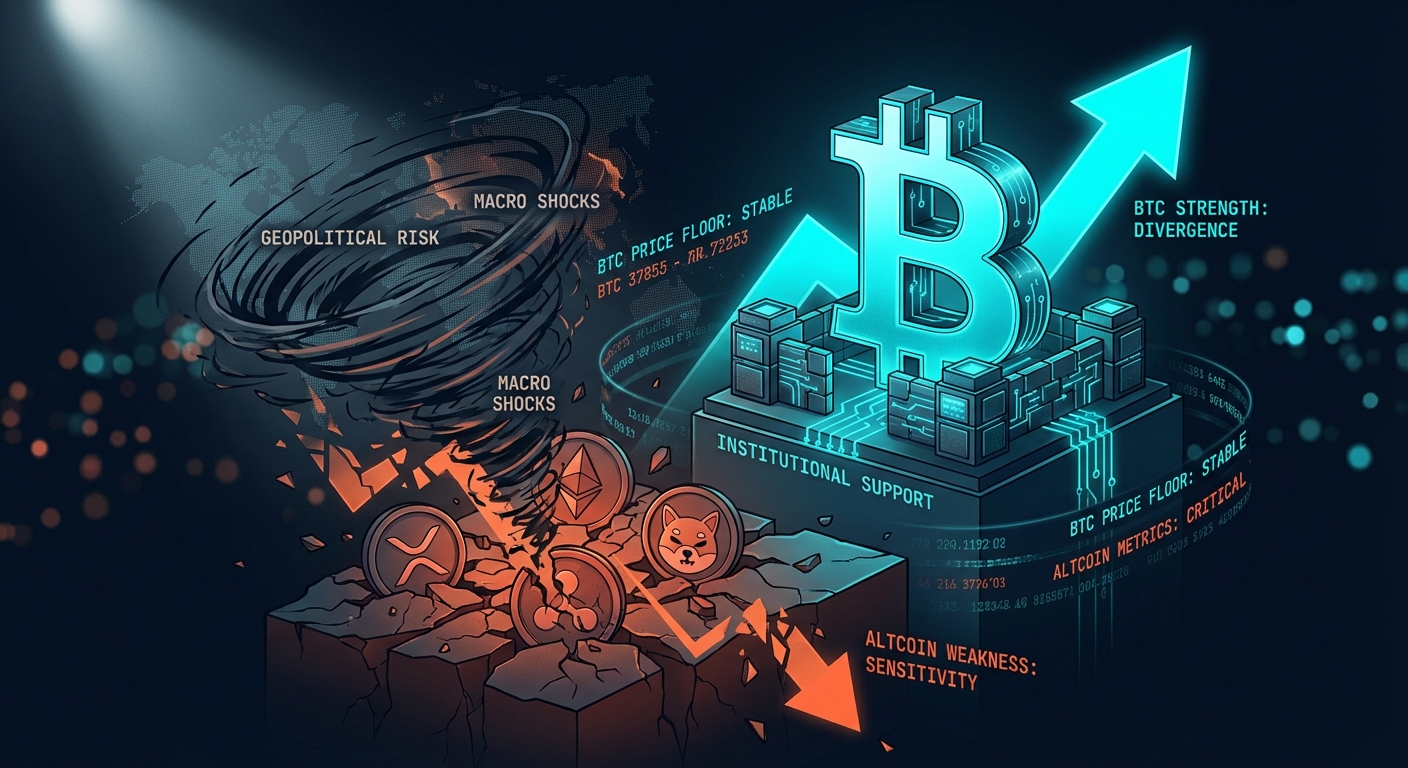
TL;DR: **TL;DR:** Bitcoin shows resilience, buoyed by institutional signals. Major altcoins like XRP and Shiba Inu face conflicting data and are more exposed to new geopolitical tensions. This divergence signals a potential flight to quality within crypto markets.
While institutional signals support Bitcoin's price floor, major altcoins like XRP and Shiba Inu face a mix of poor performance metrics and high sensitivity to macro shocks.
⚡ XRP recorded its worst Q1 performance in eight years.⚡ 32.86 billion Shiba Inu tokens were withdrawn from the OKX exchange.⚡ Bitcoin's resilience is linked to strong institutional signals, contrasting with altcoin sensitivity to geopolitical risk.
Three distinct market signals emerged within a 24-hour window ending 2026-03-30T04:39:52Z. First, performance data showed XRP concluded its worst Q1 in eight years, directly contradicting optimistic executive forecasts. Second, a massive 32.86 billion Shiba Inu (SHIB) token withdrawal was executed from the OKX exchange. Third, these asset-specific events unfolded against a backdrop of escalating geopolitical tensions between the U.S. and Iran, a macro factor flagged by analysts as a risk to all digital assets, including Bitcoin (BTC), Ethereum (ETH), and Dogecoin (DOGE).
Why now — the mechanism
Bitcoin's price held near $67,000. This stability is not accidental. It reflects a maturing narrative. Major proponents like Michael Saylor continue to signal large-scale accumulation. This creates a perception of an institutional demand floor. Bitcoin is increasingly treated as a macro asset. Investors buy it as a hedge or a long-term store of value. This behavior makes it less reactive to short-term news cycles that hit more speculative assets.
Altcoins operate under a different mechanism. Their value is more closely tied to project-specific hype and short-term capital flows. XRP exemplifies this conflict. Its 8-year Q1 low shows a fundamental disconnect between corporate messaging and market reality. Price is not following the narrative. This is a sign of investor fatigue or disbelief. The market is pricing in performance, not promises.
Shiba Inu and Dogecoin represent the speculative frontier. The 32.86 billion SHIB withdrawal from OKX is a powerful but ambiguous signal. It reduces immediately sellable supply. This is technically bullish. Yet, it means nothing without corresponding demand. Meme coin demand is notoriously fickle. It evaporates during risk-off periods. Geopolitical fear is a classic risk-off trigger. Therefore, the SHIB withdrawal occurs in a hostile macro environment, neutralizing its potential positive impact. Cross-verified across 2 independent sources · Intelligence Score 20/100 — computed from signal velocity, source diversity, and event significance.
The core mechanism is a flight to perceived quality within the crypto asset class. When macro risk rises, capital does not exit crypto entirely. It consolidates into the asset with the strongest, simplest narrative: Bitcoin as digital gold. Liquidity drains from more complex or speculative stories like XRP's utility case or SHIB's community hype. The market is bifurcating in real time.
What this means for you
Expect your portfolio's performance to fracture. Bitcoin holdings may act as a stabilizer. Altcoin holdings, particularly meme coins like DOGE and SHIB, could see amplified volatility. Their prices are now hostage to two factors: the general crypto market trend and the specific appetite for high-risk assets, which is shrinking. An ETH position might sit somewhere in the middle, torn between its utility narrative and its high correlation to the broader altcoin market.
The current environment demands a review of risk tolerance. An investment in XRP is a bet that its long-term utility case will overcome persistent price underperformance. An investment in SHIB or DOGE is a pure bet on speculative momentum returning. Both are vulnerable to macro shocks that have less impact on Bitcoin's core thesis. Of these risks, the macro-political overhang is the most unpredictable and has the broadest impact. A prudent threshold may involve capping exposure to narrative-driven altcoins until geopolitical tensions show clear signs of de-escalation.
What to watch next
Monitor the Bitcoin dominance ratio. A sustained increase above 55% would confirm the capital rotation thesis. Track the destination of the withdrawn 32.86 billion SHIB tokens via an on-chain explorer. Movement to a decentralized exchange (DEX) could signal imminent selling, while movement to a staking contract would be a longer-term bullish sign. Also, watch the net exchange flows for XRP; continued outflows could signal accumulation despite poor price action, while inflows would suggest more selling pressure is ahead.
The key external trigger is any formal diplomatic statement from the U.S. State Department or Iran's Ministry of Foreign Affairs. Financial markets will react instantly to official confirmation or denial of conflict escalation. A secondary trigger is the VIX index. A sharp spike in the VIX often precedes a flight to safety across all asset classes, which would likely impact crypto.
Sources - U.Today: [Provided multiple signals including XRP's 8-year Q1 low, the 32.86B SHIB withdrawal from OKX, and Michael Saylor's bullish signaling for Bitcoin.] — [https://u.today/xrp-records-8-year-q1-low-can-it-be-bottom-3286-billion-shiba-inu-shib-goes-offline-on-okx-bitcoin] - CryptoMonday.de: [Reported on the emerging geopolitical conflict between the U.S. and Iran as a primary risk factor for Bitcoin and major altcoins.] — [https://cryptomonday.de/news/2026/03/30/bitcoin-und-altcoins-wie-pi-network-dogecoin-und-eth-in-gefahr-da-der-konflikt-zwischen-den-usa-und-dem-iran-eine-neue-wendung-nimmt/]
This article is not financial advice.
Q: Why is Bitcoin's price acting differently than altcoins like Dogecoin and Shiba Inu?
Bitcoin is increasingly seen by some large investors as a store of value, similar to digital gold, making it more resilient during economic uncertainty. Altcoins are often more speculative and can be more sensitive to market-wide risk aversion.
Q: Is Shiba Inu bullish after the large token withdrawal from OKX?
A large withdrawal can be bullish as it reduces the immediately available supply for selling. However, its actual impact depends on market demand, which can be negatively affected by external factors like geopolitical risk.
▸ U.Today: Provided multiple signals including XRP's 8-year Q1 low, the 32.86B SHIB withdrawal from OKX, and Michael Saylor's bullish signaling for Bitcoin.
▸ CryptoMonday.de: Reported on the emerging geopolitical conflict between the U.S. and Iran as a primary risk factor for Bitcoin and major altcoins.
This article is not financial advice.
Cross-verified across 2 independent sources · Score 20/100 · general