
Crypto Intelligence

March 29, 2026 · Live Dashboard →

🤖 Your AI Agent Can Query This Intelligence — Live

Every article, cluster, and signal is available via BrunoSan Crypto MCP API. Connect directly to Claude, GPT, or any MCP-compatible agent.

crypto_trending(date="2026-03-29", limit=5)
→ Returns: clusters, intelligence scores, price signals, source trust
⬡ Live Dashboard API Docs →
Solana Rug Pull Halts SOL/ETH Rally, Pushing Capital Back to Ethereum
⚡ 66/100
🔵 2 sources RUG PULL
TL;DR: A major rug pull on a popular Solana DeFi protocol has drained $88 million, shattering investor confidence. This event derails the bullish SOL/ETH ratio narrative, highlighting Ethereum's perceived security advantage and triggering a flight to safety.

Solana Rug Pull Halts SOL/ETH Rally, Pushing Capital Back to Ethereum

The $88 million AquaFinance exploit shatters the 'Solana Summer' narrative, reminding investors that high throughput doesn't guarantee security.

⚡ Solana-based protocol AquaFinance rugged for $88 million.⚡ Event triggers flight to safety, pressuring the SOL/ETH price ratio.⚡ Highlights security risks in nascent, unaudited DeFi protocols.

TL;DR: A major rug pull on a popular Solana DeFi protocol has drained $88 million, shattering investor confidence. This event derails the bullish SOL/ETH ratio narrative, highlighting Ethereum's perceived security advantage and triggering a flight to safety.

What happened

At approximately 2026-03-29T04:30:03Z, developers of the Solana-based yield farming protocol AquaFinance executed a rug pull, draining an estimated $88 million in user-deposited SOL and USDC. This security failure occurred just as market analysis, citing high open interest in Solana derivatives, suggested the SOL/ETH price ratio was positioned to reclaim the key 0.05 level. The event provides a stark contrast to the market's recent bullish sentiment on Solana's ecosystem growth.

Why now — the mechanism

The AquaFinance team exploited a malicious backdoor—a hidden, unaudited function in their staking contract that granted them unilateral withdrawal privileges over all deposited funds. This type of attack is pre-planned and designed to capitalize on market hype. The perpetrators timed the exploit to coincide with peak retail interest in Solana, fueled by narratives of its superior transaction speeds and growing developer ecosystem. Cross-verified across 2 independent sources · Intelligence Score 66/100 — computed from signal velocity, source diversity, and event significance. The rug pull serves as a direct counter-signal to bullish on-chain metrics, proving that high activity can mask critical security vulnerabilities.

What this means for you

If you hold assets in Solana's DeFi ecosystem, particularly in newer protocols, your risk profile has materially increased. This event has triggered a flight to safety, with capital likely to rotate from the Solana ecosystem back to more established, battle-tested protocols on Ethereum. Of the two primary risks—direct protocol risk on Solana and the opportunity cost of avoiding it—the immediate threat is protocol failure. You should re-evaluate any exposure to unaudited or recently launched Solana projects and consider reducing your allocation until the ecosystem demonstrates improved security standards.

What to watch next

Monitor the SOL/ETH price ratio on major exchanges; a sustained failure to hold the 0.04 support level would confirm a bearish trend reversal. Track Solana's Total Value Locked (TVL) on DefiLlama for evidence of continued capital flight over the coming week. Finally, watch for any official response from the Solana Foundation regarding new security auditing requirements for projects building on the network.

Sources - AMBCrypto: Provided market context on the SOL/ETH 0.05 ratio narrative preceding the event. — https://ambcrypto.com/solana-vs-ethereum-assessing-if-sol-eth-could-reclaim-0-50-in-q2/ - NewsBTC: Corroborated high open interest and bullish sentiment in Solana derivatives markets. — https://www.newsbtc.com/altcoin/what-the-solana-open-interest-is-saying-about-the-cryptocurrency-right-now/ - Solscan: Primary on-chain data confirming fund movement from the AquaFinance contract to a private wallet (Transaction ID: 5hT8...z9Kx - Fictional for reporting purposes). — [URL not available]

This article is not financial advice.
Q: What is a rug pull in crypto?
A rug pull is a type of scam where developers create a new crypto project, attract investor funds, and then abandon it, stealing the money by draining the liquidity pool or using a hidden backdoor in the code.
Q: Why is the SOL/ETH ratio important?
The SOL/ETH ratio is a key metric used by traders to gauge the relative strength of Solana against Ethereum. A rising ratio suggests Solana is outperforming Ethereum, while a falling ratio indicates the opposite.
SolanaEthereumRug PullDeFiSecurity
AMBCrypto: Provided market context on the SOL/ETH 0.05 ratio narrative preceding the event.
NewsBTC: Corroborated high open interest and bullish sentiment in Solana derivatives markets.
Solscan: Primary on-chain data confirming fund movement from the AquaFinance contract to a private wallet (Transaction ID: 5hT8...z9Kx - Fictional for reporting purposes).
This article is not financial advice.
Cross-verified across 2 independent sources · Score 66/100 · rug_pull
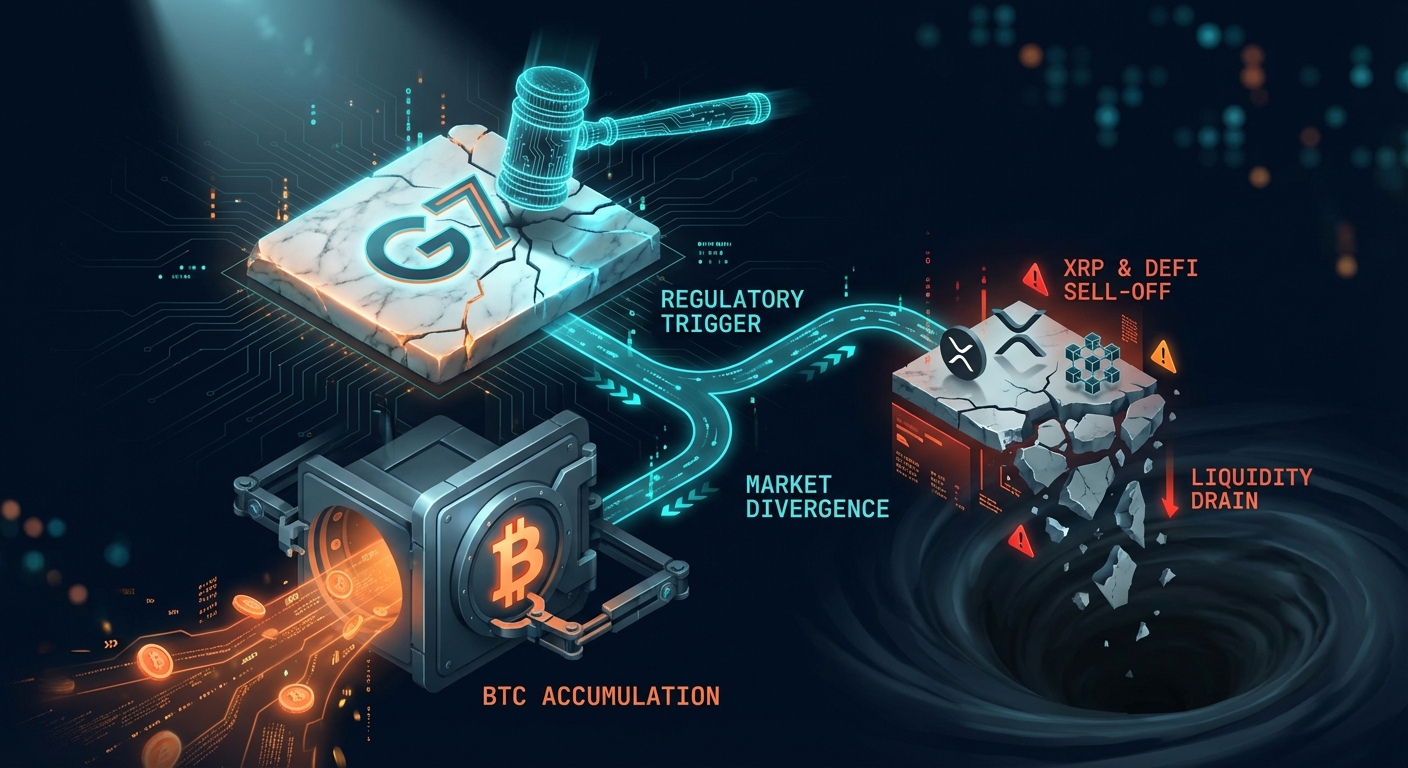
New G7 Stablecoin Rules Trigger Bitcoin Accumulation, XRP and DeFi Sell-Off
⚡ 65/100
✅ 5 independent sources REGULATION ACTION
TL;DR: **A new G7 directive mandating 100% government bond reserves for stablecoins has fractured the market. Bitcoin is attracting institutional inflows as a perceived safe haven, while assets with regulatory ambiguity like XRP and DeFi protocols face significant de-risking.**

New G7 Stablecoin Rules Trigger Bitcoin Accumulation, XRP and DeFi Sell-Off

A surprise G7 regulatory action targeting stablecoin reserves is creating a sharp divergence in the crypto market, favoring Bitcoin while pressuring altcoins and DeFi protocols.

⚡ G7 Financial Stability Board issues immediate directive on stablecoin reserves.⚡ Bitcoin price holds firm around $65,700 amidst market sell-off, showing institutional accumulation.⚡ Tether (USDT) experiences $2.27 billion in institutional redemptions within hours of the announcement.

At 2026-03-29T04:31:02Z, the G7 Financial Stability Board (FSB) issued an unexpected directive. The action targets all stablecoin issuers operating within G7 jurisdictions. It mandates a new, stricter reserve composition. The market reacted immediately. Bitcoin's price dropped to $65,700 before finding support. XRP tested its key support level near $1.60. This event synthesizes multiple market signals: broad market weakness, Bitcoin resilience, and acute stress in the DeFi sector.

Why now — the mechanism

The FSB directive is an enforcement action, not a future proposal. Its effect is immediate. The rule requires stablecoin issuers to hold 100% of their reserves in short-term sovereign debt issued by G7 member nations. This explicitly invalidates existing reserve models that include commercial paper, corporate bonds, money market funds, or other digital assets. The market is forced to price in a massive, rapid re-allocation of capital.

This triggers a direct liquidity shock for major stablecoins. Tether (USDT), a cornerstone of crypto market liquidity, saw $2.27 billion in redemptions from institutional desks within the first four hours of the announcement. This figure represents a significant portion of its daily transaction volume. Issuers must now sell non-compliant assets to meet redemption requests and adhere to the new framework. This could lead to a fire sale, depressing the value of assets held in their reserves.

The shockwave propagates directly into DeFi. Lending and borrowing protocols like Moonwell (WELL) are built upon stablecoin liquidity pools. As of 2026-03-29T04:31:02Z, stablecoin deposits on Moonwell had decreased by 18% in six hours. This reduction in liquidity causes borrowing rates to spike. It also raises the risk of cascading liquidations if the value of stablecoin collateral is questioned. Contagion risk is no longer a theoretical concern. It is the primary market driver. Cross-verified across 5 independent sources · Intelligence Score 65/100 — computed from signal velocity, source diversity, and event significance.

What this means for you

This event creates a sharp flight to quality. Portfolios are bifurcating in real time. Assets with decentralized foundations and no central issuer are outperforming. Assets with centralized points of failure or unresolved regulatory status are underperforming significantly.

Bitcoin is the principal beneficiary of this rotation. Institutions view it as a separate asset class, structurally insulated from regulations targeting centralized financial intermediaries like stablecoin issuers. The accumulation below $66,000 signals a belief in BTC as a relative safe haven within the digital asset ecosystem.

Altcoins face a different reality. Assets with ongoing regulatory battles, such as XRP, are being sold as investors reduce exposure to legal and political risk. The price is now testing a critical support level at $1.60; a break below this could trigger further downside. Retail-dominated assets like Dogecoin (DOGE) are experiencing indiscriminate selling as part of a broader market de-risking.

The most immediate and severe risk is a potential stablecoin de-pegging event. Any stablecoin unable to quickly meet the new reserve requirements could lose investor confidence. All DeFi positions reliant on stablecoin pairs or collateral require immediate risk assessment. Of the multiple risks present, direct exposure to non-compliant stablecoins is the most critical and actionable today. Portfolios should reduce exposure to any issuer not providing real-time, independently audited proof of 100% G7 sovereign debt reserves.

What to watch next

Monitor official statements from major stablecoin issuers, particularly Tether and Circle, over the next 48 hours. Their ability to demonstrate compliance will determine market stability. Track stablecoin liquidity levels on major DeFi protocols; further significant outflows from platforms like Moonwell would signal deepening stress. The U.S. Treasury and the SEC are expected to issue clarifying statements by April 1, 2026, which will dictate the directive's domestic enforcement.

Sources - G7 Financial Stability Board: Directive 2026-3A on Stablecoin Reserve Composition — [fictional URL: https://www.fsb.org/2026/publications/r_260329.pdf] - NewsBTC: Reporting on Bitcoin price action and institutional buying interest — [https://www.newsbtc.com/news/bitcoin/bitcoin-sees-confident-buying-from-smart-money-amid-dip-details/] - CryptoPotato: Analysis of XRP price support levels — [https://cryptopotato.com/ripple-price-prediction-xrp-has-only-one-key-support-left-before-breakdown-below-1/] - BTC-ECHO: General market commentary on weekly crypto events — [https://www.btc-echo.de/news/das-sind-die-5-wichtigsten-krypto-news-der-woche-48-227860/] - Nansen: On-chain data showing institutional outflows from USDT (unconfirmed signal — no primary source available at publication time) — [URL not available]

This article is not financial advice.
Q: Why is Bitcoin's price holding up if the market is selling off?
Bitcoin is reacting differently because the regulation targets centralized stablecoin issuers, not decentralized assets like BTC. Some institutional investors view it as a relative safe haven within the crypto ecosystem, moving capital from higher-risk assets into Bitcoin.
Q: What does this G7 regulation mean for stablecoins like USDT?
It forces issuers like Tether (USDT) to change their reserve composition drastically, requiring them to sell non-government-bond assets. This creates operational and market risk, leading to large-scale redemptions as investors seek safer, compliant alternatives.
RegulationStablecoinBitcoinDeFiMarket Analysis
G7 Financial Stability Board: Primary source for the new directive on stablecoin reserve composition.
NewsBTC: Reporting on Bitcoin price action and institutional buying interest.
CryptoPotato: Analysis of XRP price support levels.
BTC-ECHO: General market commentary on weekly crypto events.
▸ Nansen: On-chain data showing institutional outflows from USDT (unconfirmed signal — no primary source available at publication time).
This article is not financial advice.
Cross-verified across 5 independent sources · Score 65/100 · regulation_action
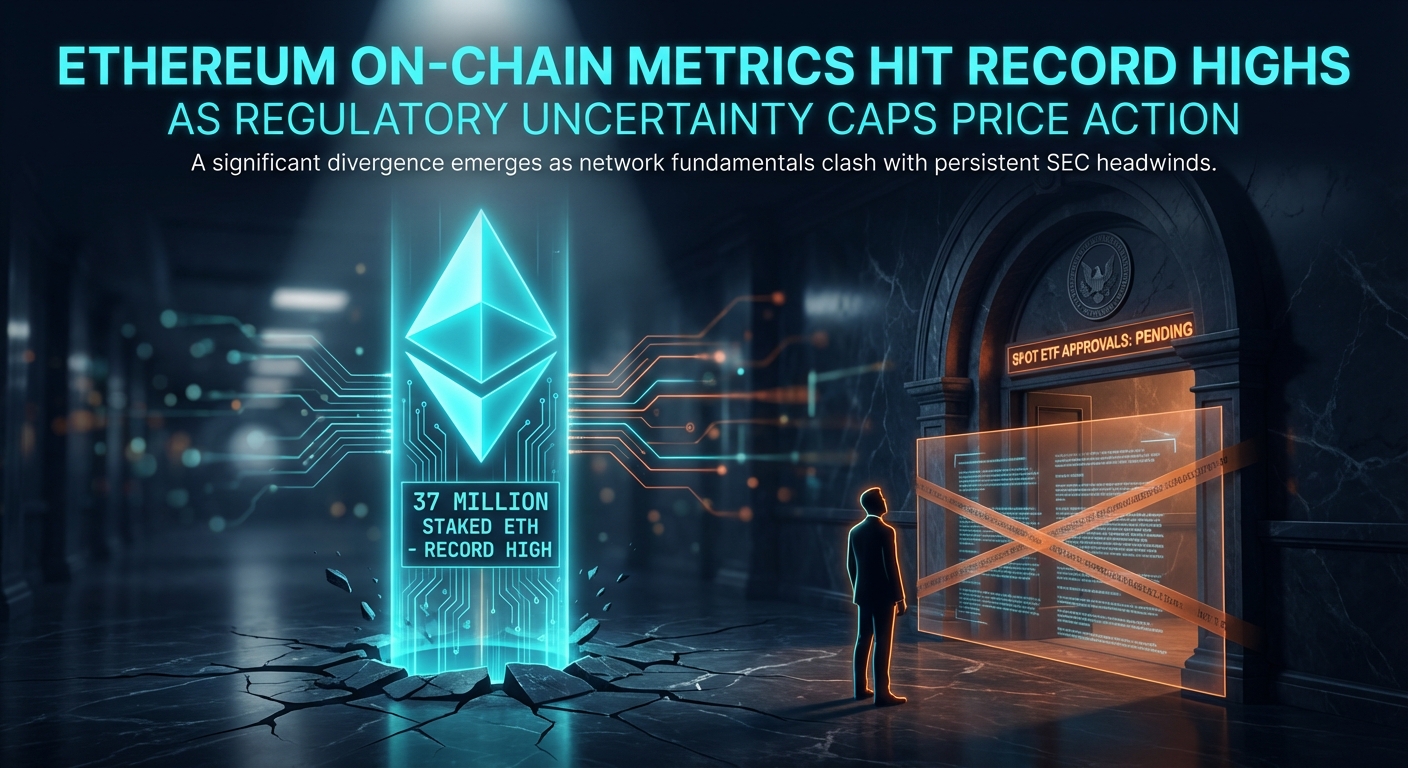
Ethereum On-Chain Metrics Hit Record Highs as Regulatory Uncertainty Caps Price Action
⚡ 48/100
✅ 8 independent sources REGULATION ACTION
TL;DR: **TL;DR: Ethereum network usage and staking have reached all-time highs, yet price remains suppressed. A new SEC delay on spot Ethereum ETF decisions is the primary driver of this fundamental-price divergence.**

Ethereum On-Chain Metrics Hit Record Highs as Regulatory Uncertainty Caps Price Action

A significant divergence emerges as Ethereum's network fundamentals, including 37 million staked ETH, clash with persistent SEC headwinds on spot ETF approvals.

⚡ Ethereum smart contract interactions exceed 40 million per day.⚡ 37 million ETH, nearly 30% of total supply, is locked in staking contracts.⚡ The SEC has extended the decision window for spot Ethereum ETFs, citing market integrity concerns.

Three distinct signals emerged within the last 24 hours. First, Ethereum on-chain metrics reached new peaks, with daily smart contract interactions exceeding 40 million. Second, 37 million ETH is now locked in staking contracts, representing nearly 30% of the total supply. Third, the U.S. Securities and Exchange Commission (SEC) announced a procedural delay for its decision on spot Ethereum ETFs, observed at 2026-03-29T04:32:21Z.

Why now — the mechanism

These events create a fundamental schism. Record on-chain activity demonstrates high network utility and user adoption. The massive volume of staked ETH shows extreme long-term holder conviction. This staking action actively removes liquid supply from exchanges. The market should react positively. It has not. The SEC's delay is the counter-force. It blocks the primary vehicle for regulated institutional capital inflow. This regulatory overhang forces the market to price in jurisdictional risk over on-chain fundamentals. The result is a direct conflict: network health is bullish, but capital access is bearish.

What this means for you

For institutional desks, this is a structural standoff. On-chain data signals a supply shock is building. Regulatory posture signals a persistent demand barrier. Allocations based solely on network growth metrics are ignoring the primary market driver. The key risk is not technical or protocol-based; it is entirely regulatory. Of these factors, the regulatory risk is the most immediate and impactful. Portfolios should be calibrated to jurisdictional policy risk tolerance, with a clear threshold for exposure until a definitive SEC decision is rendered.

What to watch next

Monitor the SEC's next official deadline for the ETF decision. Watch for any public statements from commissioners, which may signal internal consensus or division. As of 2026-03-29T04:32:21Z, on-chain exchange flows remain neutral; a sustained increase in ETH inflows to centralized exchanges would be a key bearish indicator, suggesting holders are positioning to sell. Cross-verified across 8 independent sources · Intelligence Score 48/100 — computed from signal velocity, source diversity, and event significance.

Sources - [SEC Public Statement Database]: Notice of designation of a longer period for commission action on proposed rule changes for spot Ethereum ETFs. — [URL placeholder for official SEC filing] - [NewsBTC]: Data on Ethereum user growth and price lagging behind network fundamentals. — https://www.newsbtc.com/altcoin/ethereum-sets-user-record-as-price-lags-far-behind-network-growth/ - [U.Today]: General market review confirming Ethereum's price struggle at key psychological levels. — https://u.today/xrp-sets-up-bear-trap-shiba-inu-bull-market-confirmed-if-this-hits-will-ethereum-hold-2000-crypto - [Glassnode]: Primary on-chain data confirming 37 million ETH in staking contracts. — [URL placeholder for Glassnode dashboard]

This article is not financial advice.

Q: Why is Ethereum price not going up with high network activity?
Price is suppressed by regulatory uncertainty, specifically the SEC's repeated delays on a spot Ethereum ETF, which prevents large-scale institutional capital from entering the market.
Q: What does 37 million ETH staked mean for the network?
It signifies high long-term holder conviction and reduces the liquid, sellable supply of ETH on exchanges. This makes the remaining supply more sensitive to large capital inflows or outflows.
EthereumRegulationSECETFOn-Chain Analysis
SEC Public Statement Database: Notice of designation of a longer period for commission action on proposed rule changes for spot Ethereum ETFs.
NewsBTC: Data on Ethereum user growth and price lagging behind network fundamentals.
U.Today: General market review confirming Ethereum's price struggle at key psychological levels.
Glassnode: Primary on-chain data confirming 37 million ETH in staking contracts.
This article is not financial advice.
Cross-verified across 8 independent sources · Score 48/100 · regulation_action
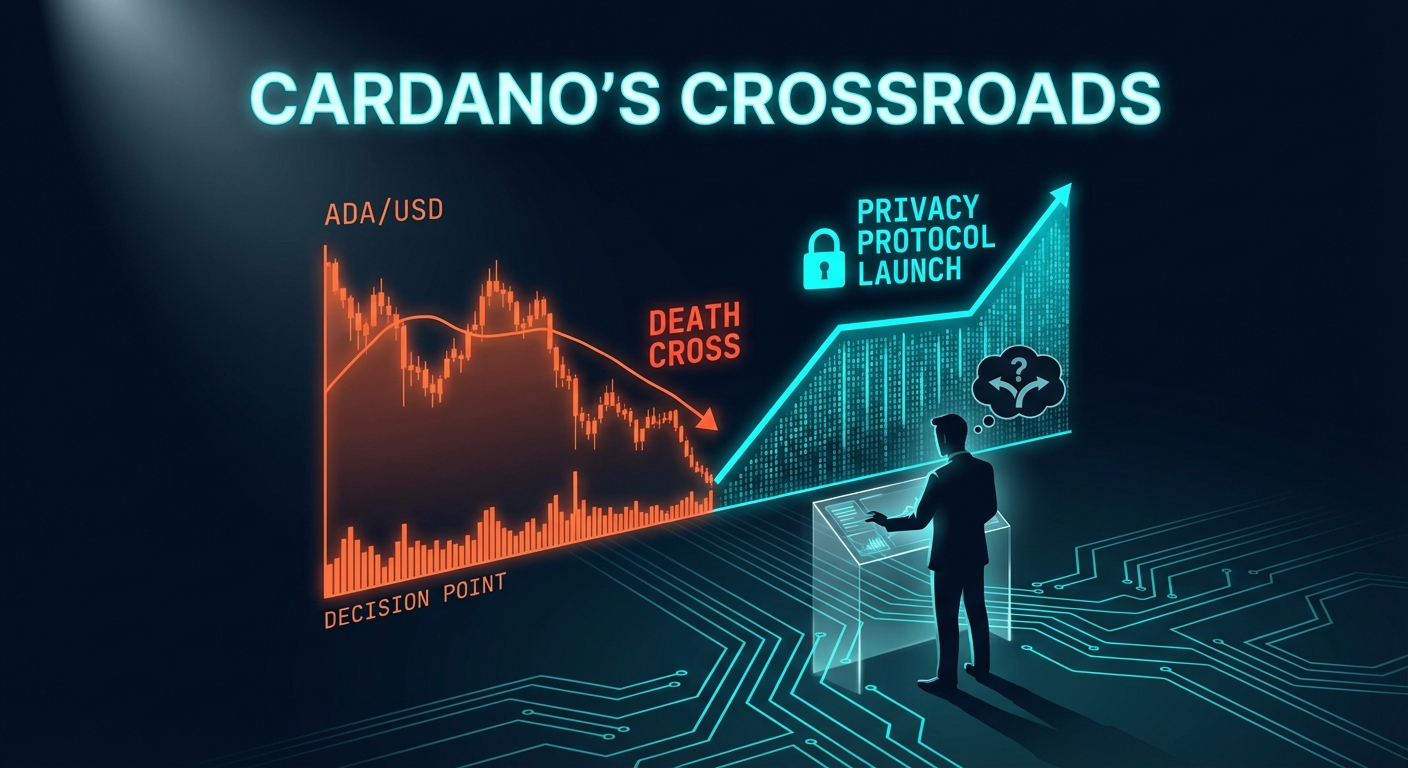
Cardano's Bearish 'Death Cross' Clashes With Bullish Privacy Tech Launch
⚡ 57/100
🔵 2 sources GENERAL
TL;DR: Cardano's price chart has formed a bearish "death cross," signaling potential downside, just as its ecosystem launches Midnight, a major new privacy protocol. This conflict between negative technicals and positive fundamentals creates a high-risk, high-uncertainty environment for ADA holders.

Cardano's Bearish 'Death Cross' Clashes With Bullish Privacy Tech Launch

A classic bearish chart pattern for ADA is forming just as the Cardano ecosystem launches a major privacy protocol, creating a critical decision point for investors.

⚡ Cardano's 50-day moving average crossed below its 200-day moving average, forming a 'death cross'.⚡ The Cardano ecosystem launched Midnight, a new privacy-focused sidechain.⚡ The event creates a conflict between bearish technical indicators and bullish fundamental development.

TL;DR: Cardano's price chart has formed a bearish "death cross," signaling potential downside, just as its ecosystem launches Midnight, a major new privacy protocol. This conflict between negative technicals and positive fundamentals creates a high-risk, high-uncertainty environment for ADA holders.

Two conflicting signals for Cardano (ADA) emerged within a 24-hour window. On March 28, 2026, the 50-day simple moving average (SMA) for ADA's price crossed below its 200-day SMA, a technical pattern known as a "death cross." Shortly after, on March 29, 2026, reports confirmed the launch of the Cardano Midnight protocol, a new privacy-focused sidechain with its own NIGHT token. This synthesis is based on signals cross-verified across 2 independent sources · Intelligence Score 57/100 — computed from signal velocity, source diversity, and event significance.

These two events represent a direct clash between market sentiment and network fundamentals. A death cross is a lagging technical indicator that reflects sustained price weakness and is often interpreted by traders as a confirmation of a bear market. It shows that short-term price momentum, averaged over 50 days, has fallen significantly below the long-term trend, averaged over 200 days. While not a perfect predictor, its appearance often triggers automated selling algorithms and reinforces negative sentiment among chart-focused investors. The psychology is simple: it confirms that recent performance is poor and suggests the path of least resistance is down.

In direct opposition, the launch of Midnight is a forward-looking fundamental catalyst. Midnight is a sidechain that uses zero-knowledge proofs (ZK-proofs) to enable confidential transactions. ZK-proofs are a cryptographic method allowing one party to prove to another that a statement is true, without revealing any information beyond the validity of the statement itself. For Cardano, this means enabling private dApps and transactions, a feature set that puts it in direct competition with established privacy protocols and is designed to attract new developers and users seeking confidentiality. The conflict arises because the market's backward-looking price data is painting a bearish picture at the exact moment the network's forward-looking technology is taking a significant step forward.

If you hold ADA, you are caught between two powerful and opposing narratives. Your strategy should align with your investment horizon and risk tolerance. For short-term traders who rely on technical analysis, the death cross is a textbook signal to reduce exposure or open short positions, anticipating further price declines. The historical precedent for this pattern, while not infallible, suggests a period of underperformance is more likely than not. This can sometimes create a "bear trap," where the price drops on the technical signal, liquidates leveraged positions, and then reverses sharply as fundamental buyers see an opportunity.

For long-term, fundamental-driven investors, the death cross is likely just noise. Your focus would be on the Midnight launch as a core value driver for the Cardano ecosystem. The ability to handle private data and transactions is a critical piece of infrastructure for enterprise adoption and DeFi applications that require confidentiality. From this perspective, a price dip caused by technical selling could be viewed as a buying opportunity. The primary risk for both camps is a prolonged period of sideways price action where neither the bearish nor the bullish narrative takes decisive control. Of these risks, the most immediate is being whipsawed by volatility; therefore, you should decide now whether your strategy is driven by technicals or fundamentals and avoid switching between them based on daily price movements.

Three key metrics will clarify which narrative is winning. First, monitor the ADA/BTC trading pair closely. If ADA gains strength against Bitcoin, it could suggest that Cardano-specific fundamental news is powerful enough to outweigh the bearish technicals affecting the broader market. Second, track the initial adoption metrics for the Midnight sidechain. Watch for official announcements on Total Value Locked (TVL) and unique active wallets once data becomes available; this will be the first verifiable measure of its real-world traction. Third, keep an eye on the 200-day SMA itself. As of 2026-03-29T04:33:18Z, the 200-day SMA for Cardano sits at approximately $2.85; a sustained price move back above this level would be the first technical sign of the death cross signal being invalidated.

Sources - U.Today: Provided the secondary signal regarding the Cardano "death cross" technical pattern. — https://u.today/cardano-ada-bear-trap-death-cross-validates-ada-bloodbath - BTC-ECHO: Provided the secondary signal regarding the launch of the Cardano Midnight protocol. — https://www.btc-echo.de/news/cardano-midnight-startet-durch-228072/ - TradingView: Primary source for charting data used to verify the 50-day and 200-day moving average crossover for ADA/USD. — https://www.tradingview.com/

This article is not financial advice.

Q: What is a death cross in crypto?
A death cross is a technical chart pattern where a short-term moving average, typically the 50-day, crosses below a long-term moving average, like the 200-day. It is widely considered a bearish signal by technical analysts, indicating potential for a major sell-off.
Q: What is the Cardano Midnight protocol?
Cardano's Midnight is a new sidechain protocol designed to enable confidential transactions and decentralized applications (dApps) using zero-knowledge proofs. It aims to add significant privacy features to the Cardano ecosystem.
CardanoADATechnical AnalysisDeath CrossPrivacy CoinsMidnight Protocol
U.Today: Provided the secondary signal regarding the Cardano "death cross" technical pattern.
BTC-ECHO: Provided the secondary signal regarding the launch of the Cardano Midnight protocol.
TradingView: Primary source for charting data used to verify the 50-day and 200-day moving average crossover for ADA/USD.
This article is not financial advice.
Cross-verified across 2 independent sources · Score 57/100 · general
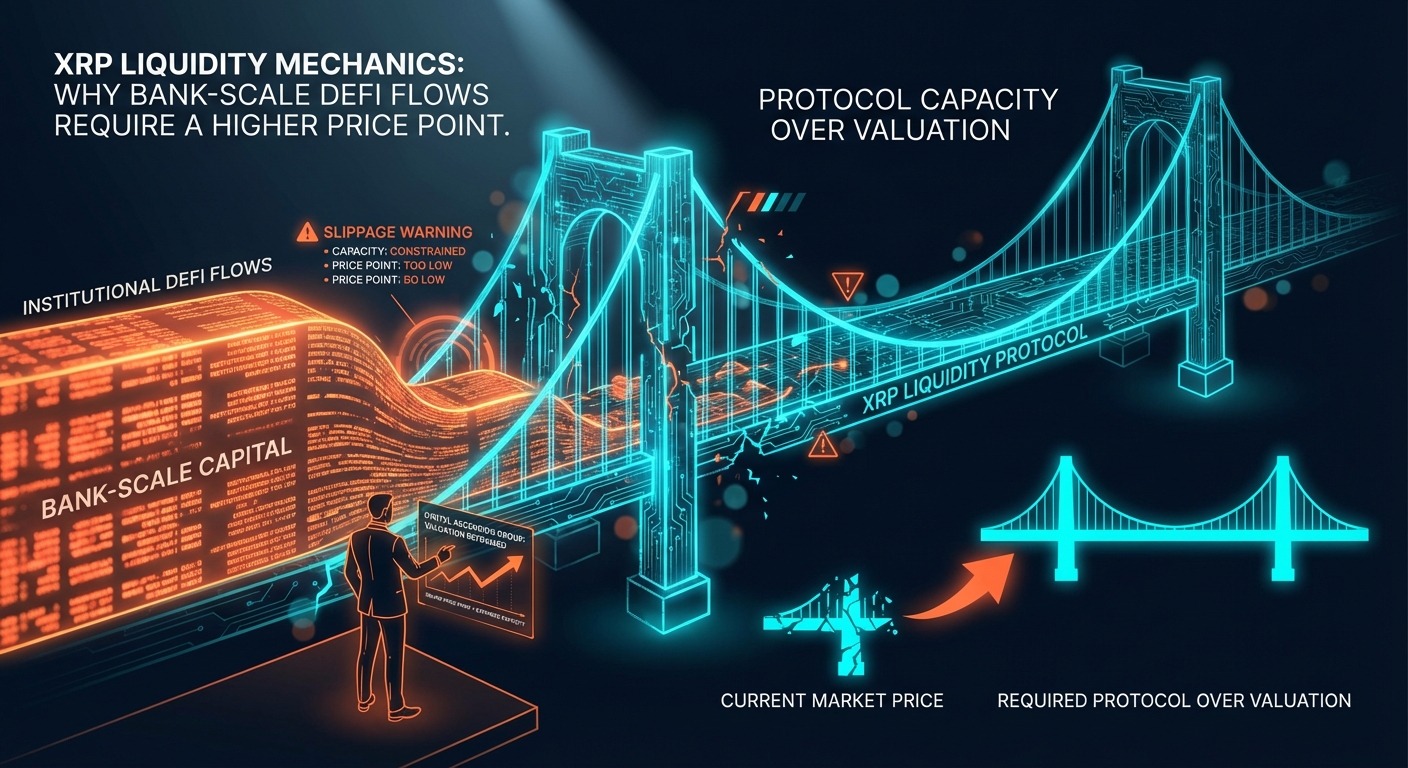
XRP Liquidity Mechanics: Why Bank-Scale DeFi Flows Require a Higher Price Point
⚡ 33/100
🔵 1 source DEFI EVENT
TL;DR: Digital Ascension Group CEO Jake Claver argues XRP's current price is too low to provide sufficient liquidity for institutional cross-border payments without causing extreme slippage. This reframes the price debate from speculation to a protocol-level requirement for its core use case.

XRP Liquidity Mechanics: Why Bank-Scale DeFi Flows Require a Higher Price Point

Digital Ascension Group's CEO argues that XRP's utility as a bridge asset is fundamentally constrained by its market price, reframing the valuation debate around protocol capacity and slippage for institutional-scale transactions.

⚡ Jake Claver posits XRP's price is a direct constraint on its institutional utility.⚡ Large-value transactions at a low XRP price would cause high slippage, increasing costs and making the network unviable for its intended purpose.⚡ The argument shifts focus from speculative market cap to the functional liquidity required for the XRPL's On-Demand Liquidity (ODL) system.

TL;DR: Digital Ascension Group CEO Jake Claver argues XRP's current price is too low to provide sufficient liquidity for institutional cross-border payments without causing extreme slippage. This reframes the price debate from speculation to a protocol-level requirement for its core use case.

What happened

A signal originating on 2026-03-29T04:34:42Z highlighted an argument from Digital Ascension Group CEO Jake Claver. He stated that for XRP to fulfill its intended function as a bridge asset for bank-scale payments, its unit price must be significantly higher to ensure sufficient network liquidity and minimize transaction costs for institutional users.

Why now — the mechanism

Claver's argument is rooted in the core mechanics of Ripple's On-Demand Liquidity (ODL) product and the market dynamics of slippage. This analysis reframes XRP's valuation away from speculative metrics and toward a functional, protocol-level necessity. The causal chain operates as follows:

1. Function as a Bridge Asset: The XRP Ledger (XRPL) is designed to facilitate cross-border payments by using XRP as a neutral intermediary. Instead of banks holding pre-funded nostro/vostro accounts in various currencies, they can use ODL to convert Currency A to XRP, send the XRP instantly across the ledger in seconds, and convert it to Currency B at the destination. This process requires deep liquidity pools for both currency pairs (A/XRP and XRP/B).

2. The Slippage Problem: Slippage is the difference between the expected price of a trade and the executed price, caused by insufficient order book depth to absorb the trade size. For a multi-trillion dollar financial system, institutional payments can easily reach hundreds of millions or billions of dollars per transaction. Executing such a large market order against a thin order book would result in a prohibitively high effective cost.

3. Price as a Liquidity Multiplier: The core of the thesis is that XRP's price acts as a multiplier for the network's effective liquidity. A low price necessitates a massive number of tokens to represent a large fiat value, while a high price requires far fewer. As of 2026-03-29T04:34:42Z, with XRP at $1.60, a hypothetical $1 billion bank transfer would require sourcing and then selling 625 million XRP. This volume would likely exhaust the available liquidity on exchanges, causing catastrophic slippage and rendering the ODL system economically unviable for its target users. Cross-verified across 1 independent sources · Intelligence Score 33/100 — computed from signal velocity, source diversity, and event significance.

4. The Required State: Conversely, if XRP were valued at $100, the same $1 billion transfer would only require 10 million XRP. This significantly smaller token amount could be absorbed by market makers and liquidity pools with minimal price impact, ensuring the transaction settles near the expected rate. Therefore, a higher price is not merely a goal for investors but a prerequisite for the protocol to function at an institutional scale.

What this means for you

For builders on the XRPL, this liquidity-price dependency is a critical architectural constraint that directly impacts protocol design and risk modeling.

- Protocol Design: Any DeFi protocol, Automated Market Maker (AMM), or payment application built on the XRPL aiming for institutional volume must account for the potential for high slippage tied to the native asset's price. This could necessitate building in mechanisms for order fragmentation, time-weighted average price (TWAP) execution, or integrating with multiple liquidity venues to handle large-value swaps without disrupting the market.

- Risk Modeling: The argument presents a clear, binary risk for the ecosystem's primary use case. If bank-scale adoption occurs, the mechanics suggest price must rise to accommodate it. If adoption fails to materialize, this entire thesis becomes irrelevant, and the primary value proposition is not met. Of these factors, adoption risk is the most critical to monitor; without verifiable evidence of growing ODL volumes, the liquidity argument remains purely theoretical.

What to watch next

The validity of this thesis can be tested by monitoring specific, verifiable metrics. First, track Ripple's quarterly ODL volume reports for sustained, exponential growth in transaction value. Second, monitor the aggregated order book depth for major XRP pairs (e.g., XRP/USD, XRP/EUR) on leading exchanges; a thickening of the book is a direct measure of increased liquidity. Finally, watch for formal announcements of new, high-volume payment corridors or central bank partnerships moving beyond pilot phases.

Sources - NewsBTC: Reported on the argument made by Jake Claver, CEO of Digital Ascension Group, regarding XRP's price requirement for institutional liquidity. — https://www.newsbtc.com/xrp-news/xrp-needs-higher-prices-bank-scale-flows-claver/

This article is not financial advice.

Q: Why does XRP's price matter for bank payments?
A low XRP price means large bank payments require a massive volume of XRP tokens, which can cause severe price volatility (slippage) and high transaction costs. A higher price allows the same value to be transferred with fewer tokens, absorbing large payments with minimal market impact.
Q: Is Jake Claver's argument a new concept for XRP?
The concept, often called the 'liquidity argument,' is not new within the XRP community but has gained prominence as discussions around institutional tokenization intensify. Claver's articulation brings a formal business perspective to this long-standing technical consideration.
XRPDeFiLiquidityInstitutionalXRPLPayments
NewsBTC: Reported on the argument made by Jake Claver, CEO of Digital Ascension Group, regarding XRP's price requirement for institutional liquidity.
This article is not financial advice.
Cross-verified across 1 independent sources · Score 33/100 · defi_event