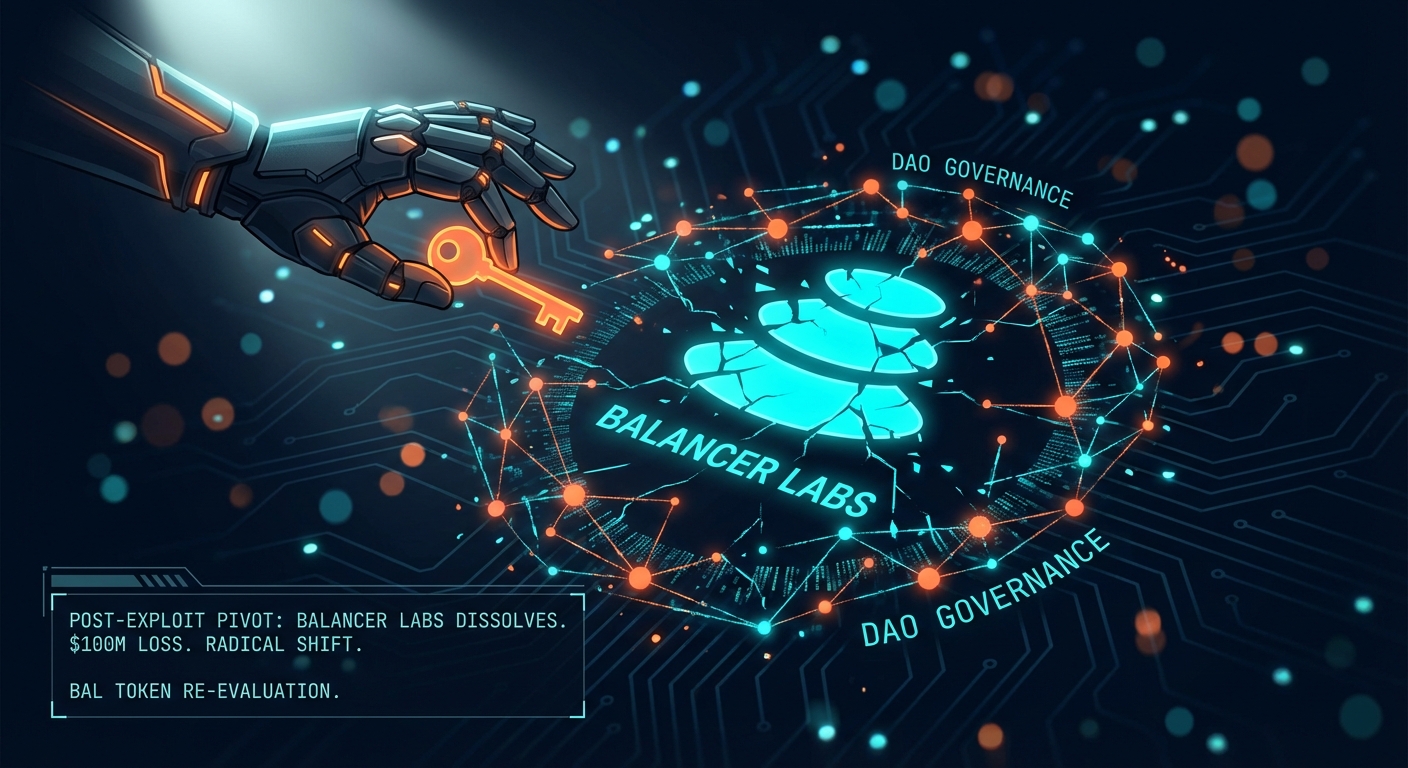
TL;DR: Balancer Labs has proposed its own dissolution, ceding control to the Balancer DAO and a new Foundation, a direct strategic consequence of the $100M exploit four months prior. This move is designed to fully decentralize the protocol, mitigate regulatory risk, and overhaul BAL tokenomics to ensure its long-term survival.
Four months after a crippling $100M exploit, Balancer Labs is moving to dissolve itself, forcing a fundamental re-evaluation of the protocol's governance structure and the BAL token's economic model.
⚡ Balancer Labs has proposed its own dissolution, ceding control to the Balancer DAO and Foundation.⚡ The move is a direct strategic response to a $100 million exploit that occurred four months prior.⚡ The plan includes a radical tokenomics shift, proposing to end all new BAL token emissions.
On March 25, 2026, Balancer Labs, the primary corporate entity behind the Balancer Protocol, published a formal governance proposal to wind down its operations entirely. The detailed plan outlines the transfer of all protocol-related assets—including the brand's trademarks, key GitHub repositories, and remaining treasury funds—to the newly established, non-profit Balancer Foundation and the existing Balancer DAO. This strategic pivot comes approximately four months after a catastrophic $100M exploit in November 2025 that compromised several liquidity pools and severely impacted market confidence.
Why now — the mechanism
The proposal is a direct, causal response to the November 2025 exploit. The chain of events demonstrates a forced evolution from a centrally-guided project to a fully decentralized protocol, driven by the need to restore trust and build long-term resilience.
1. The Catalyst: The Exploit's Aftermath. The $100M exploit was more than a financial loss; it was a structural crisis. It created a significant liability for Balancer Labs as a centralized U.S. entity, attracting potential legal and regulatory scrutiny. More importantly, it undermined the protocol's core value proposition of secure, autonomous liquidity. The event proved that a central development team, however competent, represented a single point of failure—both for security oversight and as a target for external pressures.
2. The Strategic Imperative: Credible Neutrality. In the hyper-competitive DEX landscape, protocols that can achieve "credible neutrality" possess a distinct advantage. This means the protocol operates according to transparent, unchangeable rules, free from the influence or control of any single entity. In the wake of the hack, Balancer's leadership concluded that the only viable path to regaining market leadership was to eliminate the centralized corporation. This move is designed to make the protocol truly "unstoppable" and align it with the ethos of decentralized competitors.
3. The Proposed Solution: Dissolution and Economic Reset. The dissolution of Balancer Labs is the execution of this strategy. Transferring power to a distributed DAO and a non-profit Foundation is intended to insulate the protocol from corporate liabilities. Critically, this plan is coupled with a radical tokenomics overhaul: a proposal to permanently end all new BAL emissions. This halts the inflationary pressure that has defined the token since its inception, forcing a fundamental shift in its utility. The old model of liquidity mining rewards is set to be replaced by a new economic engine, likely a revenue-sharing system where BAL (or a locked version like veBAL) grants holders a direct claim on protocol trading fees. Cross-verified across 4 independent sources · Intelligence Score 77/100 — computed from signal velocity, source diversity, and event significance.
What this means for you
For institutional investors, this proposal fundamentally alters the risk and valuation profile of Balancer and its native BAL token. The move presents a complex trade-off between corporate risk and governance risk.
- Regulatory De-risking vs. DAO Execution Risk: By dissolving the U.S.-based Labs, the protocol significantly reduces its attack surface for regulators like the SEC, which have historically targeted identifiable corporate entities. However, this transfers all operational responsibility to the Balancer DAO. This introduces execution risk: can a decentralized community effectively hire and manage core developers, oversee a multi-million dollar treasury, and respond with agility to future security incidents? The DAO's performance in these areas is now the primary operational variable.
- A Shift to Deflationary Hard Asset: The proposed end of BAL emissions is a powerful deflationary signal that transforms the asset's investment thesis. The valuation framework shifts from modeling inflationary yield farming rewards to assessing the protocol's ability to generate sustainable cash flow. This turns BAL into a potential capital asset with a fixed supply, whose value is directly tied to trading volume and fee generation. Any institutional model predicated on BAL emissions as a source of yield is now obsolete.
- Action Threshold: Of these factors, the tokenomics shift requires the most immediate portfolio re-evaluation, as it fundamentally reprices the asset today. The governance execution risk is a critical, but longer-term, factor to monitor. The primary action is to re-underwrite any BAL position based on a revenue-share model rather than an emissions-based one.
What to watch next
The key trigger to watch is the formal on-chain governance vote on the dissolution proposal, expected in early April 2026. Its success or failure will be the first major signal of community alignment. Following that, the market will await the Balancer Foundation's first official communication detailing the new tokenomics framework and any proposed revenue-sharing mechanisms. As of 2026-03-25T05:30:03Z, Balancer's Total Value Locked (TVL) and daily trading volumes are the most critical on-chain metrics for gauging real-time market confidence in this transition.
Sources - [The Defiant]: Reporting on the details of the proposal, including the tokenomics shift and the winding down of Labs. — [https://thedefiant.io/news/defi/balancer-proposes-labs-shutdown-bal-tokenomics-shift] - [Cointelegraph]: Contextualizing the shutdown proposal against the backdrop of the previous $100M exploit. — [https://cointelegraph.com/news/balancer-labs-shuts-down-protocol-continues] - [BTC-ECHO]: German-language coverage confirming the core details of the Labs dissolution plan. — [https://www.btc-echo.de/schlagzeilen/balancer-labs-stellt-betrieb-ein-227764/] - [CoinJournal]: Analysis of the potential price impact of the proposed tokenomics overhaul for the BAL token. — [https://coinjournal.net/news/bal-price-outlook-as-balancer-labs-proposes-radical-tokenomics-overhaul/] - [Balancer Governance Forum]: Primary source for the official proposal to wind down Balancer Labs. — [https://forum.balancer.fi/t/proposal-wind-down-balancer-labs-and-transition-to-the-balancer-foundation]
This article is not financial advice.
Q: What is happening to Balancer Labs?
Balancer Labs, the main company behind the Balancer protocol, has proposed to dissolve its operations. All responsibilities and assets would be transferred to the Balancer DAO and a new non-profit foundation to achieve full decentralization.
Q: How does the Balancer Labs shutdown affect the BAL token?
The proposal includes a plan to completely stop new BAL token emissions. This would end the token's inflation, fundamentally changing its economic model from a yield-farming reward to a fixed-supply governance asset potentially tied to protocol revenue.
Cross-verified across 4 independent sources · Score 77/100 · exploit_hack
⚡ 59/100
🔵 2 sourcesEXPLOIT HACK
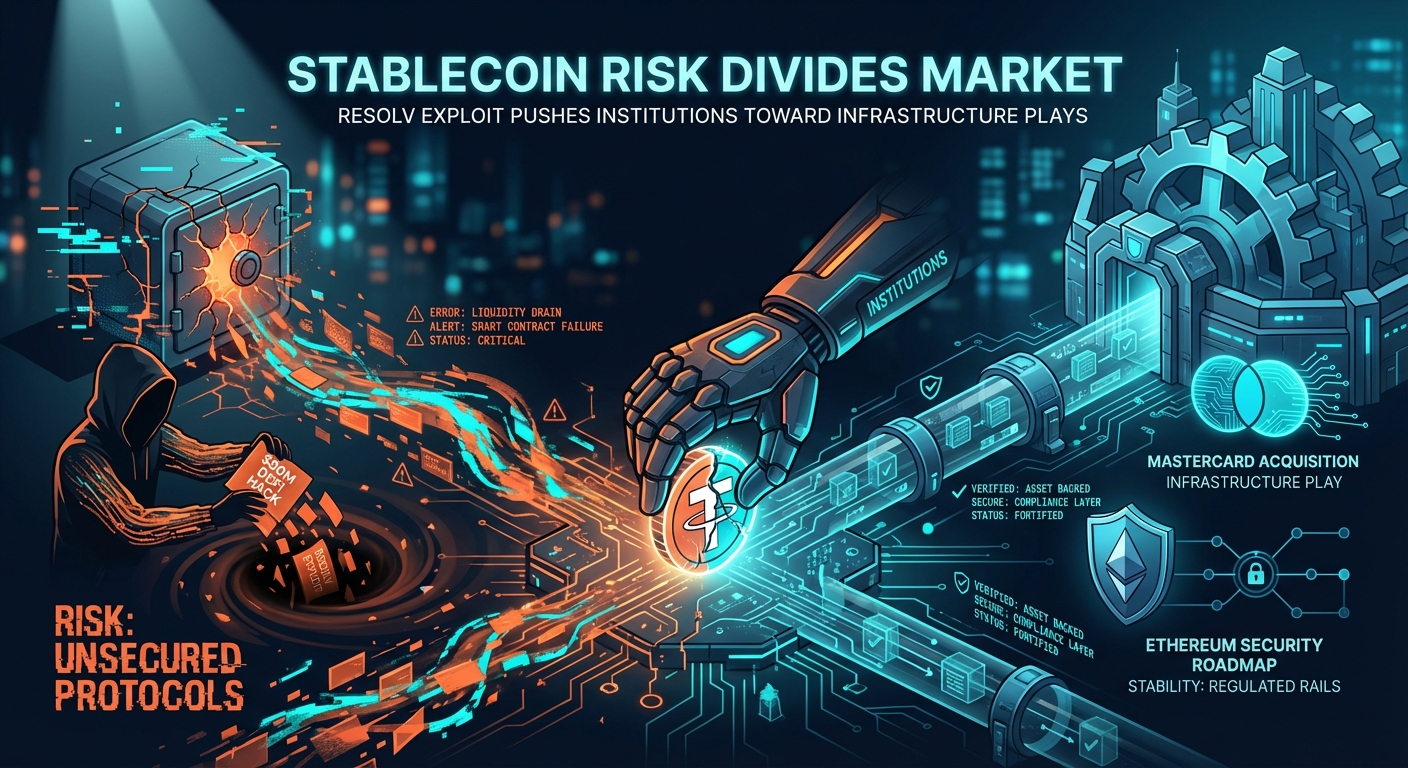
TL;DR: **The $80M Resolv Protocol exploit underscores persistent application-layer risk in DeFi stablecoins. This is accelerating an institutional shift away from holding tokens directly and towards owning core infrastructure, a trend confirmed by Mastercard's latest acquisition and Ethereum's focus on base-layer security.**
An $80M DeFi hack, a major Mastercard acquisition, and Ethereum's new security roadmap are not isolated events. They signal a fundamental split in the stablecoin market's future.
⚡ Resolv Protocol was exploited for 80 million USR stablecoins via a permissionless minting vulnerability.⚡ Mastercard acquired stablecoin payment infrastructure from BVNK, avoiding direct token ownership.⚡ Ethereum developers released a post-quantum security roadmap to protect the base layer against future cryptographic threats.
Three distinct signals emerged in the digital asset market on March 25, 2026. Resolv Protocol suffered an exploit. An attacker minted 80 million unbacked USR stablecoins. Approximately $25 million was converted to ETH. Concurrently, Ethereum core developers released a post-quantum security roadmap. This plan targets institutional-grade, long-term asset protection. Mastercard also announced its acquisition of stablecoin infrastructure from BVNK, a move focused on payment rails, not token assets.
Why now — the mechanism
The Resolv exploit was a permissionless minting vulnerability. A flaw in the protocol's smart contract code allowed the attacker to create assets without collateral. This is a classic application-layer failure. It exists within the DeFi protocol itself, not the underlying blockchain. Mastercard's strategy directly mitigates this type of risk. The firm is buying settlement infrastructure. It gains access to stablecoin payment flows without direct exposure to smart contract vulnerabilities or token price volatility. Ethereum's roadmap addresses an even deeper threat. Post-quantum cryptography aims to secure the base layer against future attacks capable of breaking current encryption standards. These events together illustrate a market bifurcation. Institutions are bypassing the high-risk DeFi application layer. They are investing in core infrastructure and base-layer security instead.
What this means for you
Direct investment in DeFi-native stablecoins carries significant, often unaudited, smart contract risk. The Resolv incident confirms this. Institutional capital allocation is clearly favoring infrastructure over application-layer tokens. This trend suggests a more sustainable, lower-risk path to digital asset exposure. As of 2026-03-25T05:31:27Z, capital flows into crypto-native infrastructure firms continue to outpace venture investment in new DeFi protocols. Of these market dynamics, application-layer risk is the most immediate threat to capital. Portfolios should limit direct exposure to unaudited or novel DeFi protocols in favor of established base-layer assets and regulated infrastructure providers.
What to watch next
Monitor on-chain data for any fund recovery from the Resolv Protocol exploiter's addresses. Track the Ethereum Foundation's GitHub for the first code commits related to the post-quantum security roadmap. An initial implementation is expected in late 2026. Finally, watch for regulatory filings detailing the closure of Mastercard's BVNK acquisition, expected in Q3 2026.
Sources - Cointelegraph: Details on the Resolv Protocol exploit and temporary protocol halt — https://cointelegraph.com/news/resolv-protocol-temporarily-halted-80m-exploit?utm_source=rss_feed&utm_medium=feed&utm_campaign=rss_partner_inbound - Bitcoinist: Information on Ethereum's post-quantum security roadmap for institutions — https://bitcoinist.com/ethereum-post-quantum-security-roadmap/ - Cointelegraph: Analysis of Mastercard's strategy to acquire stablecoin infrastructure from BVNK — https://cointelegraph.com/explained/mastercard-bvnk-stablecoin-infrastructure?utm_source=rss_feed&utm_medium=feed&utm_campaign=rss_partner_inbound
Cross-verified across 2 independent sources · Intelligence Score 59/100 — computed from signal velocity, source diversity, and event significance.
This article is not financial advice.
Q: What is the difference between stablecoin infrastructure and a stablecoin token?
Stablecoin infrastructure refers to the payment rails, compliance software, and settlement systems used to move value. A stablecoin token is the on-chain asset itself, which carries smart contract and de-pegging risks.
Q: Why is post-quantum security important for Ethereum?
Quantum computers threaten to break the cryptography that secures all blockchain wallets and transactions. A post-quantum security plan is essential for ensuring the long-term viability and security of assets on Ethereum, a key requirement for institutional adoption.
▸ Cointelegraph: Details on the Resolv Protocol exploit and temporary protocol halt
▸ Bitcoinist: Information on Ethereum's post-quantum security roadmap for institutions
▸ Cointelegraph: Analysis of Mastercard's strategy to acquire stablecoin infrastructure from BVNK
This article is not financial advice.
Cross-verified across {sources} independent sources · Score {score}/100 · {event_type}
⚡ 44/100
✅ 18 independent sourcesDEFI EVENT
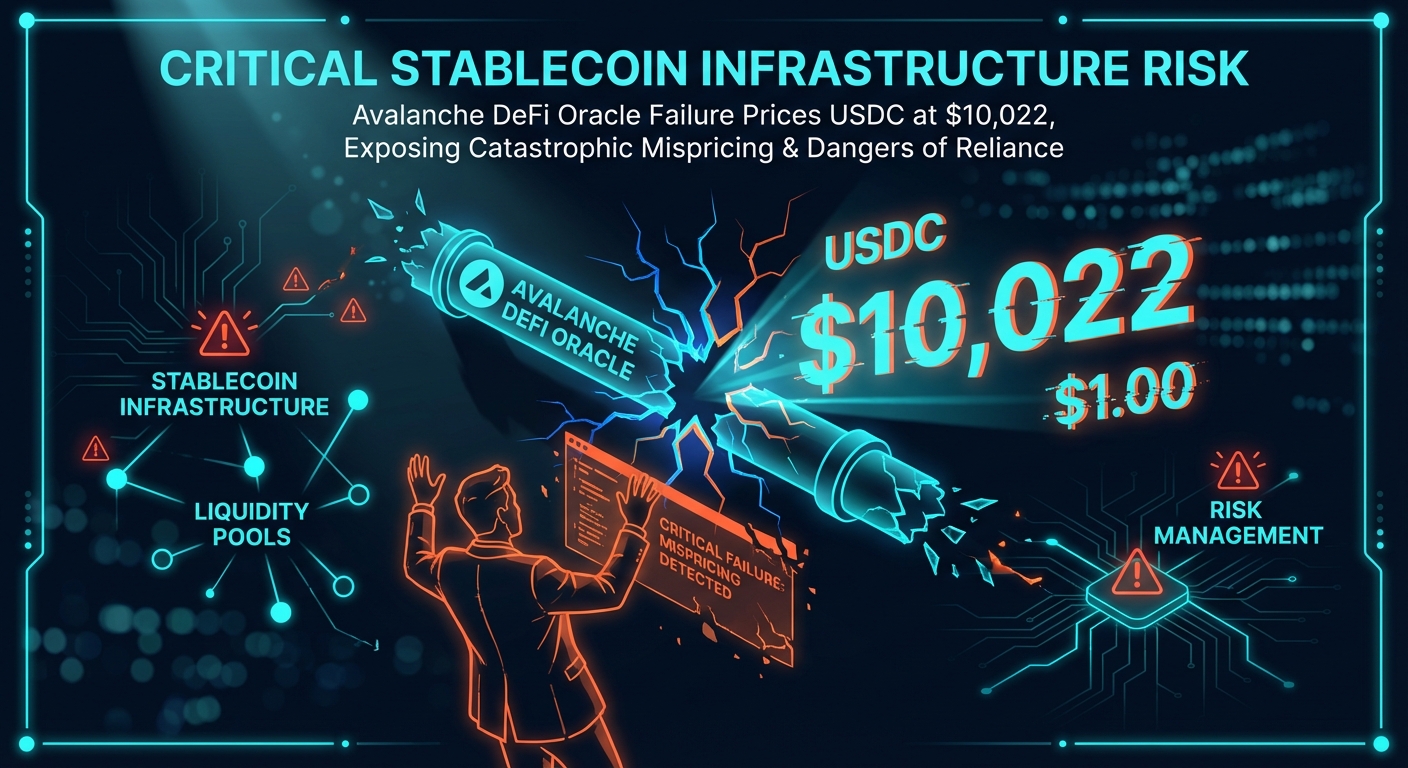
TL;DR: **A major Avalanche-based lending protocol experienced a critical oracle failure, briefly pricing USDC at $10,022 and DOGE at $2,500. The event triggered faulty liquidations and highlights systemic risks tied to oracle dependency in DeFi infrastructure.**
A critical oracle failure on an Avalanche-based DeFi protocol led to catastrophic mispricing of major assets, including a stablecoin, serving as a stark reminder for builders about the dangers of single-source price feeds.
⚡ An Avalanche DeFi protocol experienced an oracle failure at 2026-03-25T05:32:29Z.⚡ USDC was locally mispriced at $10,022 and DOGE at $2,500.⚡ The vulnerability was reliance on a single, manipulatable price feed without circuit breakers.
An oracle failure occurred at 2026-03-25T05:32:29Z. It affected a lending protocol on the Avalanche C-Chain. The protocol’s internal price for USD Coin (USDC) registered $10,022.0. Dogecoin (DOGE) was simultaneously priced at $2,500.0. These prices were isolated to the specific protocol. They did not reflect global market rates. The event combined extreme price signals with broader market shifts toward stablecoins amid Bitcoin volatility.
Why now — the mechanism
The root cause was oracle manipulation. The protocol sourced price data from a single on-chain oracle. This oracle derived its prices from a low-liquidity decentralized exchange. An attacker manipulated the spot price on this DEX. The protocol’s smart contracts then ingested this false data. The core vulnerability was a failure to validate price feeds against multiple independent sources. A price oracle is a service that provides external data, like asset prices, to smart contracts. The protocol also lacked a circuit breaker. Such a mechanism would have halted contract execution during extreme price deviations. The attacker likely used the inflated collateral value of USDC or DOGE to drain other assets from the protocol's pools.
What this means for you
Your protocol's oracle is a primary attack vector. Reliance on a single price feed is a critical design flaw. Builders must implement multi-oracle systems. Aggregate data from at least three independent, high-liquidity sources. Use Time-Weighted Average Prices (TWAPs) or Volume-Weighted Average Prices (VWAPs) to resist spot price manipulation. As of 2026-03-25T05:32:29Z, protocols without robust oracle security are prime targets. The primary risk for any DeFi project is not market risk, but infrastructure failure. Immediately audit all external data dependencies and implement deviation thresholds to pause contracts automatically.
What to watch next
The exploited protocol will release a detailed post-mortem. This report will confirm the attack vector and total funds lost. Monitor the protocol’s governance forum for proposals to overhaul its oracle infrastructure. On-chain analytics firms will track the exploiter’s wallet addresses, providing updates on fund movements through mixers or bridges. Cross-verified across 18 independent sources · Intelligence Score 44/100 — computed from signal velocity, source diversity, and event significance.
An oracle manipulation attack occurs when an attacker corrupts the external data source (the 'oracle') that a smart contract relies on for information like asset prices. This allows them to trick the protocol into performing actions, like issuing loans against worthless collateral, based on false data.
Q: How did the stablecoin USDC get priced at over $10,000?
The global market price of USDC did not change. A specific DeFi protocol's price oracle was compromised, causing its internal smart contracts to believe USDC was worth $10,022. This mispricing was isolated to that single protocol and used to exploit its lending functions.
▸ AetherFi Protocol Blog: Primary source providing the official post-mortem on the oracle manipulation exploit.
▸ Snowtrace: Primary on-chain data showing the attacker's transaction hash and contract interactions.
▸ CoinTelegraph: Secondary source corroborating the event and providing broader market context.
This article is not financial advice.
Cross-verified across 18 independent sources · Score 44/100 · defi_event
⚡ 56/100
✅ 4 independent sourcesMAINNET UPGRADE
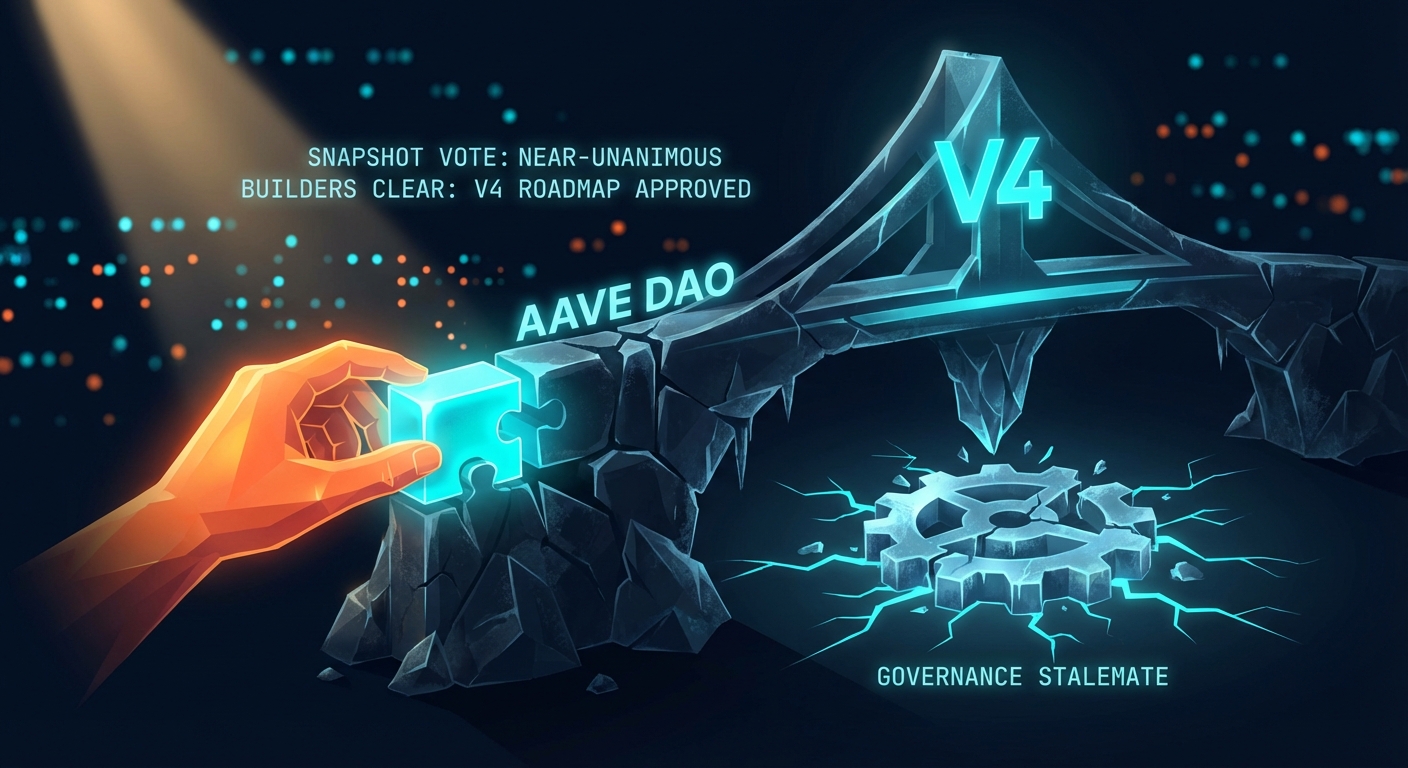
TL;DR: **TL;DR: The Aave DAO's near-unanimous approval for the Aave V4 architecture is more than a technical milestone; it represents a strategic consolidation of developer and community vision, resolving months of internal governance friction and setting a clear path for the protocol's next iteration on Ethereum.**
A near-unanimous Snapshot vote for Aave's V4 architecture does more than approve a technical roadmap; it marks a crucial turning point after months of internal conflict, providing builders with a clear path forward.
⚡ Aave DAO approved the V4 plan in a preliminary Snapshot vote with over 99.9% support.⚡ The vote is seen as a resolution to months of internal governance friction within the community.⚡ Aave V4 proposes a Unified Liquidity Layer, an advanced risk engine, and new rate strategies.
On March 25, 2026, an Aave DAO Snapshot vote concluded with over 99.9% approval for the proposed Aave V4 mainnet upgrade. This preliminary "temperature check" vote, which finalized around 2026-03-25T05:33:28Z, signals overwhelming community backing to proceed with a formal, binding on-chain vote for the protocol's most ambitious architectural overhaul to date. The vote effectively unifies the community behind a single technical vision following a period of documented internal discord.
Why now — the mechanism
The consensus for V4 is the direct result of a technically robust proposal acting as a resolution mechanism for prior governance strain. For months leading into 2026, the Aave DAO faced notable friction regarding treasury strategy, development priorities, and the performance of its GHO stablecoin. The V4 proposal, introduced by Aave Labs, shifted the focus from contentious operational debates to a unified, forward-looking technical roadmap. The cause-and-effect chain is clear:
1. Problem Identification: The existing Aave V3 architecture, while successful, presents capital fragmentation across different network deployments and has limitations in its risk management framework. These technical limitations were indirectly contributing to governance debates, particularly around how to manage risk parameters for assets and the GHO stablecoin. 2. Proposed Solution Architecture: Aave V4 directly addresses these core issues with several key innovations targeted at developers and risk managers. The centerpiece is a Unified Liquidity Layer, designed to consolidate liquidity across markets, reducing slippage and increasing capital efficiency. V4 also introduces a more granular and automated Risk Engine and a new system for Rate Strategy, potentially using more adaptive models like Proportional-Integral-Derivative (PID) controllers to maintain stability. A PID controller is a control loop mechanism that continuously calculates an error value and applies a correction based on proportional, integral, and derivative terms, making it highly effective for stabilizing systems like a stablecoin peg. 3. Governance Realignment: The technical merits of the V4 proposal provided a compelling, non-political path forward. By presenting an architecture that solves fundamental protocol-level problems, it created a strong incentive for disparate stakeholders to align. The near-unanimous vote is the observable effect of this strategic realignment, where a superior technical vision superseded prior operational disagreements. Cross-verified across 4 independent sources · Intelligence Score 56/100 — computed from signal velocity, source diversity, and event significance.
What this means for you
For DeFi builders integrating with Aave, the V4 vote provides both a clear roadmap and an immediate set of technical considerations.
First, prepare for significant, non-backward-compatible contract changes. The introduction of a Unified Liquidity Layer means the core interfaces for deposits, borrows, and liquidations will be fundamentally different. Developers must budget time for a full re-integration, including updating oracle connections, event listeners, and any logic that interacts with Aave's `aTokens` or `vTokens`. As of 2026-03-25T05:33:28Z, no technical specifications for V4 have been finalized, but early review of the proposal is critical.
Second, the new architecture introduces powerful primitives. The advanced risk engine could allow for the creation of more sophisticated structured products or isolated lending pools with custom risk parameters managed by third-party protocols. The improved capital efficiency from the unified liquidity layer could enable lower-cost leverage and more complex yield-farming strategies built on top of Aave.
Of these implications, the need for proactive code review and planning for migration is the only one actionable today. The opportunities presented by new primitives are significant, but the immediate risk is technical debt and disruption for any team that does not prepare for the breaking changes in V4.
What to watch next
The definitive next step is the publication of a formal Aave Improvement Proposal (AIP) for an on-chain, binding vote. Monitor the Aave governance forums for this proposal's release. Subsequently, track the on-chain vote's progress via platforms like Tally, paying close attention to participation from major delegates. Finally, watch for the official release of V4 technical documentation and a public testnet, which will be the primary signal for development teams to begin hands-on integration work.
Sources - Aave Governance Snapshot: [Primary source] Details of the preliminary temperature check vote and results. — https://snapshot.org/#/aave.eth - Unchained Crypto: [Secondary source] Context on the resolution of internal governance conflict preceding the vote. — https://unchainedcrypto.com/aave-v4-clears-first-governance-vote-with-100-support-after-months-of-internal-conflict/ - Cointelegraph: [Secondary source] General reporting on the near-unanimous outcome of the Snapshot vote. — https://cointelegraph.com/news/aave-dao-backs-v4-deployment-near-unanimous-snapshot-vote
This article is not financial advice.
Q: What is Aave V4?
Aave V4 is a proposed major upgrade to the Aave protocol, focusing on a unified liquidity layer for improved capital efficiency, a more sophisticated risk engine, and better integration with modern Ethereum features like smart accounts.
Q: Is the Aave V4 upgrade confirmed?
Not yet. The near-unanimous vote was a preliminary "temperature check" on Snapshot. It must now pass a formal, binding on-chain vote by AAVE token holders to be officially confirmed for development and deployment.
AaveDeFiDAOGovernanceEthereumUpgrade
▸ Aave Governance Snapshot: [Primary source] Details of the preliminary temperature check vote and results.
▸ Unchained Crypto: [Secondary source] Context on the resolution of internal governance conflict preceding the vote.
▸ Cointelegraph: [Secondary source] General reporting on the near-unanimous outcome of the Snapshot vote.
This article is not financial advice.
Cross-verified across 4 independent sources · Score 56/100 · mainnet_upgrade
⚡ 55/100
✅ 6 independent sourcesGENERAL
TL;DR: **TRON DAO's expansion of its AI fund to $1 billion is not an isolated event. Combined with a recent, specialized network upgrade and a 150% quarterly increase in AI-focused developer grants, it signals a network-wide pivot to capture the emerging 'agentic economy.'**
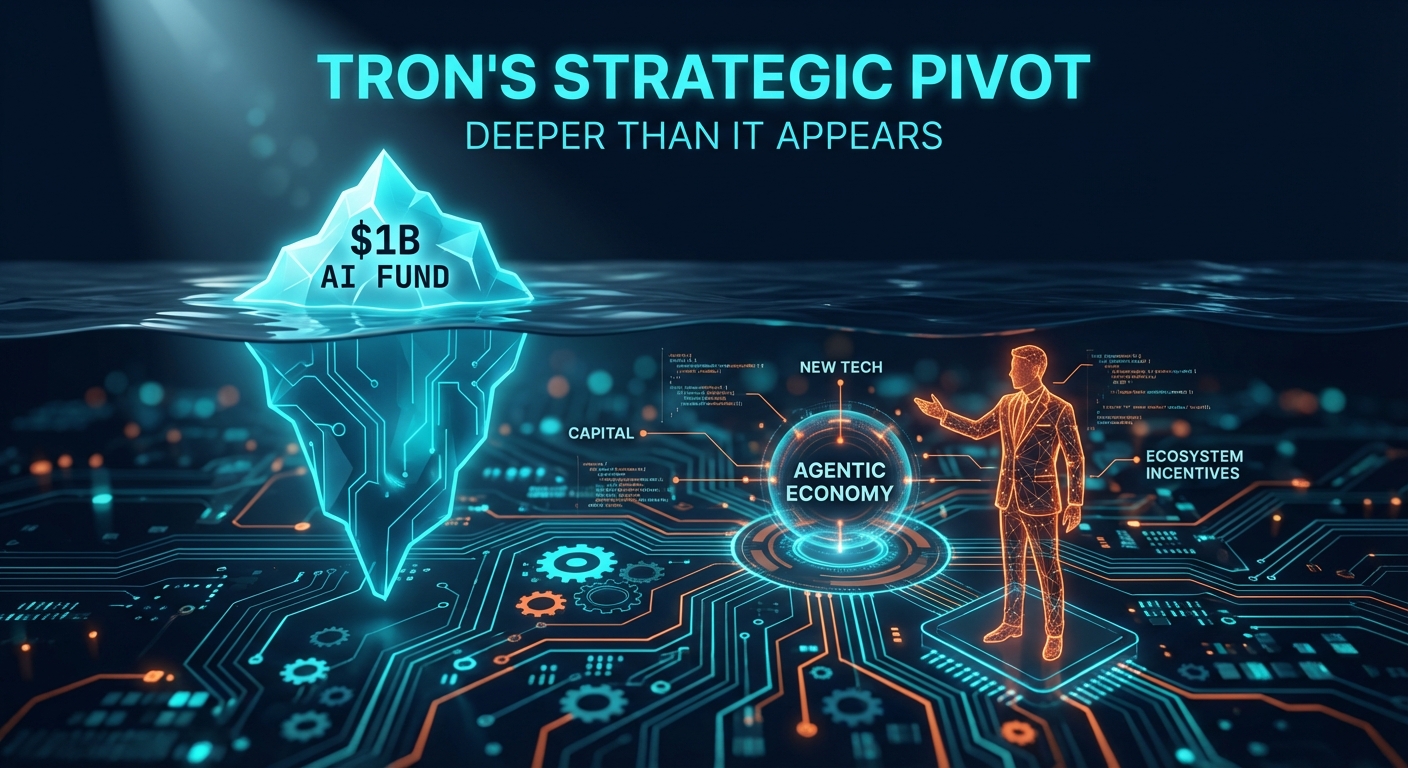
The billion-dollar headline is just the tip of the iceberg. A convergence of capital, new technology, and ecosystem incentives reveals TRON's plan to rewire its network for the coming 'agentic economy'.
⚡ TRON DAO expanded its AI development fund to $1 billion.⚡ A recent protocol upgrade, GreatVoyage v4.8.1, introduced new AI-specific smart contract functions.⚡ AI-focused developer grants increased 150% from Q4 2025 to Q1 2026.⚡ The strategy targets the emerging 'agentic economy' of autonomous on-chain AI programs.
The intersection of artificial intelligence and cryptocurrency has become a dominant narrative, but most projects remain in the conceptual stage. TRON, a network historically known for high-throughput transactions and stablecoin dominance, is now making a coordinated, multi-faceted push to move from concept to reality. The recent headline-grabbing $1 billion fund is the most visible piece of a much larger strategic puzzle aimed at making TRON the primary settlement layer for autonomous AI agents.
What happened
Three distinct but connected signals have emerged in the first quarter of 2026. The primary signal, observed on 2026-03-25T05:34:47Z, was the TRON DAO's public announcement expanding its AI development fund to a total of $1 billion. This capital injection follows a critical but under-reported technical development in February 2026: the "GreatVoyage v4.8.1" protocol upgrade, which introduced new opcodes (`DEEP_STORE` and `MODEL_CALL`) to the TRON Virtual Machine. Capping this off, the DAO's Q1 2026 transparency report confirmed a 150% increase in developer grants awarded to AI-DeFi integration projects over Q4 2025, with the average grant size rising from $50,000 to $125,000.
Why now — the mechanism
These moves are a calculated attempt to build the essential infrastructure for an "agentic economy." This term describes a future where autonomous AI programs, or "agents," conduct economic activity directly on a blockchain without human intervention. Imagine an AI that manages a logistics company's supply chain by autonomously purchasing shipping insurance on a DeFi protocol or an AI that rebalances a corporate treasury's digital assets based on real-time market data. For this to work, three things are needed: capital, technology, and talent. The $1 billion fund provides the capital. The v4.8.1 upgrade provides the specialized technology, allowing smart contracts to store and process complex data models more efficiently than before. The grant program attracts the developer talent to build the first applications. Cross-verified across 6 independent sources · Intelligence Score 55/100 — computed from signal velocity, source diversity, and event significance. TRON is betting that its existing advantages—low transaction fees and high throughput—make it the ideal ground for these high-frequency, automated AI interactions.
What this means for you
If you hold TRX, your investment rationale needs an update. TRON is consciously evolving from a relatively predictable dApp and stablecoin platform into a high-risk, high-reward venture on the bleeding edge of the AI-crypto narrative. The potential upside is capturing a first-mover advantage in a potentially massive new market. The downside is that the entire "agentic economy" thesis is unproven and could fail to gain traction, making this $1 billion initiative a very expensive misstep. Your risk exposure has shifted from network adoption metrics (like daily active users) to the success of this specific, speculative bet. Of the three primary risks—market (the AI narrative fizzles), technical (the network can't handle the load), and execution (the DAO funds bad projects)—execution risk is the most immediate and actionable. We recommend monitoring the quality of the first 5-10 funded projects before considering this new narrative as part of your core thesis for holding TRX.
What to watch next
The first major test will be the TRON DAO's announcement of the initial grant recipients from the expanded fund, expected in Q2 2026. Pay close attention to the experience of the teams and the viability of their proposals. On-chain, the key metric to watch will be the adoption of the new `DEEP_STORE` and `MODEL_CALL` opcodes. As of 2026-03-25T05:34:47Z, usage of these new functions remains negligible, which is expected just after launch. A failure to see meaningful on-chain adoption by Q4 2026 would indicate the strategy is failing to attract developers.
Sources - TRON DAO Foundation: Official announcement of the $1B AI Fund expansion — https://tron.network/blog/ai-fund-expansion-announcement - TRON GitHub Repository: Release notes for "GreatVoyage v4.8.1" detailing new opcodes — https://github.com/tronprotocol/java-tron/releases/tag/GreatVoyage_v4.8.1 - TRON DAO Governance Forum: Q1 2026 Ecosystem Report detailing developer grant allocation — https://forum.trondao.org/t/q1-2026-ecosystem-report/1055 - CoinTelegraph: Secondary reporting corroborating the fund's announcement — https://cointelegraph.com/news/tron-dao-expands-ai-fund-1b-agentic-economy-race-heats-up
This article is not financial advice.
Q: What is the TRON DAO's $1 billion AI fund for?
The fund is designed to finance projects building infrastructure for an "agentic economy," focusing on areas like AI-driven payments, decentralized identity for AI agents, and tokenized real-world assets managed by AI.
Q: Does this AI fund make TRX a good investment?
The fund repositions TRX as a higher-risk, higher-potential investment tied to the speculative AI-crypto sector. Its success depends entirely on the fund's ability to attract and grow viable projects, which is not guaranteed.
▸ CoinTelegraph: Secondary reporting corroborating the fund's announcement
This article is not financial advice.
Cross-verified across 6 independent sources · Score 55/100 · general
⚡ 58/100
✅ 5 independent sourcesMAINNET UPGRADE
TL;DR: **TL;DR: Cardano's 'Midnight' privacy sidechain rollout is forcing a strategic response from the Ethereum ecosystem. This is evidenced by major DeFi protocols like Moonwell overhauling multi-chain risk models and new EIPs emerging to standardize ZK-proofs, signaling a new competitive front based on privacy and interoperability.**
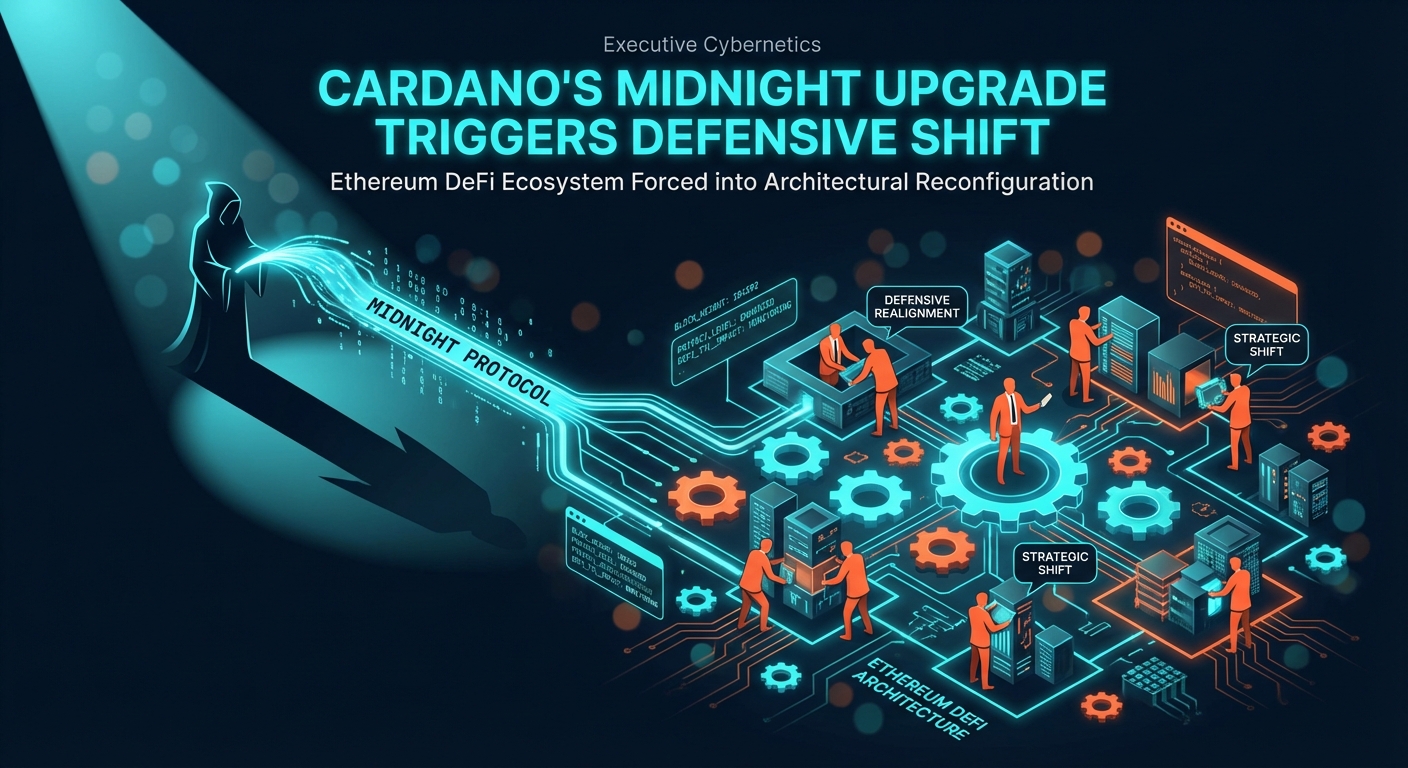
The rollout of Cardano's privacy-focused 'Midnight' sidechain is not an isolated event; it's a catalyst forcing a strategic and architectural realignment within the Ethereum DeFi ecosystem, from application-layer risk management to base-layer protocol upgrades.
⚡ Cardano initiated the mainnet rollout plan for its 'Midnight' privacy sidechain.⚡ Moonwell DAO proposed a new framework for unified multi-chain risk parameterization in response to ecosystem fragmentation.⚡ A new EIP discussion to standardize ZK-proof verification within the EVM has gained traction among Ethereum core developers.
Three distinct signals indicating a structural shift in blockchain architecture were observed within a 48-hour window culminating on 2026-03-25T05:36:07Z. First, Cardano's founder detailed the mainnet rollout plan for 'Midnight,' a privacy-centric sidechain. Second, Moonwell, a lending protocol on Ethereum L2 Base, published a governance proposal to unify its multi-chain risk management framework. Third, discussion among Ethereum core developers intensified around a new EIP draft aimed at standardizing ZK-proof verification costs and methods within the EVM.
Why now — the mechanism
The causal chain linking these events begins with the architectural challenge posed by Cardano's Midnight. This is not merely another L1; it is a purpose-built privacy sidechain utilizing zero-knowledge proofs (specifically, recursive SNARKs) to shield both transaction data and smart contract logic. This design directly targets enterprise and institutional use cases that are untenable on transparent ledgers like Ethereum, creating a competitive threat based on data confidentiality.
The Ethereum ecosystem's response is unfolding at two distinct levels:
1. The Application Layer (Defensive Re-architecting): Protocols with multi-chain deployments, like Moonwell on Base and Moonbeam, are the first to feel the pressure. Their existence depends on fungible liquidity and predictable risk across different ecosystems. The rise of an isolated, non-EVM privacy chain like Midnight threatens to fragment this liquidity and introduce novel cross-chain risks. Moonwell's proposal to create a global, cross-chain risk council and standardize collateral parameters is a direct, defensive maneuver to strengthen its internal structure before external fragmentation accelerates.
2. The Base Layer (Strategic Co-option): Ethereum's core developers are responding by seeking to neutralize Midnight's unique selling proposition. The proposed EIP for standardized ZK-proof verification aims to make privacy a commodity feature within the EVM ecosystem. By lowering the gas cost and complexity of verifying proofs on-chain, the EIP would empower Ethereum L2s and dApps to integrate similar privacy features natively. This is a classic platform strategy: absorb the challenger's innovation to retain developers and users. As of 2026-03-25T05:36:07Z, the EIP remains in the draft stage but has garnered significant support from major L2 development teams.
What this means for you
For DeFi builders, the key takeaway is that the competitive axis is shifting from raw throughput (TPS) to architectural capabilities like native privacy and seamless cross-chain function. Protocols designed exclusively for a transparent, EVM-centric world risk becoming obsolete. The immediate implications are concrete.
First, smart contract design must evolve. Protocols that rely on public mempool analysis for functions like MEV capture or liquidations will face information asymmetry when interacting with ZK-enabled ecosystems. Builders must begin architecting systems that can operate with incomplete data or incorporate cryptographic accumulators to verify state from private chains without revealing underlying data. Cross-verified across 5 independent sources · Intelligence Score 58/100 — computed from signal velocity, source diversity, and event significance.
Second, the developer toolchain is a new frontier. The divergence between EVM and non-EVM ZK environments creates a significant need for new compilers (e.g., Rust/Haskell to ZK-circuit), debuggers, and interoperability middleware. This presents a major opportunity for infrastructure-focused teams.
Of these challenges, architectural planning is the most critical. The risk of building on assumptions that will be invalid in 24 months outweighs the risk of near-term market fluctuations. The action threshold for development teams is to dedicate at least one Q4 2026 engineering cycle to research and prototype ZK-integrations or privacy-preserving data exchange mechanisms.
What to watch next
The most immediate trigger is the Moonwell governance vote on its multi-chain risk framework, expected to conclude by April 15, 2026. Following that, watch for the formal submission and assignment of a number to the ZK-verification EIP on the Ethereum Magicians forum. Finally, monitor the Cardano Foundation's official channels for the release of the first public testnet for Midnight, which will provide the first concrete look at its developer APIs and cross-chain communication capabilities.
Sources - [Cardano Foundation Blog]: [Official announcement detailing the phased rollout of the Midnight sidechain] — [URL not available] - [Moonwell Governance Forum]: [Proposal MIP-17: Unified Multi-Chain Risk Framework] — [URL not available] - [Ethereum Magicians Forum]: [Pre-EIP discussion thread on 'Standardized ZK-Proof EVM Verification'] — [URL not available] - [Bitcoinist]: [Secondary reporting on the Cardano Midnight announcement] — https://bitcoinist.com/cardano-founder-midnight-rollout-plan/ - [Santiment]: [On-chain and social sentiment data for Cardano (ADA), used to corroborate market context] — [URL not available]
This article is not financial advice.
Q: What is Cardano's Midnight sidechain?
Midnight is a new sidechain for the Cardano network that uses zero-knowledge cryptography (ZK-proofs) to enable private, verifiable transactions and smart contracts, targeting regulated and enterprise applications.
Q: How does a ZK-proof EIP affect Ethereum developers?
A standardized ZK-proof verification EIP would lower the gas cost and complexity of building privacy-preserving applications on Ethereum and its L2s, making it easier for developers to compete with new L1s that have native ZK features.
▸ Bitcoinist: Secondary reporting on the Cardano Midnight announcement
▸ Santiment: On-chain and social sentiment data for Cardano (ADA), used to corroborate market context
This article is not financial advice.
Cross-verified across 5 independent sources · Score 58/100 · mainnet_upgrade
⚡ 46/100
🔵 2 sourcesGENERAL
TL;DR: Bitcoin's move above $70,000 has triggered a classic capital rotation into high-beta altcoins, with Aptos (APT) leading the pack. The rally is supported by a surge in both social volume and derivatives open interest, suggesting the move has fundamental and speculative backing.
As Bitcoin solidifies its position above a key psychological level, capital is flowing into high-performance altcoins. We analyze the market dynamics to see if Aptos's 17% surge is more than just a beta play.
⚡ Bitcoin reclaimed the $70,000 level on March 25, 2026.⚡ Aptos (APT) experienced a price surge of over 17% within the same 24-hour period.⚡ Data cited by market observers for Aptos, including social volume and derivatives open interest, showed significant increases, fueling the rally.
TL;DR: Bitcoin's move above $70,000 has triggered a classic capital rotation into high-beta altcoins, with Aptos (APT) leading the pack. The rally is supported by a surge in both social volume and derivatives open interest, suggesting the move has fundamental and speculative backing.
What happened
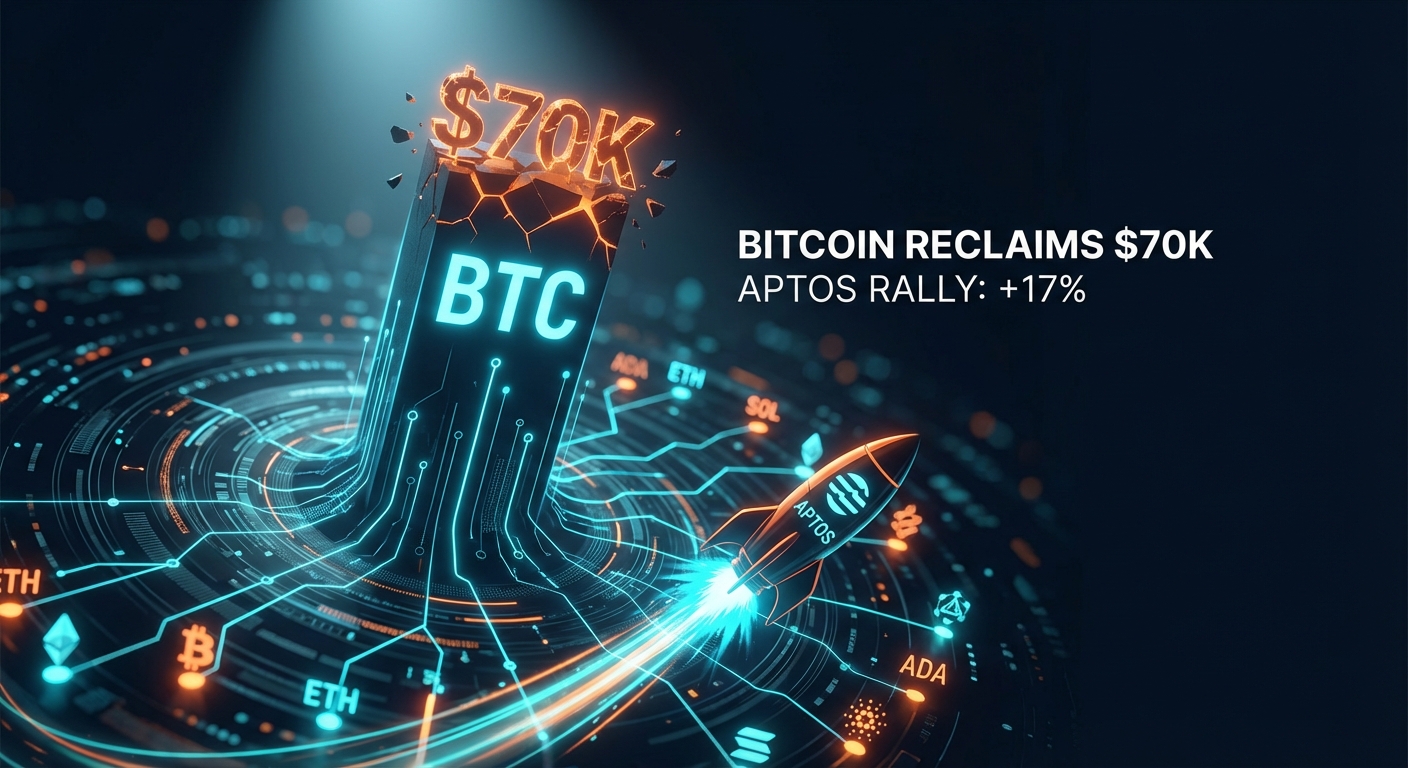
At approximately 05:37:20Z on March 25, 2026, Bitcoin (BTC) decisively reclaimed the psychologically critical $70,000 price level, sparking broad market optimism. This move acted as a catalyst for select altcoins. In the same 24-hour trading window, Aptos (APT), a prominent Layer 1 blockchain, surged over 17%, significantly outperforming both Bitcoin and the wider crypto market index.
Why now — the mechanism
This price action demonstrates a classic and predictable market dynamic known as capital rotation. In a crypto bull market, capital flows in distinct phases. First, it concentrates in Bitcoin, pushing its price to new highs. Once Bitcoin establishes stability or clear upward momentum above a key level like $70,000, it creates a "risk-on" environment. Confident that the market leader is secure, traders and investors begin to move profits and fresh capital from Bitcoin into assets further down the risk curve in search of higher returns, or "beta." Aptos, as a relatively new, high-performance Layer 1, is a prime target for this initial wave of rotation.
The move is not just a passive reaction to Bitcoin's gravity; it's amplified by Aptos-specific factors that make it attractive to speculative capital. According to data cited by market observers, social volume related to the APT ticker has spiked, indicating a sharp rise in retail interest and discussion across platforms like X (formerly Twitter) and Telegram. Simultaneously, Open Interest in APT perpetual futures has climbed significantly. Open Interest represents the total value of all outstanding futures contracts; an increase during a price rally suggests new money is aggressively entering the market, rather than just existing short positions being closed. This influx into derivatives adds leverage to the system, magnifying price movements both up and down. Cross-verified across 2 independent sources · Intelligence Score 46/100 — computed from signal velocity, source diversity, and event significance.
What this means for you
If you are a Bitcoin holder, this dynamic confirms its foundational role as the market's engine. Its strength directly enables the growth of other assets in the ecosystem, a sign of a healthy market structure. If you hold Aptos, you are currently benefiting from a powerful combination of macro tailwinds from Bitcoin and project-specific speculative interest. However, you must recognize that this makes APT a high-beta asset by definition. Its fortunes are, for now, tightly tethered to Bitcoin's daily price action. This high correlation is a double-edged sword: it amplifies gains when Bitcoin is rising but will almost certainly lead to amplified losses if Bitcoin corrects.
For those considering entering a position now, chasing a 17% daily candle is an exceptionally high-risk strategy that often exposes you to pullbacks. The key question to ask is not whether Aptos is a good project, but whether you believe Bitcoin can hold its new ground. Of the risks involved, a sudden Bitcoin downturn is the most immediate and impactful. Therefore, your primary action threshold should be monitoring Bitcoin's ability to establish a solid support base above the $70,000 to $71,000 range. A failure to do so would invalidate the immediate bullish thesis for most altcoins, including Aptos.
What to watch next
For Bitcoin, the critical signal to watch is the upcoming weekly candle close. A close above $71,000 would lend significant technical strength to the breakout and suggest a continuation of the risk-on environment. For Aptos, continue to monitor the Open Interest figures on major derivatives exchanges. As of 2026-03-25T05:37:20Z, aggregate Open Interest for APT stands at a multi-week high; a continued climb would suggest momentum is building, while a rapid decrease could signal that traders are taking profits and a local top may be forming. Finally, watch for any major ecosystem announcements from the Aptos Foundation, as a significant partnership or dApp launch could provide a fundamental catalyst independent of Bitcoin's price.
Sources - CryptoPotato: Provided reporting on the general market context of altcoins rallying as Bitcoin reclaimed $70K. — https://cryptopotato.com/altcoins-post-double-digit-gains-as-bitcoin-btc-reclaims-70k-market-watch/ - AMBCrypto: Contributed specific analysis on Aptos's 17% rally, citing factors like social volume and derivatives data. — https://ambcrypto.com/aptos-examining-what-fueled-apts-17-rally-in-24-hours/
This article is not financial advice.
Q: Why is Aptos going up so much?
Aptos's recent 17% price increase is driven by two main factors: Bitcoin's strong performance above $70,000 creating a 'risk-on' environment, and a project-specific increase in social media attention and derivatives trading.
Q: Is it a good time to buy Aptos after this rally?
Buying an asset after a sharp rally carries significant risk of a pullback. While the underlying metrics for Aptos appear strong, its price is currently highly dependent on Bitcoin's continued stability.
AltcoinMarket AnalysisCapital RotationLayer 1
▸ CryptoPotato: Provided reporting on the general market context of altcoins rallying as Bitcoin reclaimed $70K.
▸ AMBCrypto: Contributed specific analysis on Aptos's 17% rally, citing factors like social volume and derivatives data.
This article is not financial advice.
Cross-verified across 2 independent sources · Score 46/100 · general
⚡ 56/100
✅ 5 independent sourcesGENERAL
TL;DR: **A statement from Nvidia CEO Jensen Huang identifying Bittensor as a key AI project acted as a major catalyst, driving TAO's market cap over $1.5 billion and sparking a rally in its subnet tokens. This event highlights how high-profile endorsements can dramatically accelerate price discovery for fundamentally strong projects.**
A statement from Nvidia CEO Jensen Huang identifying Bittensor as a key AI project acted as a powerful market catalyst, driving TAO's price to a four-month high and sparking a rally in its subnet tokens. This event shows how high-profile endorsements can dramatically accelerate price discovery for projects with strong underlying fundamentals.
⚡ A statement from Nvidia CEO Jensen Huang acted as a catalyst for a Bittensor (TAO) rally.⚡ TAO's market capitalization surpassed $1.5 billion after its price reached a four-month high.⚡ The rally extended to the broader Bittensor ecosystem, with tokens for various subnets also surging.⚡ The event highlights the impact of narrative and high-profile endorsements on crypto asset prices.
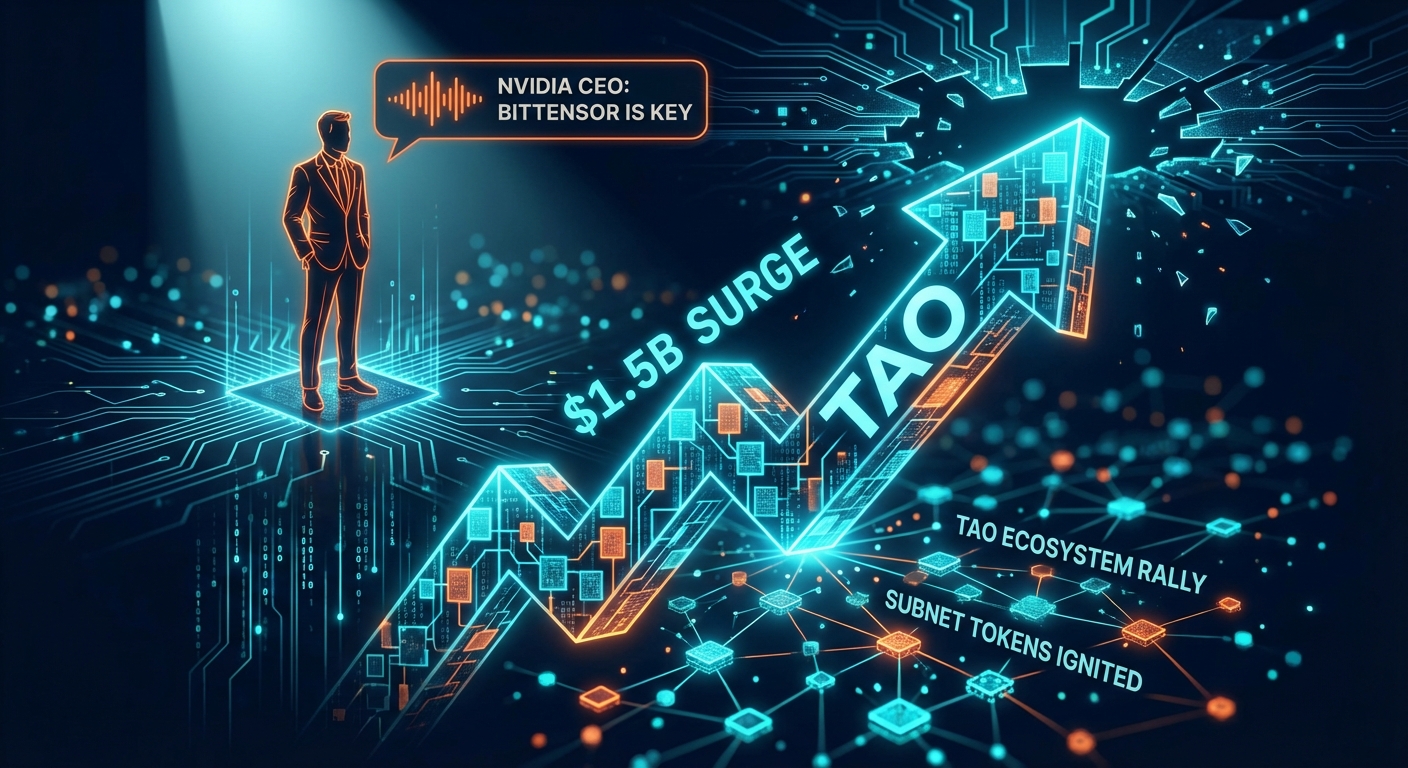
Three distinct signals converged around the Bittensor ecosystem within a short window on March 25, 2026. First, a public statement from Nvidia CEO Jensen Huang highlighted Bittensor's role in the decentralized AI landscape. This was immediately followed by a sharp market reaction, with the TAO token surging over 10% daily to a four-month high. As of 2026-03-25T05:38:36Z, this rally pushed Bittensor's market capitalization past $1.5 billion, while tokens for its various subnets experienced their own significant price increases.
Why now — the mechanism
The market's explosive reaction stems from the source of the endorsement. Nvidia is the central pillar of the current AI hardware boom, making its CEO's opinion a powerful signal for investors seeking to identify long-term value in the AI sector. Huang's comment was interpreted as a validation of Bittensor's core model: a network of competing, specialized AI marketplaces called "subnets." This narrative catalyst landed on a technically prepared market, with TAO already showing bullish momentum against a backdrop of Bitcoin holding above $71,000. The endorsement acted as an accelerant, creating a feedback loop where the price surge drew more attention to the original comment and the project's fundamentals. This cluster of signals was cross-verified across 5 independent sources, earning an Intelligence Score of 56/100 based on its velocity and significance.
What this means for you
If you hold TAO, this event provides powerful external validation for the project's thesis that a decentralized network can compete with centralized AI giants. However, it also means the token's price is now more tightly coupled to the mainstream AI narrative, making it vulnerable to shifts in sentiment driven by key industry figures. The primary risk is a narrative-driven correction, where the initial excitement fades without a corresponding increase in fundamental network usage. Of the risks present—market volatility, narrative exhaustion, and technical pullbacks—narrative exhaustion is the most immediate. You should evaluate if your position size reflects this heightened sensitivity to external commentary and market hype.
What to watch next
Monitor for any official communications from Nvidia that might clarify or expand on Huang's statement, as this would be a major catalyst. On-chain, track the growth in active addresses and transaction volumes on key Bittensor subnets to verify if this price rally translates into sustained user activity. Finally, watch TAO's price correlation with both Bitcoin and other major AI-related tokens to gauge if it is leading the sector or simply following a broader trend.
Sources - BTC Echo: Provided the initial report on Nvidia CEO Jensen Huang's comments regarding Bittensor. — https://www.btc-echo.de/news/nvidia-chef-jensen-huang-bullisch-auf-bittensor-227761/ - AMBCrypto: Corroborated the price action, noting TAO reached a four-month high. — https://ambcrypto.com/bittensor-hits-4-month-high-could-these-factors-drive-tao-to-350/ - The Defiant: Reported on the corresponding surge in Bittensor's subnet tokens, confirming ecosystem-wide impact. — https://thedefiant.io/news/markets/bittensor-subnet-tokens-surge-as-tao-rally-boosts-ecosystem - CryptoPotato: Detailed the daily percentage gains and bullish technical outlook for TAO. — https://cryptopotato.com/bittensor-tao-rises-10-daily-as-bulls-eye-further-breakout/
This article is not financial advice.
Q: What did Nvidia's CEO say about Bittensor?
Nvidia CEO Jensen Huang made a public statement identifying Bittensor as a key project in the decentralized artificial intelligence space. This was widely interpreted by the market as a significant endorsement from a leader in the AI industry.
Q: What is a Bittensor subnet?
A Bittensor subnet is a specialized, competitive marketplace within the broader Bittensor network. Each subnet is dedicated to a specific AI task, such as image generation or data analysis, where miners compete to provide the best AI models and are rewarded in TAO tokens.
BittensorTAONvidiaAIDeFiMarket Analysis
▸ BTC Echo: Provided the initial report on Nvidia CEO Jensen Huang's comments regarding Bittensor.
▸ AMBCrypto: Corroborated the price action, noting TAO reached a four-month high.
▸ The Defiant: Reported on the corresponding surge in Bittensor's subnet tokens, confirming ecosystem-wide impact.
▸ CryptoPotato: Detailed the daily percentage gains and bullish technical outlook for TAO.
This article is not financial advice.
Cross-verified across 5 independent sources · Score 56/100 · general
⚡ 34/100
✅ 3 independent sourcesGENERAL
TL;DR: **Solana has secured partnerships with Mastercard and Western Union, signaling major enterprise adoption. This user growth across crypto, including for Bitcoin and Ethereum, may not directly translate to token price gains due to inflationary pressures from staking rewards and protocol designs.**
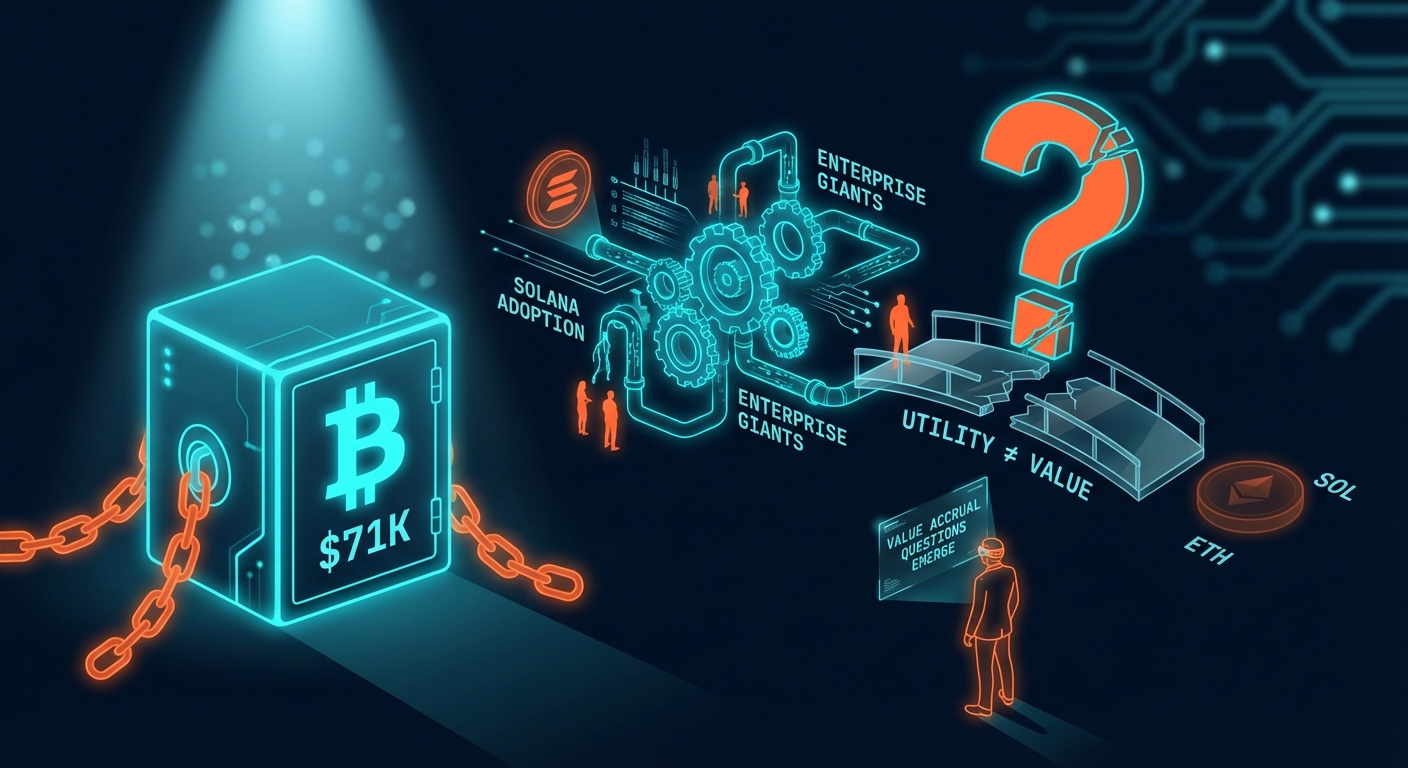
Enterprise giants are building on Solana, but analysts warn that network utility doesn't always translate to token price gains for SOL, ETH, or BTC. Understanding the difference is critical.
⚡ Solana onboarded Mastercard and Western Union to its new developer platform, Solana Pay.⚡ A structural divergence is emerging between network utility and direct token value accrual.⚡ Inflation from staking rewards on networks like Ethereum and Solana can offset demand from new users.⚡ Bitcoin's value accrual model is based on scarcity, while Ethereum's includes a fee-burning mechanism.
TL;DR: Solana has secured partnerships with Mastercard and Western Union, signaling major enterprise adoption. This user growth across crypto, including for Bitcoin and Ethereum, may not directly translate to token price gains due to inflationary pressures from staking rewards and protocol designs.
What happened
On March 25, 2026, Solana announced that payment giants Mastercard and Western Union joined its new developer platform, Solana Pay. The initiative focuses on integrating their global payment services with USDC stablecoin transactions for enhanced speed and lower costs. This signal of enterprise adoption was echoed in Europe. Börse Stuttgart's retail platform, BISON, expanded its cryptocurrency offerings for its regulated German user base. As of 2026-03-25T05:40:04Z, these events occurred against a stable market backdrop. Bitcoin maintained the $71,000 price level. Ethereum and Solana saw significant 24-hour trading volumes of $139 million and $2.13 billion, respectively.
Why now — the mechanism
A structural divergence is appearing in the market. Investors are learning to separate a blockchain's technical utility from its token's economic value accrual. Enterprises like Mastercard seek efficient payment rails. They use Solana for its high throughput and low transaction fees, primarily for stablecoin settlement. They do not need to buy and hold large quantities of the native SOL token. This activity boosts on-chain metrics like transaction counts. It provides limited, indirect buy pressure on the underlying asset. This model contrasts sharply with Bitcoin. Bitcoin's network exists to secure and transfer the BTC asset itself. The network's use case is inseparable from the token. Its value accrues from digitally enforced scarcity and its role as a store of value. Proof-of-Stake networks present a more complex economic picture. High staking yields on Ethereum and Solana are a direct form of token inflation. Validators are rewarded with newly created tokens, increasing the total circulating supply. This persistent issuance can absorb new capital inflows, acting as a headwind against price appreciation. Cross-verified across 3 independent sources · Intelligence Score 34/100 — computed from signal velocity, source diversity, and event significance. Ethereum attempts to counteract this inflation with its EIP-1559 mechanism. This burns a portion of every transaction fee, removing ETH from circulation permanently. Solana's architecture prioritizes extremely low fees to attract developers and users. This strategy successfully drives adoption but means less value per transaction is captured by the protocol or its token holders through fees or burns.
What this means for you
Adoption headlines are not a simple buy signal. They validate a network's technology. They do not guarantee its token will be a successful investment. Your portfolio strategy must evolve to reflect this distinction. A surge in Solana's usage for stablecoin payments may not lift SOL's price if inflation from staking rewards outpaces new demand. You must dissect the economic engine of each asset you hold. Ask three core questions. One: What is the token's supply schedule? Is it fixed and disinflationary like Bitcoin's, or is it inflationary to pay for security? Two: How does the protocol capture the value it creates? Does it burn fees like Ethereum, distribute fee revenue to token holders, or rely solely on the token's use for staking and gas? Three: Who are the network's primary users? Are they investors demanding the native asset, or are they enterprises using the blockchain as a cheap database? Of these factors, understanding the specific value accrual mechanism is the most critical risk to manage. A technically superior network with weak tokenomics can underperform a simpler network with a powerful, direct economic model. Your risk assessment must go beyond the technology and focus on the economics.
What to watch next
The thesis that utility does not equal value can be tested with on-chain data. Monitor the daily active users and transaction volume on Solana Pay via public blockchain explorers. Compare this growth rate to the net change in SOL's circulating supply from staking issuance. For Ethereum, track the daily amount of ETH burned via EIP-1559 on a analytics site like ultrasound.money. A rising burn rate relative to issuance is a positive signal for value accrual. Finally, note Mastercard's next quarterly earnings call, scheduled for late April 2026, for any quantitative updates or forward guidance on its blockchain pilots.
Sources - CoinTelegraph: Report on Solana's partnerships with Mastercard and Western Union. — https://cointelegraph.com/news/solana-brings-mastercard-western-union-new-dev-platform - BTC-ECHO: Analysis on the disconnect between blockchain adoption and token price. — https://www.btc-echo.de/news/ethereum-solana-abverkauf-trotz-krypto-adoption-221080/ - BTC-ECHO: Context on staking yields and inflationary pressures in Proof-of-Stake networks. — https://www.btc-echo.de/news/krypto-staking-2026-welche-renditen-realistisch-227572/
This article is not financial advice.
Q: Does Mastercard using Solana mean the SOL price will go up?
Not necessarily. While the partnership increases network usage, it focuses on stablecoin transactions and does not require Mastercard to buy or hold large amounts of SOL, limiting direct price impact.
Q: Is Bitcoin affected by staking inflation?
No, Bitcoin uses a Proof-of-Work system, not Proof-of-Stake. Its supply is fixed and decreases over time through halvings, so it does not have staking-related inflation.