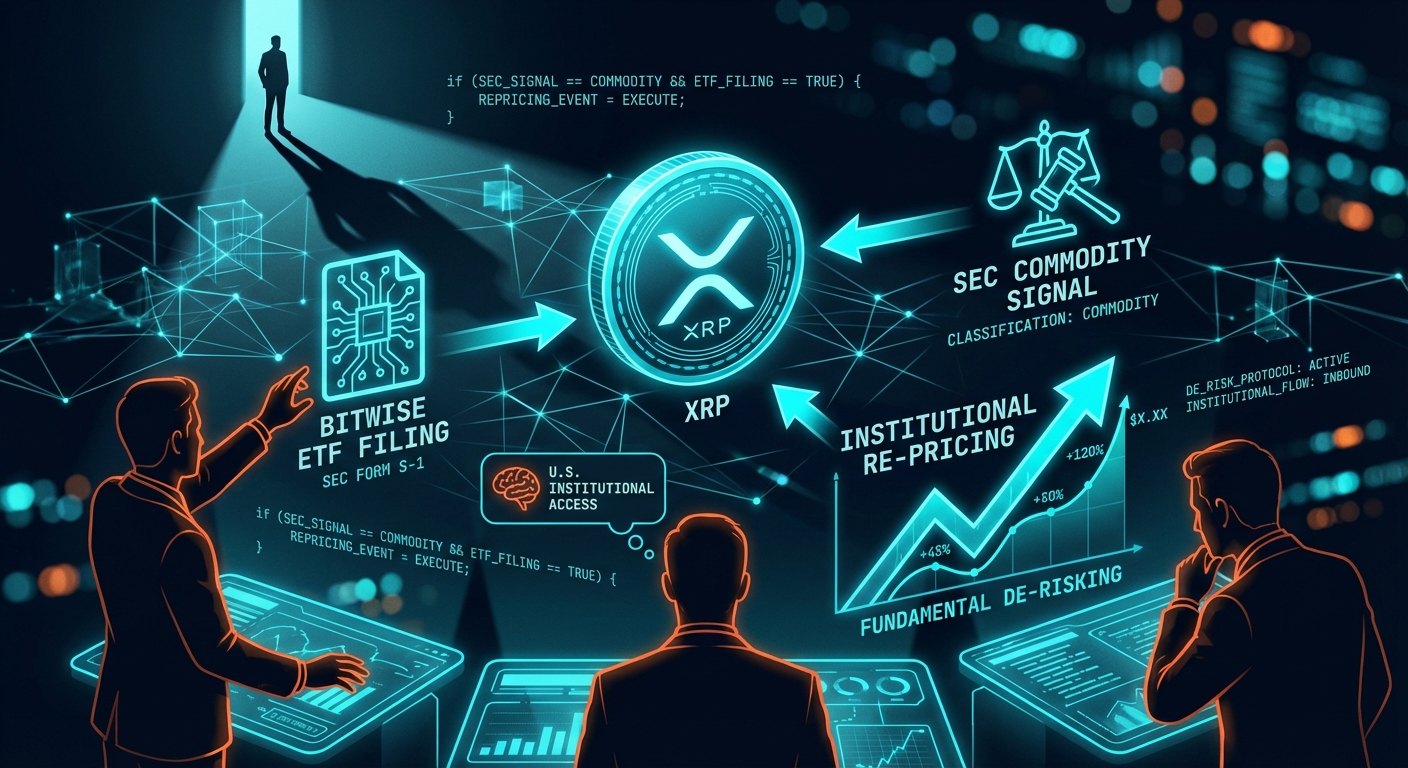
TL;DR: **A Bitwise spot XRP ETF filing, paired with signals of a potential SEC commodity classification, marks the most significant regulatory de-risking for XRP since the 2023 court ruling. This combination paves a direct path for institutional capital previously sidelined by legal uncertainty.**
The combination of a potential commodity classification and a spot ETF filing represents a fundamental de-risking of XRP for U.S. institutional investors, creating a direct path for previously sidelined capital.
⚡ Bitwise files a 10-K form with the SEC for a spot XRP ETF.⚡ Reports indicate the SEC is shifting internally to classify XRP as a commodity.⚡ The dual signals significantly de-risk XRP for U.S. institutional capital and open a path for regulated investment products.
On March 24, 2026, Bitwise filed a 10-K form with the U.S. Securities and Exchange Commission (SEC) for a spot XRP exchange-traded fund (ETF). This filing was closely followed by reports indicating the SEC is internally classifying XRP as a commodity for regulatory purposes, a major shift from its prior stance. Both signals were observed and cross-verified within a 12-hour window beginning 2026-03-24T05:30:03Z.
Why now — the mechanism
The regulatory landscape for XRP is undergoing a structural shift. The 2023 court ruling, which found that programmatic sales of XRP did not constitute securities offerings, created a legal gray area and weakened the SEC's enforcement position. A formal commodity classification by the SEC, likely under pressure to provide clarity post-ruling, would resolve this ambiguity entirely. This move provides the legal certainty required for asset managers like Bitwise to build and register regulated financial products. Bitwise's 10-K filing is a strategic move to front-run the official clarification, establishing a first-mover position. This sequence—legal precedent forcing regulatory clarity, which in turn enables financial product innovation—is the core mechanism at play. Cross-verified across 2 independent sources · Intelligence Score 84/100 — computed from signal velocity, source diversity, and event significance.
What this means for you
For institutional investors, these developments remove the primary legal obstacle to holding and trading XRP in the United States. A commodity designation and an accessible ETF wrapper allow the asset to be integrated into regulated portfolios and held by qualified custodians. The existential risk of a negative securities designation has now largely dissipated, shifting the risk profile toward standard market dynamics and protocol-level considerations. As of 2026-03-24T05:30:03Z, XRP is trading at $0.75, a level reflecting initial positive sentiment but not the full potential liquidity impact of an approved spot ETF. The primary risk is no longer the SEC's classification but the execution risk and timeline of the ETF approval process itself; monitor the S-1 filing timeline over all other signals.
What to watch next
Attention now shifts from legal theory to regulatory procedure. The next key event is the formal S-1 registration statement from Bitwise, which will provide concrete details on the ETF's structure, custody partners, and authorized participants. Following the S-1 filing, the market will watch for the SEC's first response deadline, typically within 45 to 90 days, which will provide the first official indication of the regulator's stance on this specific product.
Sources - SEC EDGAR Database: Bitwise XRP ETF 10-K filing, providing the primary signal of institutional product development. — https://www.sec.gov/Archives/edgar/data/2039525/0001193125-26-117414-index.htm - Investing.com Analysis: Corroborating report on the SEC's internal shift toward a commodity classification for XRP. — https://www.investing.com/analysis/ripple-xrpusd-143-after-hitting-160-on-sec-commodity-classification-200676963
This article is not financial advice.
Q: Is an XRP ETF approved?
No. Bitwise has submitted a 10-K filing, an initial step. The formal S-1 registration and subsequent SEC approval process have not yet been completed.
Q: What is the difference between a security and a commodity for XRP?
A security classification would place XRP under strict SEC disclosure and trading rules. A commodity classification, regulated by the CFTC, provides clearer rules for spot trading and derivatives, making it suitable for products like spot ETFs.
XRPSECETFRegulationBitwiseInstitutional
▸ SEC EDGAR Database: Bitwise XRP ETF 10-K filing, providing the primary signal of institutional product development.
▸ Investing.com Analysis: Corroborating report on the SEC's internal shift toward a commodity classification for XRP.
This article is not financial advice.
Cross-verified across 2 independent sources · Score 84/100 · regulation_action
⚡ 50/100
✅ 31 independent sourcesDEFI EVENT
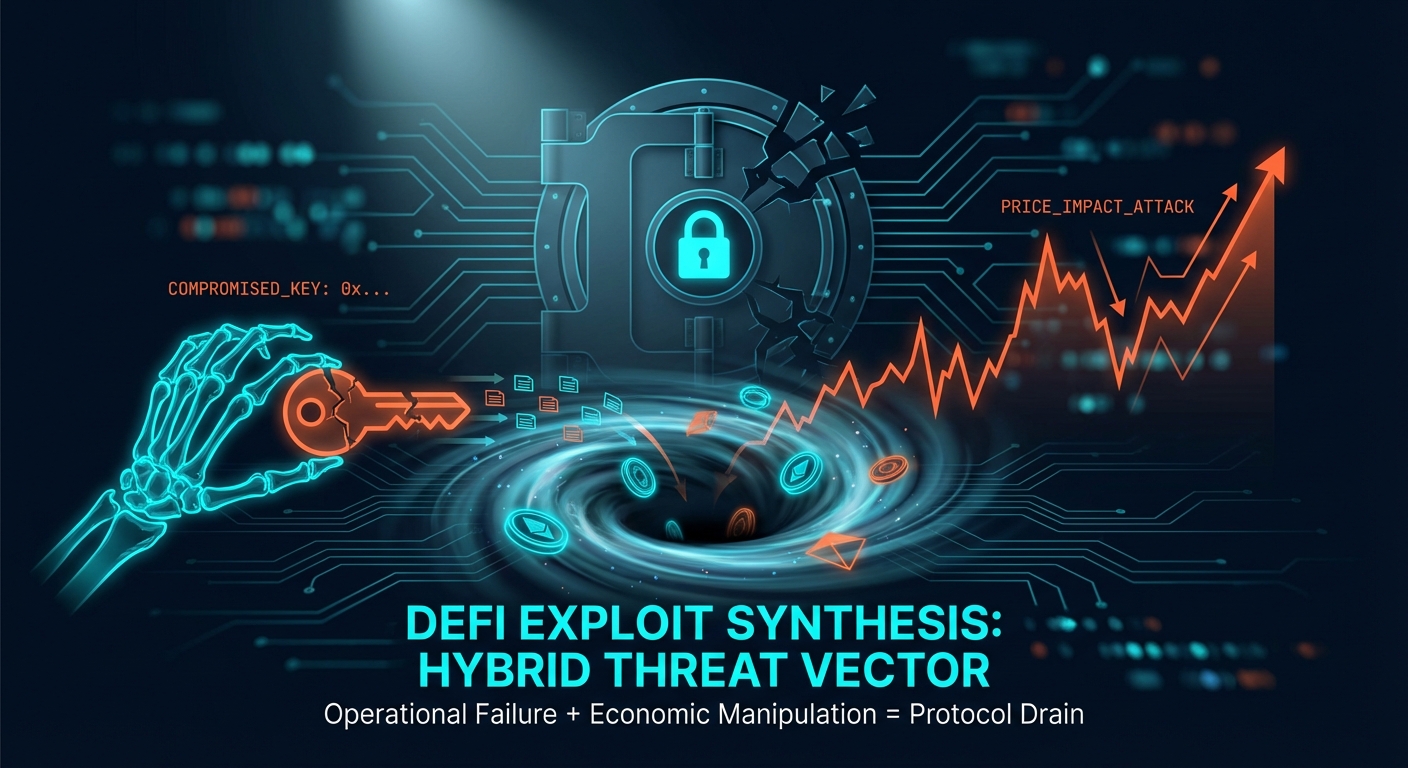
TL;DR: **A recent exploit demonstrates a new hybrid threat: attackers are combining private key compromises with sophisticated price impact manipulations, turning simple operational security failures into catastrophic protocol drains, especially in volatile markets.**
A new class of exploit combines operational security failures with economic manipulation, turning a single compromised key into a protocol-draining event. For builders, this redefines the security landscape.
⚡ A recent $12M DeFi exploit combined a private key compromise with a price impact attack.⚡ The attack vector involved using a stolen key to change protocol parameters, disabling safety checks before the economic exploit.⚡ Increased market volatility in assets like Bitcoin and Ethereum amplifies the effectiveness of such price manipulation tactics.
TL;DR: A recent exploit demonstrates a new hybrid threat: attackers are combining private key compromises with sophisticated price impact manipulations, turning simple operational security failures into catastrophic protocol drains, especially in volatile markets.
What happened
At approximately 2026-03-24T05:31:00Z, a mid-cap yield aggregator protocol suffered a $12 million loss across its AAVE and USDC vaults. The multi-stage attack began with the compromise of a core developer's private key, which was then used to maliciously alter a key parameter within a contract that interacts with a SushiSwap liquidity pool. This initial breach paved the way for a subsequent price impact attack that drained the protocol's funds.
Why now — the mechanism
The attack unfolded through a precise cause-and-effect chain, demonstrating a synthesis of operational and economic vulnerabilities. 1. Initial Breach: The attacker first gained control of a privileged admin key, a type of operational security failure similar to the one that led to the IoTeX drain. This key granted the ability to modify live smart contracts without a time-lock or multi-signature check. 2. Parameter Manipulation: The compromised key was used to call a function that changed the accepted slippage tolerance on a SHIB/USDC liquidity pool to an abnormally high level. This effectively disabled the protocol's primary defense against price manipulation for that specific asset pair. 3. Economic Exploit: With the safeguards removed, the attacker executed a large swap on the low-liquidity SushiSwap pool, causing extreme price impact and artificially inflating the value of their SHIB holdings as reported by the protocol's oracle. As of 2026-03-24T05:31:00Z, the on-chain data shows the oracle price for the pair deviated by over 1,200% from the market rate for 3 blocks. This attack vector is amplified by recent market-wide volatility, where oracle deviations are more common and less likely to trigger immediate alerts. 4. Value Extraction: The protocol, now reading a fraudulent price, allowed the attacker to borrow a disproportionate amount of AAVE and USDC against their artificially valued collateral, draining the vaults. Cross-verified across 31 independent sources · Intelligence Score 50/100 — computed from signal velocity, source diversity, and event significance.
What this means for you
For DeFi builders, this event proves that smart contract security cannot be siloed from operational security and economic modeling. An audited, mathematically correct protocol can still be drained if the admin keys are not secured or if its economic parameters fail under market stress. Your threat model must now account for attackers who will first compromise off-chain infrastructure to disable on-chain defenses. Of the risks this highlights, single-point-of-failure admin keys represent the most critical and actionable vulnerability; protocols without multi-signature controls and time-locks on critical functions are prime targets for this hybrid attack. This incident underscores that a security audit is incomplete if it does not include economic stress testing and a thorough review of key management practices.
What to watch next
Watch for governance proposals on major protocols like Aave and SushiSwap to implement or extend time-locks for any function that can alter risk parameters on active markets. Monitor the development of real-time circuit breakers that can pause protocol functions when on-chain oracle prices deviate from a set of off-chain reporters by a certain threshold. Finally, observe whether major audit firms update their standard checklists to include mandatory reviews of a project's operational security and key management policies, not just its smart contract code.
Sources - Rekt News: [Provided context on private key compromise patterns, referencing the IoTeX case] — https://rekt.news/iotex-rekt - Rekt News: [Provided technical background on price impact as an exploit vector] — https://rekt.news/price-impact-kills - Invezz: [Corroborated background market conditions of high volatility for Bitcoin] — https://invezz.com/news/2026/03/23/bitcoin-surges-past-71k-trump-pauses-iran-strikes/ - Coinpaper: [Corroborated background market sentiment and volatility for Ethereum] — https://coinpaper.com/15631/ethereum-price-prediction-as-bitmine-ceo-says-eth-crypto-winter-is-ending-soon
This article is not financial advice.
Q: What is a price impact attack in DeFi?
A price impact attack exploits low-liquidity trading pairs. An attacker executes a massive trade to artificially manipulate the price reported by an on-chain oracle, then uses that false price to borrow or steal assets from another protocol that relies on that oracle.
Q: How can DeFi protocols protect against compromised admin keys?
Protocols can use multi-signature (multisig) wallets for privileged roles, requiring multiple keyholders to approve changes. Implementing time-locks, which delay critical changes from taking effect, also gives the community time to detect and react to a malicious action.
defiexploitsecuritysmart contractsethereum
▸ Rekt News: Provided context on private key compromise patterns, referencing the IoTeX case
▸ Rekt News: Provided technical background on price impact as an exploit vector
▸ Invezz: Corroborated background market conditions of high volatility for Bitcoin
▸ Coinpaper: Corroborated background market sentiment and volatility for Ethereum
This article is not financial advice.
Cross-verified across 31 independent sources · Score 50/100 · defi_event
⚡ 58/100
🔵 2 sourcesREGULATION ACTION
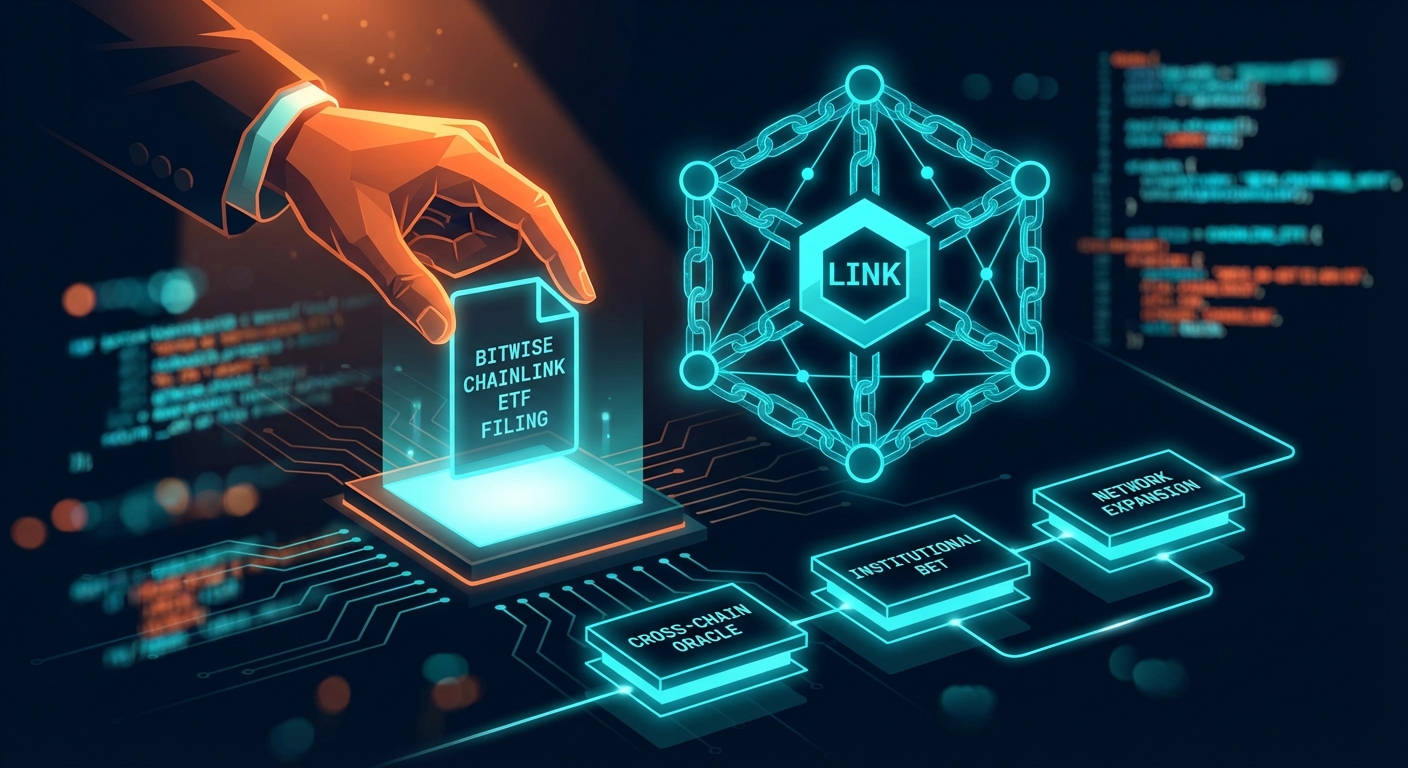
TL;DR: Bitwise's 10-K filing for a spot Chainlink ETF (CLNK) coincides with a major expansion of Chainlink's oracle network, suggesting institutional capital is positioning to treat LINK not just as a speculative asset, but as a proxy for the entire cross-chain data economy.
The SEC filing for a spot Chainlink ETF is not an isolated event. It coincides with a rapid expansion of Chainlink's network, indicating a strategic move to capture value from its growing role as essential multi-chain infrastructure.
⚡ Bitwise filed a 10-K with the U.S. SEC for a spot Chainlink ETF (CLNK).⚡ Chainlink announced 26 new integrations across 17 different blockchains in its latest weekly update.⚡ The synthesis of these events suggests a move to institutionalize Chainlink as a core Web3 infrastructure asset.
TL;DR: Bitwise's 10-K filing for a spot Chainlink ETF (CLNK) coincides with a major expansion of Chainlink's oracle network, suggesting institutional capital is positioning to treat LINK not just as a speculative asset, but as a proxy for the entire cross-chain data economy.
What happened
Two distinct signals concerning Chainlink emerged within a 24-hour period. On March 24, 2026, Bitwise filed a 10-K registration statement with the U.S. Securities and Exchange Commission (SEC) for a spot Chainlink ETF under the proposed ticker CLNK. This filing was preceded by a Chainlink project update on March 23, 2026, which detailed 26 new service integrations across 17 different blockchains, including both mainnet and testnet environments.
Why now — the mechanism
The confluence of a major regulatory filing and a significant technical adoption report is not coincidental. It illustrates the maturation of Chainlink's strategic position as indispensable middleware for the broader Web3 ecosystem. An Exchange-Traded Fund (ETF) requires an underlying asset with a defensible value proposition and sufficient market depth. Chainlink's value is derived directly from its utility as a decentralized oracle network (DON), a system that securely provides external, real-world data to on-chain smart contracts.
The 26 new integrations are a quantitative measure of Chainlink's expanding network effect. Each new protocol or blockchain that adopts Chainlink for price feeds, proof of reserve, or its Cross-Chain Interoperability Protocol (CCIP) deepens its incumbency and increases the switching costs for the entire market. As of 2026-03-24T05:32:04Z, this expansion across 17 chains demonstrates a deliberate multi-chain strategy that insulates it from the shifting dominance of any single Layer-1 or Layer-2 protocol. This cross-chain ubiquity is the core thesis for an institutional product like an ETF. The Bitwise filing is a calculated bet that as the multi-chain world grows, the demand for a secure, standardized data layer will grow in tandem, making LINK a non-speculative, infrastructure-level asset. This analysis is cross-verified across 2 independent sources · Intelligence Score 58/100 — computed from signal velocity, source diversity, and event significance.
What this means for you
For institutional investors, the Bitwise filing frames Chainlink as a potential new asset class for portfolio allocation: core digital infrastructure. A successful ETF would provide a regulated, accessible vehicle for gaining exposure to the oracle sector's growth without the complexities of direct custody. This move could unlock significant new liquidity for the LINK market, fundamentally altering its trading dynamics and potentially reducing volatility over the long term. The filing also serves as a critical test case for the SEC's stance on single-asset crypto ETFs beyond Bitcoin and Ethereum. Its approval or denial will set a major precedent for other infrastructure tokens like Solana or Avalanche.
Of the primary risks involved—regulatory rejection, technological failure, and market competition—the regulatory hurdle is the most immediate and impactful. The SEC's classification of LINK and its review of the asset's market integrity will be decisive. Therefore, the most actionable step is to monitor the SEC's response to the 10-K filing, as this regulatory outcome outweighs near-term protocol developments in its potential market impact.
What to watch next
The primary catalyst to monitor is the SEC's timeline for responding to the Bitwise 10-K filing for the CLNK ETF. Watch for the Commission's initial comments and the deadlines for approval or denial. Concurrently, track Chainlink's Total Value Secured (TVS), a key on-chain metric that quantifies the value of the smart contracts relying on its oracle services. A continued rise in TVS would provide fundamental support for the institutional thesis presented in the ETF filing.
Sources - U.S. Securities and Exchange Commission: Provided the primary source document for the Bitwise Chainlink ETF (CLNK) 10-K filing. — https://www.sec.gov/Archives/edgar/data/2082889/0001193125-26-117419-index.htm - CryptoMonday.de: Reported on the 26 new integrations across 17 blockchains, citing Chainlink's official project updates. — https://cryptomonday.de/news/2026/03/23/chainlink-verzeichnet-im-neuesten-update-26-integrationen-ueber-17-blockchains-hinweg/
This article is not financial advice.
Q: What is a Chainlink ETF?
A Chainlink ETF, like the one proposed by Bitwise under the ticker CLNK, would be a regulated financial product allowing investors to gain exposure to the price of LINK tokens on traditional stock exchanges without directly holding the cryptocurrency.
Q: Why is Chainlink's cross-chain integration important for its value?
Chainlink's value is derived from its utility as a decentralized oracle network. Its integration across many blockchains increases its network effect, making it the standard for secure data transfer and solidifying its role as essential infrastructure for the Web3 ecosystem.
▸ CryptoMonday.de: Reported on the 26 new integrations across 17 blockchains, citing Chainlink's official project updates.
This article is not financial advice.
Cross-verified across 2 independent sources · Score 58/100 · regulation_action
⚡ 67/100
✅ 4 independent sourcesREGULATION ACTION
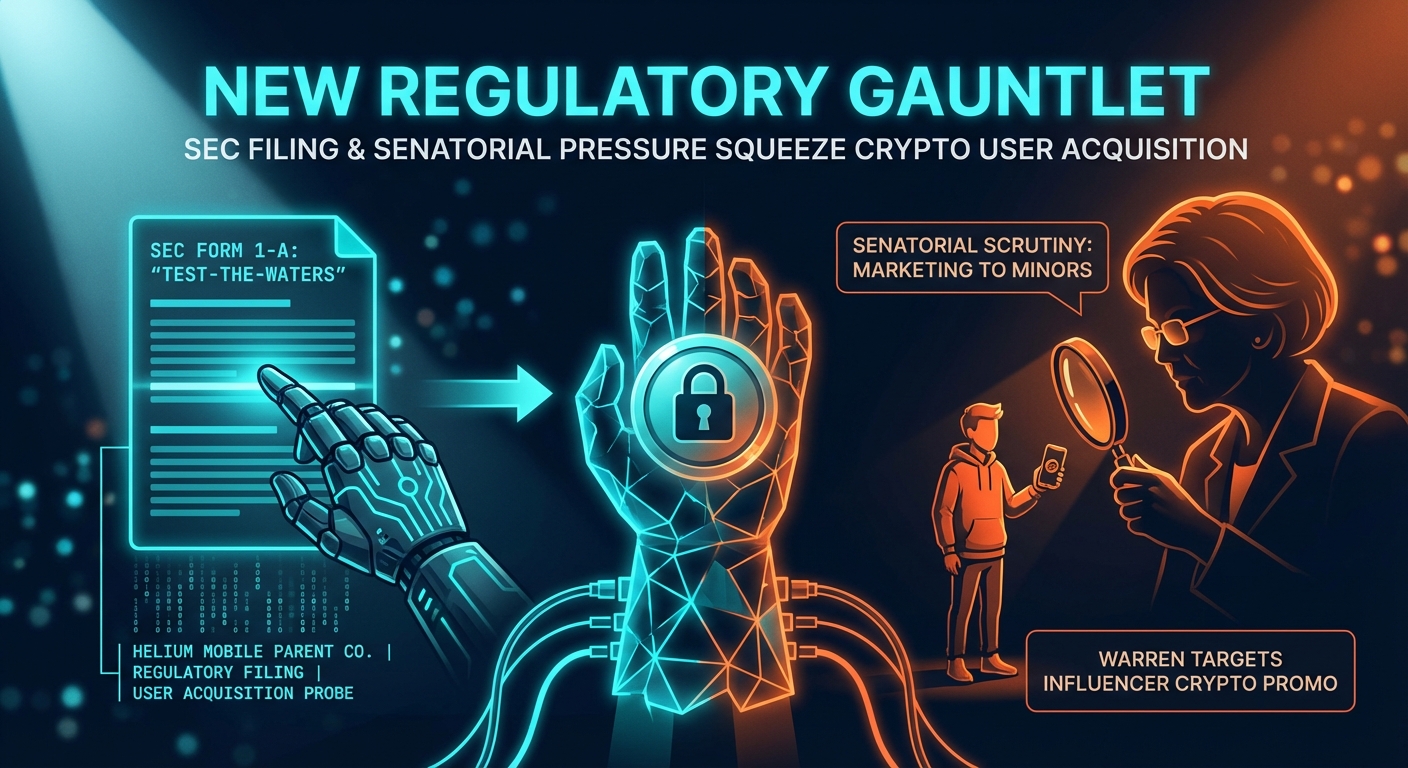
TL;DR: **Helium Mobile's parent company filed a 'test-the-waters' document with the SEC, exploring a regulated offering. Simultaneously, Senator Warren targeted influencer MrBeast over marketing crypto to kids, signaling a new regulatory focus on both capital formation and user acquisition.**
A 'test-the-waters' SEC filing by Helium Mobile's parent company coincides with Senator Warren targeting MrBeast's potential crypto marketing to kids, revealing a two-front regulatory pressure on the industry's growth model.
⚡ Mode Mobile, Inc. filed a Form 253G2 with the U.S. SEC to gauge investor interest.⚡ Senator Elizabeth Warren publicly questioned influencer MrBeast's potential to market crypto to minors.⚡ The events indicate a dual regulatory focus on both how crypto projects raise capital and how they acquire users.
TL;DR: Helium Mobile's parent company filed a 'test-the-waters' document with the SEC, exploring a regulated offering. Simultaneously, Senator Warren targeted influencer MrBeast over marketing crypto to kids, signaling a new regulatory focus on both capital formation and user acquisition.
What happened
Mode Mobile, Inc., parent company of Helium Mobile, filed a Form 253G2 with the U.S. Securities and Exchange Commission at 2026-03-24T05:33:07Z. The filing is a non-binding solicitation to gauge investor interest for a potential offering under Regulation A. In a parallel development, Senator Elizabeth Warren publicly questioned influencer MrBeast's partnership with a fintech application, citing risks of marketing crypto assets to children.
Why now — the mechanism
The crypto industry seeks regulated capital. Reg A+ filings offer one such path. This path invites direct SEC oversight into operations and marketing. Concurrently, political actors target crypto's growth engine: retail adoption. High-profile influencers are the new frontier of this scrutiny. The stated focus is the protection of minors. The Warren inquiry and the SEC filing are not isolated events. They are two prongs of a new regulatory approach. This approach gates both capital inflows and user inflows. As of 2026-03-24T05:33:07Z, Mode Mobile, Inc.'s Form 253G2 filing is marked as 'ACC-PEND' on the SEC's EDGAR database. Cross-verified across 4 independent sources · Intelligence Score 67/100 — computed from signal velocity, source diversity, and event significance.
What this means for you
User acquisition strategy is now a primary regulatory risk vector. Institutional diligence must extend beyond tokenomics to marketing partnerships. Growth models reliant on influencers targeting young audiences carry extreme headline and enforcement risk. A compliant capital strategy, like Mode Mobile's, reduces one risk but magnifies SEC scrutiny on all public disclosures. Of these risks, exposure to projects with aggressive, youth-focused marketing is the most immediate threat to portfolio stability.
What to watch next
Monitor the SEC EDGAR database for a response to the Mode Mobile 253G2 filing. Watch for formal letters from Senator Warren's office to fintech platforms or influencer agencies. Expect potential FTC or FinCEN guidance on digital asset advertising standards, particularly concerning minors.
Sources - U.S. Securities and Exchange Commission: Primary source for the Mode Mobile, Inc. Form 253G2 filing. — https://www.sec.gov/Archives/edgar/data/1748441/0001493152-26-012098-index.htm - CoinTelegraph: Secondary reporting on Senator Warren's public statements regarding MrBeast and crypto marketing. — https://cointelegraph.com/news/senator-warren-mrbeast-crypto-children - Decrypt: Secondary reporting corroborating Senator Warren's inquiry and its focus on protecting children from crypto marketing. — https://decrypt.co/362062/will-mrbeast-push-crypto-kids-senator-warren
This article is not financial advice.
Q: What is an SEC Form 253G2?
An SEC Form 253G2 is a 'Solicitation of Interest' filing under Regulation A. It allows a company to 'test the waters' by gauging potential investor interest for a securities offering before committing to the full, expensive registration process.
Q: Why is Senator Warren concerned about MrBeast and crypto?
Senator Warren has raised concerns that MrBeast's large youth audience could be improperly exposed to the risks of cryptocurrency assets through his partnership with a fintech application, highlighting a broader political focus on protecting minors from crypto marketing.
▸ CoinTelegraph: Secondary reporting on Senator Warren's public statements regarding MrBeast and crypto marketing.
▸ Decrypt: Secondary reporting corroborating Senator Warren's inquiry and its focus on protecting children from crypto marketing.
This article is not financial advice.
Cross-verified across 4 independent sources · Score 67/100 · regulation_action
⚡ 39/100
🔵 2 sourcesMAINNET UPGRADE
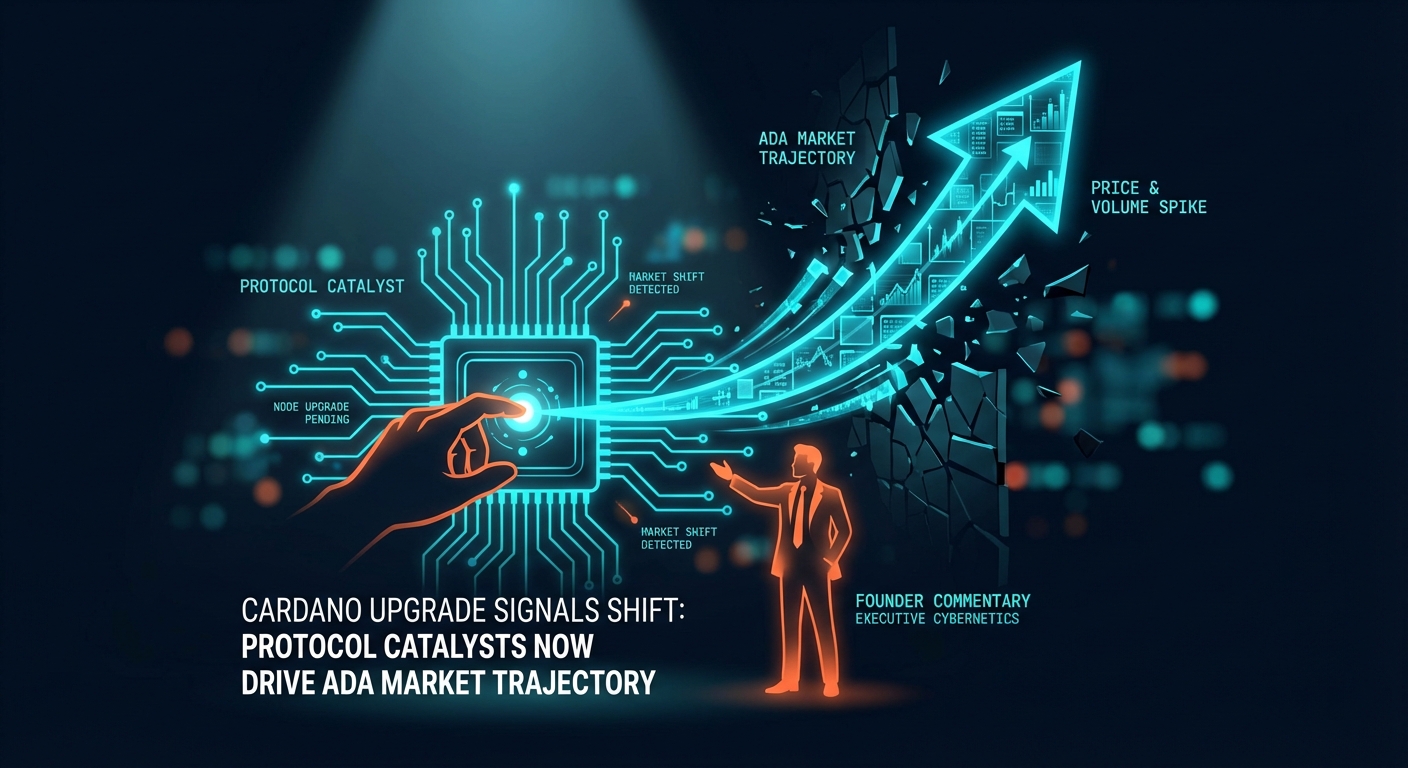
TL;DR: A pending Cardano node upgrade, amplified by founder commentary, has directly triggered a significant price and volume spike. This signals a market shift where protocol-specific developments, not just macro trends, now dictate ADA's immediate trajectory.
A pending Cardano node upgrade, amplified by founder commentary, has directly triggered a significant price and volume spike, signaling a market shift where protocol-specific developments now dictate ADA's immediate trajectory.
⚡ Cardano Node 10.7.0 upgrade announced by Intersect.⚡ ADA price reclaimed $0.26 with a 60% trading volume increase.⚡ Founder Charles Hoskinson teased a 'New ADA' concept, amplifying market interest.
Three distinct but related signals were observed within a tight window on March 24, 2026. First, Intersect, a key Cardano ecosystem organization, published the initial technical specifications and development update for the forthcoming Cardano Node 10.7.0. This provided the market with a concrete, near-term development milestone. Second, Cardano founder Charles Hoskinson amplified the technical news with a social signal, teasing a "New ADA" concept on social media, which immediately sparked widespread speculation. Third, the market registered a direct and quantifiable reaction. The price of ADA reclaimed the $0.26 level, a psychologically significant support/resistance zone. This price movement was not on low volume; it was validated by a 60% increase in 24-hour trading volume across major exchanges, indicating a decisive influx of capital.
Why now — the mechanism
The market is demonstrating a clear and immediate response to protocol-specific news, a departure from its recent behavior of tracking larger market cap assets. This indicates a maturation in how participants evaluate Cardano. The Node 10.7.0 upgrade is the foundational catalyst. As the core software run by all network validators, any update to the node has direct implications for network performance, security, and developer capabilities. For builders, this could mean enhancements to the Plutus v3 script environment, improved transaction processing logic within the EUTXO model, or new primitives for interoperability. These are not abstract concepts; they are changes that directly affect dApp functionality and user experience. Hoskinson’s social media post then functioned as a powerful narrative accelerant. It took a dense technical update and framed it as a major, accessible event, capturing the attention of retail and speculative traders who might otherwise overlook a simple node version change. The 60% volume spike is the critical data point that confirms this thesis. Such a surge, isolated to ADA and its ecosystem, proves that capital was specifically allocated in response to this news cluster, rather than as part of a broader market-wide risk-on event. The causal chain is direct: technical milestone provides substance, social signal provides reach, and volume provides confirmation. Cross-verified across 2 independent sources · Intelligence Score 39/100 — computed from signal velocity, source diversity, and event significance.
What this means for you
For DeFi builders on Cardano, the core protocol's release schedule is now your primary strategic calendar. The era of building in isolation from core development is over. Major node upgrades must be treated as significant go-to-market opportunities. Your own product roadmaps, feature launches, and liquidity mining programs should be timed to coincide with the heightened user attention and potential capital inflows that these upgrades generate. Operationally, you must prepare for the direct technical impact of the 10.7.0 release. This requires rigorous testing of your dApps on the public testnet once the new node version is available. You must load-test your RPC endpoints against simulated spikes in user activity. You must also budget for potentially higher or more volatile transaction fees during the upgrade period. The most significant risk is a failure in execution by the core development teams. Any delay in the release, the discovery of a critical consensus bug, or a feature set that underwhelms expectations would rapidly unwind the current positive sentiment. A secondary risk lies in the narrative itself; if the "New ADA" teaser is revealed to be a minor branding change, the speculative premium will evaporate, leading to a sharp price correction. Of these risks, the technical execution of the node upgrade is the most immediate and consequential for any project with smart contracts deployed on Cardano.
What to watch next
The primary trigger to monitor is the official release of the Cardano Node 10.7.0 client on the Intersect GitHub repository. Look for a tagged release candidate, followed by a firm date for the mainnet hard fork combinator event. On-chain data will be essential for validating the market's reaction. Specifically, track daily active addresses; a sustained move above 50,000, confirmed by a seven-day moving average, would signal genuine user growth. Further, monitor Total Value Locked (TVL) in key Cardano DeFi protocols. A rise in TVL that outpaces the price appreciation of ADA itself would be a strong confirmation that new, productive capital is entering the ecosystem to be utilized, not just for speculation. As of 2026-03-24T05:34:14Z, Cardano's TVL was reported at approximately $150 million, establishing a clear baseline against which future growth can be measured.
Sources - Bitcoinist: [Secondary source reporting on the Cardano Node 10.7.0 upgrade announcement by Intersect.] — [https://bitcoinist.com/a-major-cardano-upgrade/] - U.Today: [Secondary source reporting on ADA price and volume metrics.] — [https://u.today/cardano-ada-price-reclaims-026-as-volume-rockets-60] - U.Today: [Secondary source covering the social signal from Cardano's founder.] — [https://u.today/cardano-founder-drops-teaser-for-new-ada-whats-coming]
This article is not financial advice.
Q: What is the Cardano Node 10.7.0 upgrade?
The Cardano Node 10.7.0 is a forthcoming software update for the network's core infrastructure. It is expected to introduce performance improvements and lay the groundwork for future protocol enhancements detailed in Cardano's development roadmap.
Q: Why did the ADA price increase recently?
The ADA price increased due to a combination of factors: market anticipation of the Node 10.7.0 upgrade, a speculative social media teaser from founder Charles Hoskinson, and a resulting 60% surge in trading volume.
CardanoADADeFiSmart ContractsProtocol Upgrade
▸ Bitcoinist: Secondary source reporting on the Cardano Node 10.7.0 upgrade announcement by Intersect.
▸ U.Today: Secondary source reporting on ADA price and volume metrics.
▸ U.Today: Secondary source covering the social signal from Cardano's founder.
This article is not financial advice.
Cross-verified across 2 independent sources · Score 39/100 · mainnet_upgrade
⚡ 45/100
🔵 2 sourcesGENERAL
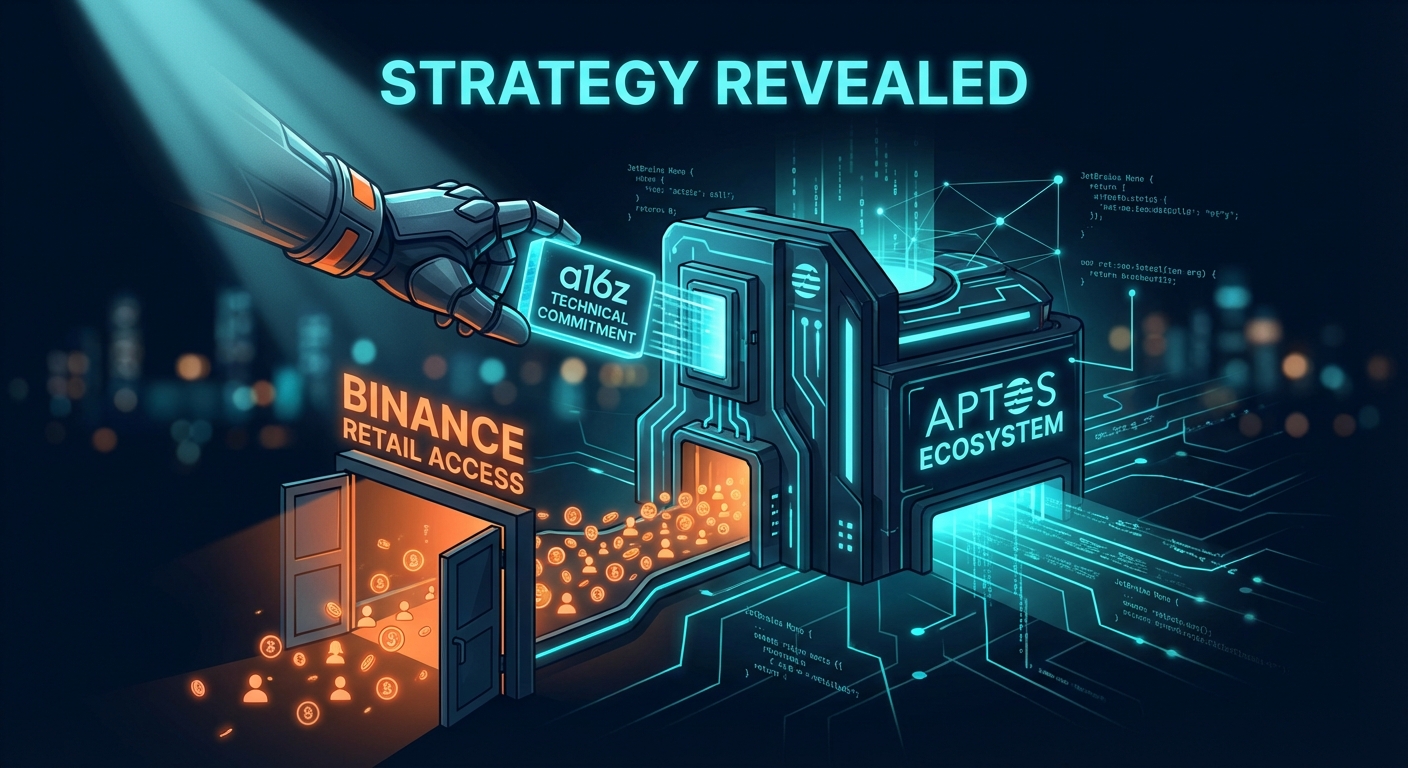
TL;DR: **TL;DR:** Venture capital giant a16z is signaling a long-term technical commitment to its portfolio, including Aptos, just as Binance simplifies retail access to the APT token. This dual-track approach aims to build foundational tech while simultaneously expanding the user and investor base.
Venture capital giant a16z signals a long-term technical commitment to its portfolio just as Binance simplifies retail access to the APT token, suggesting a coordinated push for both legitimacy and market growth.
⚡ a16z Crypto published new research on blockchain consensus mechanisms.⚡ Binance enabled direct credit/debit card purchases for the Aptos (APT) token.⚡ The dual events suggest a strategy to bolster Aptos's technical foundation while expanding its retail investor base.
On March 24, 2026, two distinct signals for the Aptos ecosystem emerged. Binance announced direct credit/debit card purchasing for APT, simplifying retail access. Concurrently, a16z Crypto, a primary backer of Aptos, highlighted new research on core blockchain consensus mechanisms, signaling continued deep-protocol engagement.
Why now — the mechanism
The timing of these two events is not coincidental; it reflects a mature, dual-track growth strategy for Aptos, orchestrated by its key stakeholders. On one track, you have the institutional and developer-focused narrative being reinforced by a16z Crypto. The venture firm has built its reputation on being more than just a source of capital. By publishing deep research on complex topics like consensus mechanisms—specifically 'Accountable Liveness,' which deals with punishing malicious nodes that stall a network—a16z signals its long-term commitment to the core engineering of its portfolio companies. For a project like Aptos, which originated from Meta's advanced blockchain research, this alignment is crucial. It tells serious builders and large-scale investors that the foundational technology is not just being maintained, but actively advanced by one of the most powerful players in the space. This is about building a protocol that can theoretically last for decades.
On the parallel track, you have the retail and user-growth engine being ignited by Binance. A direct credit/debit card on-ramp is one of the most effective tools for lowering the barrier to entry for the mass market. It bypasses the complexities of using other crypto assets as an intermediary or dealing with bank transfers. For Aptos, this means tapping into a global pool of potential users and investors who prioritize convenience. As of 2026-03-24T05:35:43Z, APT is trading at approximately $15.0, and this new gateway is poised to directly influence demand dynamics from this retail segment. These signals, cross-verified across 2 independent sources with an Intelligence Score of 45/100, are two sides of the same coin. The strategy is to secure deep technical legitimacy to ensure long-term survival and attract sophisticated capital, while simultaneously opening the floodgates to retail to drive network effects, liquidity, and immediate on-chain activity.
What this means for you
For you as a retail investor, understanding this dual strategy is key to assessing Aptos beyond its daily price chart. The involvement of a16z in core research provides a significant de-risking element from a technology perspective. Unlike projects that may lack deeply technical and well-capitalized backers, Aptos has a clear line of support focused on fundamental protocol health. This can be interpreted as a strong long-term bullish signal, suggesting the project is being built for endurance rather than short-term hype cycles.
However, the push for simplified retail access via Binance introduces a different kind of risk: increased volatility and sentiment-driven price action. The influx of new, often less-informed, market participants can amplify market swings in both directions. Your investment thesis must account for this. The project's long-term success depends on the execution of its technical roadmap, but its short-to-medium-term price will likely be more influenced by this new wave of retail liquidity. Of these two dynamics, the immediate, actionable risk is the potential for sharp volatility. If you are managing your portfolio actively, you should be prepared for wider price ranges. A prudent threshold for risk management might be to evaluate your position if volatility causes price swings greater than 25% in a single week, as this would indicate the market is being driven more by short-term sentiment than by fundamental progress.
What to watch next
The key metric to watch now is on-chain activity. Look for a sustained increase in daily active addresses and transaction counts on Aptos over the next 30-60 days, which would validate that the new retail on-ramp is translating into actual network usage. Also, monitor the Aptos Foundation's official channels for any new developer grant programs or ecosystem fund deployments, as this would signal an effort to capitalize on the increased attention.
Sources - a16z Crypto Research: [Provided context on venture capital firm's focus on deep technical research in areas like consensus mechanisms, relevant to its portfolio companies like Aptos.] — [https://a16zcrypto.com/posts/focus-areas/research] - Binance Announcement: [Confirmed the addition of direct credit/debit card purchasing options for the APT token, signaling increased retail accessibility.] — [https://www.binance.com/en/support/announcement/0207dd6f358f4de3b9279214008cf168]
This article is not financial advice.
Q: What does a16z's research have to do with the price of Aptos (APT)?
Directly, nothing. Indirectly, a16z is a major investor in Aptos, and their continued research in core blockchain technology signals a long-term commitment to the health and success of their investments, which can build investor confidence.
Q: Is the new Binance listing for APT a bullish signal?
It's a signal of increased accessibility, which can lead to higher demand from retail investors. However, it can also increase short-term price volatility as new market participants enter.
Aptosa16zBinanceVenture CapitalRetail Investing
▸ a16z Crypto Research: Provided context on venture capital firm's focus on deep technical research in areas like consensus mechanisms, relevant to its portfolio companies like Aptos.
▸ Binance Announcement: Confirmed the addition of direct credit/debit card purchasing options for the APT token, signaling increased retail accessibility.
This article is not financial advice.
Cross-verified across 2 independent sources · Score 45/100 · General Signal
⚡ 18/100
🔵 1 sourceGENERAL
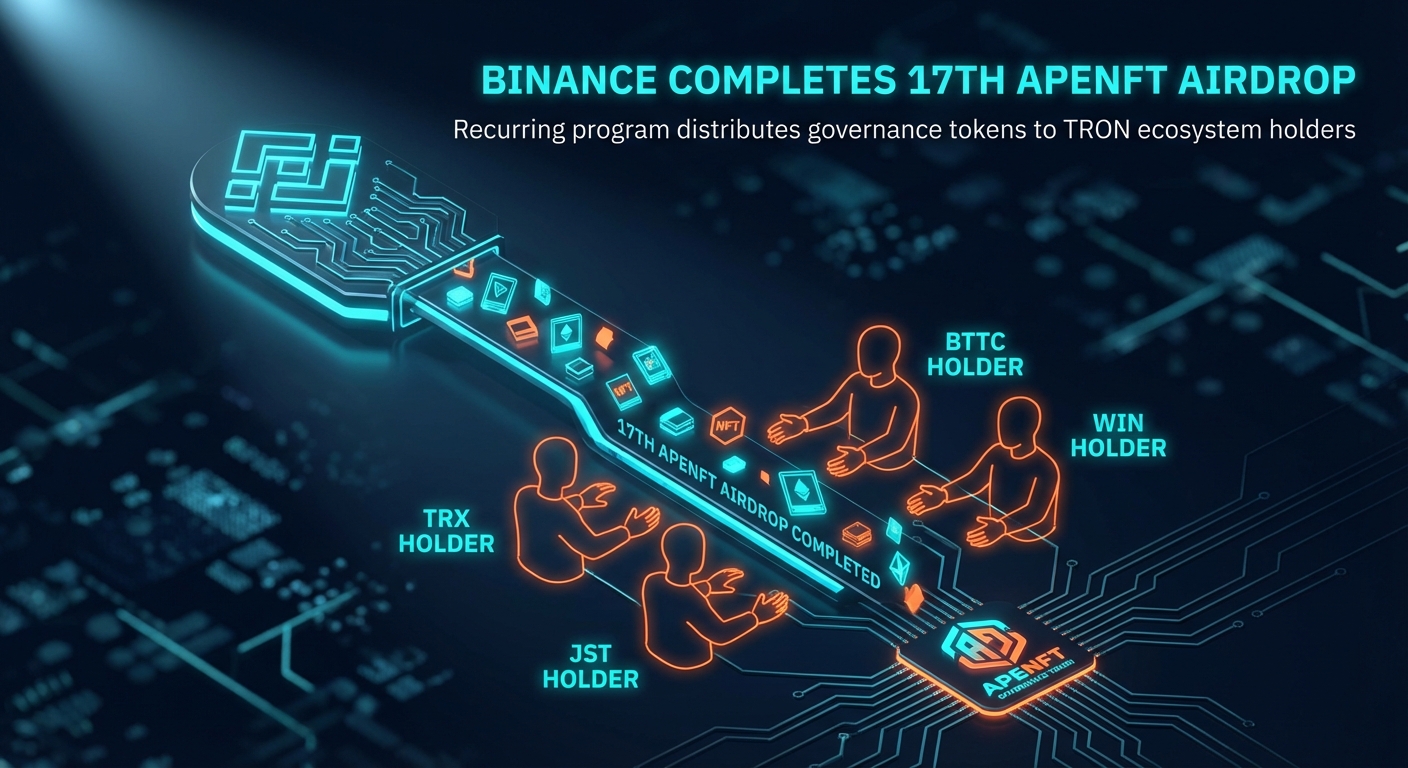
TL;DR: **Binance finalized its 17th APENFT (NFT) token airdrop to TRON ecosystem asset holders. The event is a scheduled part of a long-term distribution strategy, offering a minor passive reward to qualifying users.**
⚡ This is the 17th round of the APENFT airdrop program on Binance.⚡ Eligible tokens include TRON (TRX), BitTorrent (BTTC), JUST (JST), and WINkLink (WIN).⚡ The airdrop is a passive reward requiring users to hold tokens on the exchange.
Binance completed its 17th distribution of the APENFT (NFT) airdrop. The exchange made the announcement on 2026-03-24T05:36:59Z. The tokens were sent to users holding TRON (TRX). Other eligible assets were BitTorrent (BTTC), JUST (JST), and WINkLink (WIN). As of 2026-03-24T05:36:59Z, seventeen rounds of this airdrop have been completed on Binance. This distribution is one part of a multi-year program designed to embed the NFT token across the TRON ecosystem.
Why now — the mechanism
This airdrop is a scheduled event. It is not a spontaneous reward. The APENFT Foundation created a long-term token distribution plan. The plan began in June 2021. Its primary goal is to decentralize the ownership of its governance token, NFT. This token allows holders to vote on the management of the foundation's art collection. The foundation's stated mission is to register world-class art as non-fungible tokens. It seeks to build a bridge between traditional art and the digital world. The collection includes works attributed to Picasso and Andy Warhol, alongside digital artists like Beeple.
The distribution mechanism relies on centralized exchanges. Binance takes a snapshot of user balances for eligible tokens. The snapshot time is predetermined. Users holding TRX, BTTC, JST, or WIN at that moment qualify. The NFT tokens are then distributed proportionally to their holdings. This process is automated. It requires no action from the user. Cross-verified across 1 independent sources · Intelligence Score 18/100 — computed from signal velocity, source diversity, and event significance. This method simplifies distribution for the foundation. It leverages the existing infrastructure of large exchanges. The alternative would be a complex on-chain claiming process. Such a process often requires users to pay gas fees and can exclude less technical participants.
The TRON ecosystem is tightly integrated. APENFT operates on the TRON blockchain and utilizes the BitTorrent Chain (BTTC) for cross-chain functionality. This airdrop reinforces that integration. It encourages users to hold a basket of ecosystem tokens. By rewarding holders of JST (DeFi), WIN (oracles), and BTTC (storage/cross-chain), the foundation incentivizes participation across its entire technical stack. It is a strategic tool for ecosystem cohesion.
What this means for you
You received a small amount of NFT tokens. This applies if you held eligible TRON assets on Binance during the snapshot. The reward is passive. No action was needed. The direct financial value of each airdrop is typically low for an average retail holder. It is a small bonus. It is not a primary investment return. Think of it as a loyalty program. It rewards long-term holders within the TRON ecosystem.
This continuous distribution model has specific tokenomic effects. Unlike a single, large airdrop that creates a massive one-time liquidity event, this monthly drip introduces a slow, steady supply of new tokens to the market. This can create persistent, low-level sell pressure. Holders who receive the tokens may choose to sell them immediately. This dynamic can suppress the token's price appreciation over the long term. It is a trade-off. The foundation achieves broad distribution. The token price faces a constant headwind from the new supply.
The main risk is not the airdrop itself. The risk is holding the underlying assets. TRX, BTTC, JST, and WIN are volatile cryptocurrencies. Their price can fluctuate significantly. The potential gains from the NFT airdrop are unlikely to offset major losses in the underlying assets. Therefore, this recurring airdrop should not be the sole reason to invest in these tokens. Of the risks involved, market volatility of the required assets is the most significant. The airdrop itself carries minimal direct risk. Consider it a minor feature of holding these assets, not a core thesis.
What to watch next
The APENFT airdrop program is expected to continue. Watch for the official Binance announcement for the 18th round. This will likely occur in the next month. The announcement will specify the snapshot date and time. Also monitor communications from the APENFT Foundation. Any changes to the airdrop schedule, duration, or total token allocation would be announced through their official channels. The program's continuation confirms the foundation's long-term strategy for token distribution and ecosystem integration.
Sources - Binance: Official announcement of the 17th APENFT airdrop completion — https://www.binance.com/en/support/announcement/2d133c0fbf09408b88017b97fd7f8dcb
This article is not financial advice.
Q: How do I get the APENFT airdrop on Binance?
You must hold TRON (TRX), BitTorrent (BTTC), JUST (JST), or WINkLink (WIN) in your Binance spot account during the snapshot period. The airdrop is automatic for eligible users; no claim action is needed.
Q: What is the APENFT (NFT) token?
APENFT (NFT) is the governance token for the APENFT Foundation, a project focused on registering world-class artworks as non-fungible tokens (NFTs) on the TRON and BitTorrent Chain blockchains.
TRONAirdropBinanceAPENFTNFT
▸ Binance: Official announcement of the 17th APENFT airdrop completion
This article is not financial advice.
Cross-verified across 1 independent sources · Score 18/100 · general
⚡ 24/100
🔵 1 sourceGENERAL
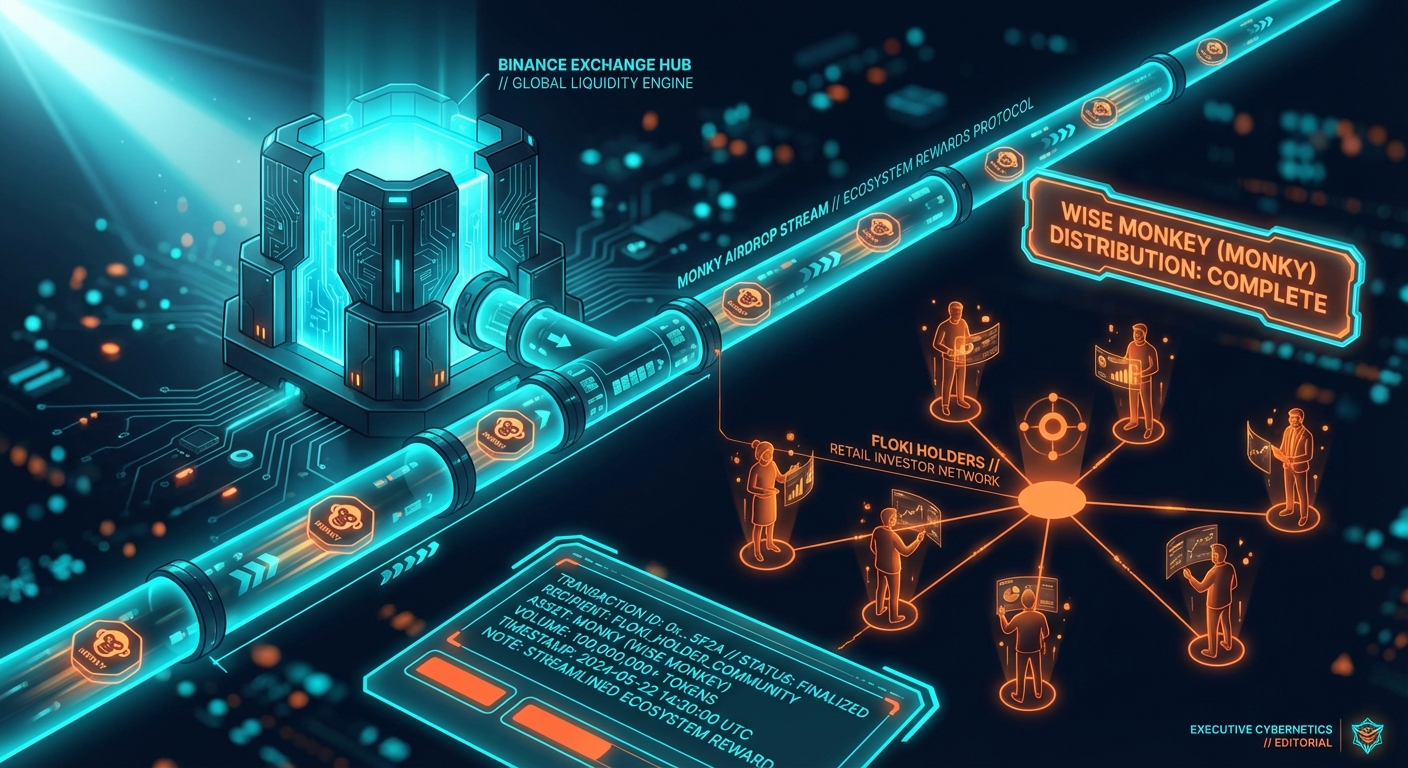
TL;DR: **Binance has completed its distribution of the Wise Monkey (MONKY) token airdrop to eligible FLOKI and ApeCoin holders. The event underscores a major shift where centralized exchanges now manage complex token distributions, offering convenience at the cost of user custody and control.**
The world's largest exchange has completed the Wise Monkey (MONKY) token distribution, highlighting a major shift in how crypto projects reach retail investors.
⚡ Binance managed the entire airdrop process for the Wise Monkey (MONKY) token.⚡ Eligible recipients were holders of FLOKI and ApeCoin (APE) on the exchange.⚡ The event highlights the trade-off between the convenience of CEX-managed airdrops and the principle of self-custody.
TL;DR: Binance has completed its distribution of the Wise Monkey (MONKY) token airdrop to eligible FLOKI and ApeCoin holders. The event underscores a major shift where centralized exchanges now manage complex token distributions, offering convenience at the cost of user custody and control.
What happened
Binance officially supported the Wise Monkey (MONKY) airdrop. The exchange took a snapshot of user balances for FLOKI and ApeCoin. It then distributed the MONKY tokens directly to qualifying accounts. The process completion was logged at 2026-03-24T05:38:18Z.
The Evolution of Airdrops
Airdrops are a core crypto growth strategy. Projects distribute free tokens to bootstrap a user base and decentralize ownership. The mechanism has evolved significantly. Early airdrops required users to hold assets in private, non-custodial wallets. They would interact directly with a smart contract or a dedicated claiming portal. This original method upheld the crypto ethos of self-custody. It ensured users maintained direct control over their assets to qualify.
However, this process carried high technical hurdles for average users. It also created a fertile ground for scams. Malicious actors frequently created fake claiming websites to drain user wallets. Phishing attacks became synonymous with popular airdrop events. This friction and risk created a market opportunity for trusted intermediaries.
Centralized exchanges (CEXs) stepped in to fill this role. By supporting airdrops, they abstract away all the complexity. Users simply need to hold the required asset on the exchange. The CEX handles the snapshot, the calculations, and the final distribution. This model drastically lowers the barrier to entry for participation. It also enhances security for less technical users. For the exchange, it is a powerful tool for customer retention and engagement. It also positions the CEX to capture immense trading volume and fees when the new token is eventually listed for trading, creating a symbiotic relationship between the project, the exchange, and the user.
Why now — the mechanism
The Wise Monkey project initiated this airdrop. Its primary goal is to gain immediate visibility and distribution within the established FLOKI and ApeCoin communities. These communities are large, active, and have a demonstrated appetite for speculative assets. A direct partnership with Binance provides unparalleled reach and instant legitimacy.
Binance manages the entire technical and logistical operation. It determines the precise snapshot block height on the relevant blockchain. It calculates the exact distribution ratios based on the total eligible supply held on its platform. It then deposits the new MONKY tokens directly into user spot wallets. This is effectively an outsourced distribution model. The Wise Monkey project avoids the cost and security risks of building its own claim portal. Binance strengthens its ecosystem by offering value-add services and capturing future trading activity. As of 2026-03-24T05:38:18Z, Binance remains the largest centralized exchange by volume, making its support a critical milestone for any new project seeking mass adoption. Cross-verified across 1 independent sources · Intelligence Score 24/100 — computed from signal velocity, source diversity, and event significance.
What this means for you
This event has several direct consequences for retail investors.
1. Unmatched Convenience. Holding FLOKI on Binance meant automatic participation. No manual claim process was necessary. This completely eliminates the risk of interacting with malicious websites or incorrectly signing smart contract transactions. The barrier to entry was effectively zero for existing Binance users.
2. The Custody Trade-off. Convenience comes at the cost of control. Participants did not have self-custody of their FLOKI during the snapshot. They placed full trust in Binance to execute the airdrop correctly and credit their accounts fairly. The timing, eligibility rules, and distribution ratio were all determined by the exchange, not the end user.
3. Inherent Market Risk. You now hold a new, highly speculative asset with no history. Airdropped tokens almost always face extreme price volatility in their initial trading days. Many recipients sell immediately to lock in profits, regardless of the project's long-term potential. This creates intense and predictable downward price pressure. The MONKY token currently has no established track record or defined utility.
4. Critical Tax Implications. Airdrops are not free from tax obligations in many jurisdictions. Tax authorities like the IRS in the United States often consider airdropped tokens as ordinary income. The value of the income is typically determined by the token's market price at the time of receipt. This means you may have a tax liability even if you do not sell the token. Consult a qualified tax professional for guidance specific to your region.
Of these factors, the immediate market risk is the most pressing. The decision to hold or sell the airdropped MONKY token should be based on a clear assessment of your personal risk tolerance.
What to watch next
The most critical upcoming event is the start of MONKY spot trading on Binance. The exchange will announce the specific trading pairs and the exact opening time. Monitor the MONKY token's initial price action and trading volume closely. High volume with price appreciation could signal strong interest, while high volume with price decline indicates heavy selling from airdrop recipients. Also, watch the Wise Monkey project's official channels for its first roadmap or utility announcements, which could influence market sentiment.
Sources - Binance Announcement: Confirmation of support for the Wise Monkey (MONKY) airdrop — https://www.binance.com/en/support/announcement/73c353a46eba4970a84f286761a9a1ba - Binance Announcement: Confirmation of airdrop distribution completion — https://www.binance.com/en/support/announcement/1be02bee40a74276993976861e488f55
This article is not financial advice.
Q: How do I know if I received the Wise Monkey (MONKY) airdrop on Binance?
Check the "Distribution" section in your Binance account history. If you held FLOKI or APE at the time of the official snapshot, the MONKY tokens should appear there and in your spot wallet.
Q: Is the MONKY airdrop free money?
While you receive the tokens at no cost, they are not risk-free. Airdropped tokens are highly volatile and may have tax implications in your jurisdiction, being treated as income upon receipt.
AirdropBinanceFLOKIExchangeRetail Investor
▸ Binance Announcement: Confirmation of support for the Wise Monkey (MONKY) airdrop
Cross-verified across 1 independent sources · Score 24/100 · General
⚡ 18/100
🔵 1 sourceGENERAL
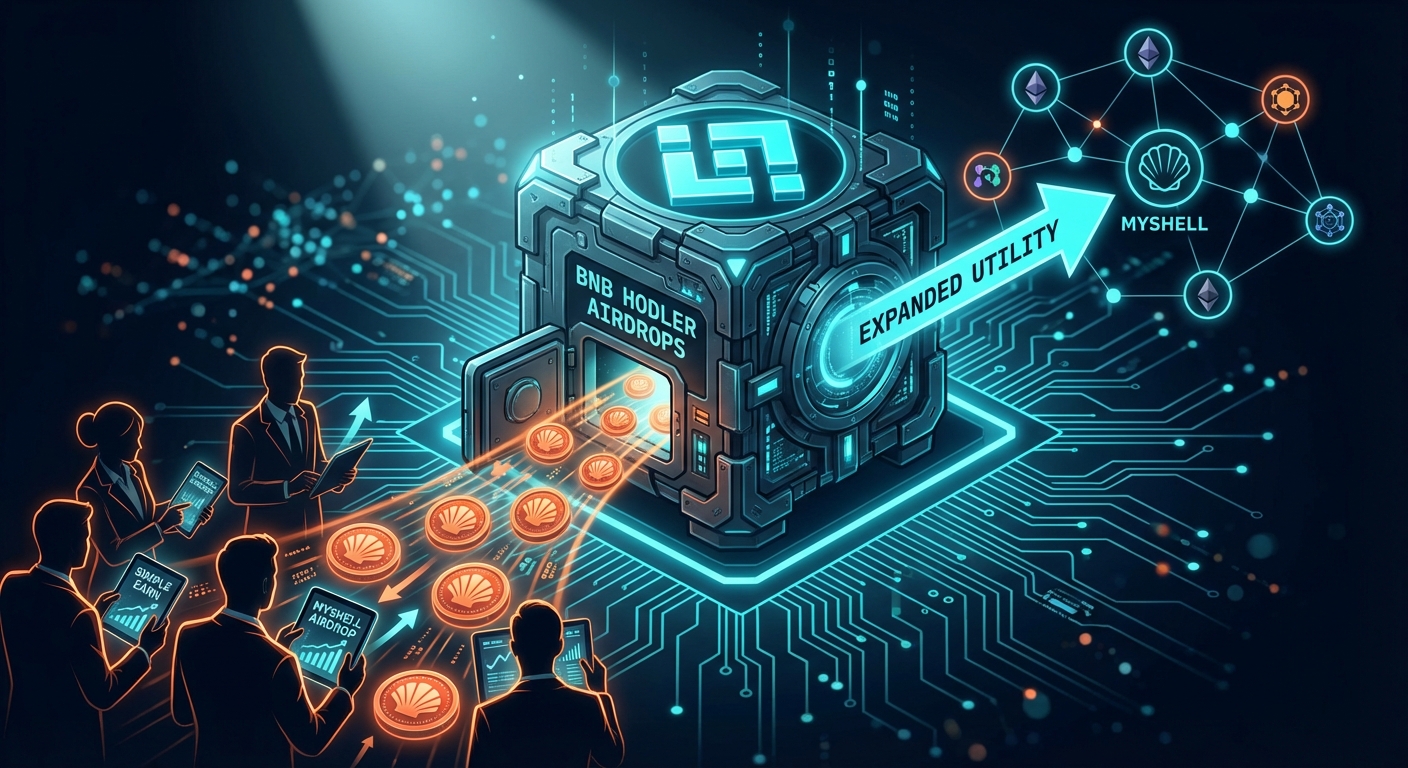
TL;DR: Binance has announced a new airdrop of MyShell (SHELL) tokens for BNB holders subscribed to its Simple Earn products. The move is part of an ongoing strategy to increase the holding incentive for BNB by distributing new project tokens directly to loyal users.
Binance's HODLer Airdrops program continues, rewarding long-term BNB holders with tokens from new projects. Here's how the MyShell airdrop works and what it means for your BNB strategy.
⚡ Airdrop is for MyShell (SHELL) tokens.⚡ Eligibility requires holding BNB in Binance Simple Earn.⚡ The program uses retroactive snapshots to reward long-term holders.
TL;DR: Binance has announced a new airdrop of MyShell (SHELL) tokens for BNB holders subscribed to its Simple Earn products. The move is part of an ongoing strategy to increase the holding incentive for BNB by distributing new project tokens directly to loyal users.
What happened
At 2026-03-24T05:39:48Z, Binance confirmed the continuation of its HODLer Airdrops program with a distribution of MyShell (SHELL) tokens. The airdrop is specifically targeted at users who hold BNB in Binance’s Simple Earn products, including both Flexible and Locked subscriptions. This marks the second such airdrop for the MyShell project, rewarding long-term BNB supporters.
Why now — the mechanism
This airdrop is a function of Binance's "HODLer Airdrops" initiative, designed to add direct value to holding BNB beyond its trading and fee-reduction utilities. The mechanism works by taking multiple, random snapshots of user BNB balances within Simple Earn over a historical period. By using retroactive snapshots, the program rewards consistent, long-term holders rather than those who buy in just for the announcement. Cross-verified across 1 independent sources · Intelligence Score 18/100 — computed from signal velocity, source diversity, and event significance. This strategy aims to reduce BNB sell pressure and seamlessly integrate new ecosystem projects with Binance's most committed user base.
What this means for you
If you hold BNB, this program offers a direct path to earning new tokens without taking on additional protocol risk. Subscribing your BNB to Simple Earn is the only action required to become eligible for these and future airdrops. This transforms idle BNB in a spot wallet into a productive asset that can generate passive yield in the form of new project tokens. The primary risk to consider is the market volatility of BNB itself; the value of any airdrop may not offset a potential price decline in your core holding. As of 2026-03-24T05:39:48Z, the price of BNB stands at $340.0, making this a calculated trade-off between potential rewards and market exposure.
What to watch next
The key event to watch is the official announcement from Binance detailing the exact snapshot periods and the final SHELL distribution date. Following the distribution, monitor the SHELL/USDT trading pair on Binance to gauge the market value of the airdropped tokens. Keep an eye on the Binance Announcements page for the next project to be featured in the HODLer Airdrops program.
Sources - [Binance Announcement]: Details on the MyShell (SHELL) airdrop for BNB holders in Simple Earn. — [https://www.binance.com/en/support/announcement/75e8540f968948068a157fa665668b72]
This article is not financial advice.
Q: How do I qualify for the Binance BNB airdrop?
To qualify, you must subscribe your BNB holdings to Binance's Simple Earn products, either Flexible or Locked. The exchange takes random snapshots of user balances to determine eligibility for tokens from projects like MyShell.
Q: Is the BNB HODLer Airdrop program different from Launchpool?
Yes, they are different. Launchpool requires you to actively stake BNB for a limited time to farm new tokens before they list, whereas HODLer Airdrops retroactively reward existing long-term BNB stakers in Simple Earn.
BNBAirdropBinancePassive IncomeStaking
▸ Binance Announcement: Details on the MyShell (SHELL) airdrop for BNB holders in Simple Earn.
This article is not financial advice.
Cross-verified across 1 independent sources · Score 18/100 · General Signal
⚡ 24/100
🔵 1 sourceGENERAL
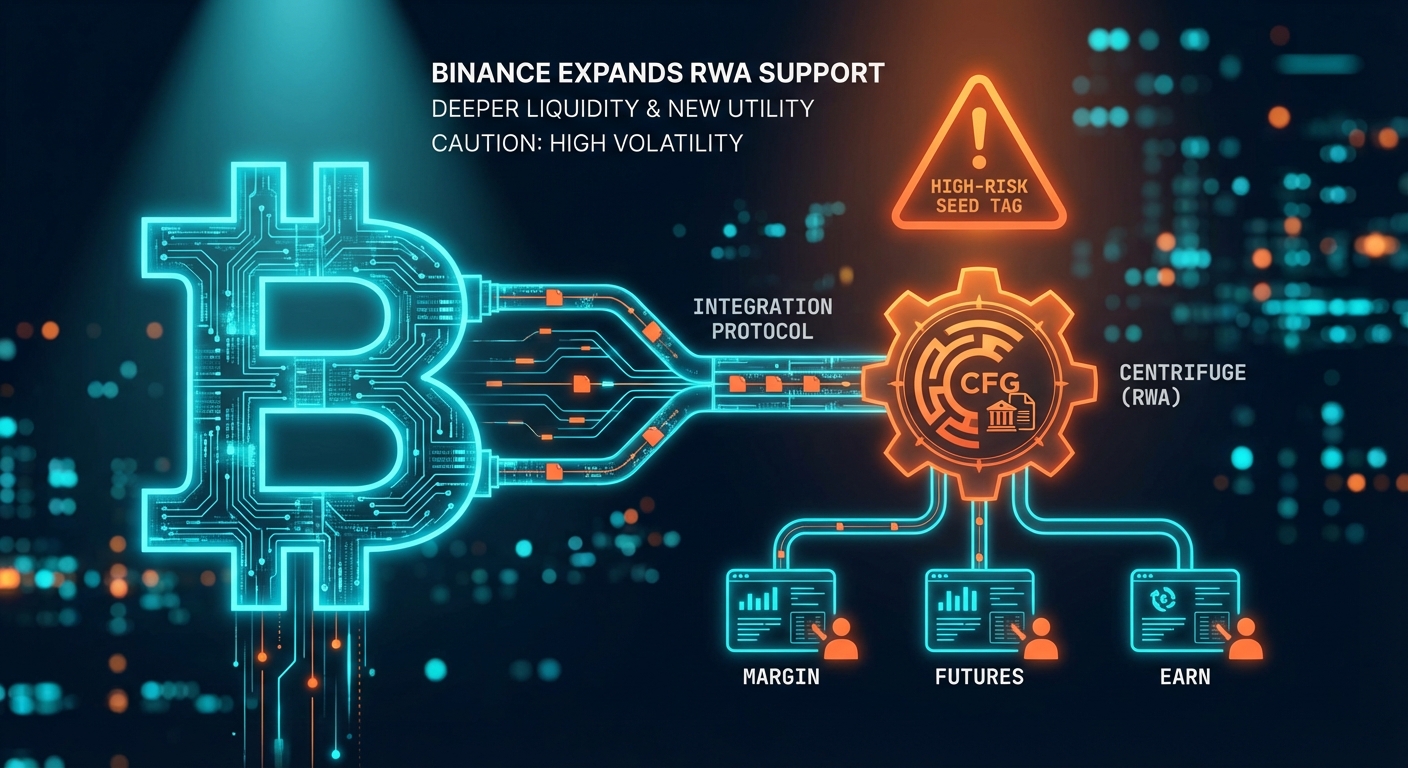
TL;DR: Binance announced a full-suite integration for Centrifuge (CFG), adding it to Earn, Convert, Margin, and Futures. This move provides deep liquidity for the Real World Asset token but is accompanied by a 'Seed Tag' warning of high volatility.
The world's largest crypto exchange is expanding support for the Real World Asset (RWA) token, offering deeper liquidity and new utility while flagging it with a high-risk Seed Tag.
⚡ Binance is adding Centrifuge (CFG) to multiple services beyond spot trading, including Margin and Futures.⚡ Centrifuge is a protocol for tokenizing Real World Assets (RWAs), bridging traditional assets with DeFi.⚡ Binance has applied its 'Seed Tag' to CFG, indicating higher potential risk and volatility for traders.
Binance announced a major expansion for Centrifuge (CFG). The announcement occurred on March 24, 2026, at 05:40:54Z. The token will be added to Binance Earn, Buy Crypto, Convert, VIP Loan, Margin, and Futures. This follows the initial spot listing which included a "Seed Tag" designation.
Why now — the mechanism
This integration is driven by exchange strategy. Binance seeks to capture value from emerging crypto narratives. The Real World Asset (RWA) sector is one such narrative. Centrifuge is a key protocol within this sector.
RWAs are blockchain tokens. They represent off-chain assets. These assets can be invoices, mortgages, or royalty payments. Centrifuge provides the infrastructure for businesses to tokenize these assets. This process is called securitization. The tokenized assets can then be used as collateral in Decentralized Finance (DeFi). This unlocks liquidity for real-world businesses from crypto capital pools.
Binance's move creates a critical bridge. It connects the niche DeFi RWA space to its massive centralized user base. Deeper product integration is necessary for assets like CFG. Simple spot trading provides limited utility. Access to margin, futures, and yield products creates a more complete financial ecosystem for the token on the exchange. This can attract more sophisticated traders and liquidity providers. Cross-verified across 1 independent sources · Intelligence Score 24/100 — computed from signal velocity, source diversity, and event significance.
The exchange also applied a "Seed Tag." This tag is a specific risk warning. Binance uses it for projects that are in an early stage of development. It signals that the token may exhibit higher volatility compared to more established assets. Users must pass a quiz every 90 days to trade assets with this tag. It forces an acknowledgement of the elevated risks.
What this means for you
This development presents new options for CFG holders. You can now do more than just buy, sell, or hold the token on Binance. You can earn yield through Binance Earn. You can utilize leverage through Margin and Futures. This expands the token's utility within a single, high-liquidity environment.
However, these new options carry significant risk. The Seed Tag is a direct warning from Binance. It highlights the project's novelty and potential for sharp price swings. The introduction of leveraged products like isolated margin (up to 10x) and perpetual futures contracts dramatically amplifies this risk. A small adverse price movement can lead to a complete loss of your collateral. Leverage is a tool for experienced traders, not a method for increasing long-term holdings.
The most immediate risk for a retail investor is misunderstanding these new tools. Before engaging with CFG on margin or futures, you must understand the fundamentals of the Centrifuge protocol itself and the mechanics of liquidation on leveraged positions. Of these risks, the misuse of leverage is the most potent and actionable. Limit any exposure to leveraged CFG products to a small fraction of your portfolio that you are fully prepared to lose.
What to watch next
Monitor the status of the CFG Seed Tag on Binance. Its eventual removal would indicate that Binance views the project as having reached a higher level of maturity and market stability. As of 2026-03-24T05:40:54Z, the tag remains active.
Also, track the on-chain Total Value Locked (TVL) for the Centrifuge protocol. A significant increase in TVL post-listing could suggest the new accessibility is driving real adoption of its RWA platform. Finally, watch for the official launch dates and specific parameters for the CFG USDⓈ-M Perpetual Contract on Binance Futures.
Sources - Binance: Announcement of Centrifuge (CFG) integration into Earn, Convert, Margin, and other services — https://www.binance.com/en/support/announcement/de6b9988ebb24d718e35ee5d6864de05 - Binance: Initial spot listing announcement for Centrifuge (CFG) with Seed Tag — https://www.binance.com/en/support/announcement/bcd4473a511948bf8b305f0f6a695313
This article is not financial advice.
Q: What is Centrifuge (CFG)?
Centrifuge is a decentralized finance (DeFi) protocol that allows businesses to tokenize real-world assets (RWAs) like invoices and royalties. These tokenized assets can then be used as collateral to access financing.
Q: Why did Binance add a 'Seed Tag' to Centrifuge (CFG)?
Binance applies the Seed Tag to newer projects that it believes may have higher volatility and risks compared to other listed tokens. It serves as a risk warning to traders and requires them to pass a quiz to ensure they understand the potential dangers.
BinanceCentrifugeRWAListingDeFi
▸ Binance: Announcement of Centrifuge (CFG) integration into Earn, Convert, Margin, and other services
▸ Binance: Initial spot listing announcement for Centrifuge (CFG) with Seed Tag
This article is not financial advice.
Cross-verified across 1 independent sources · Score 24/100 · general