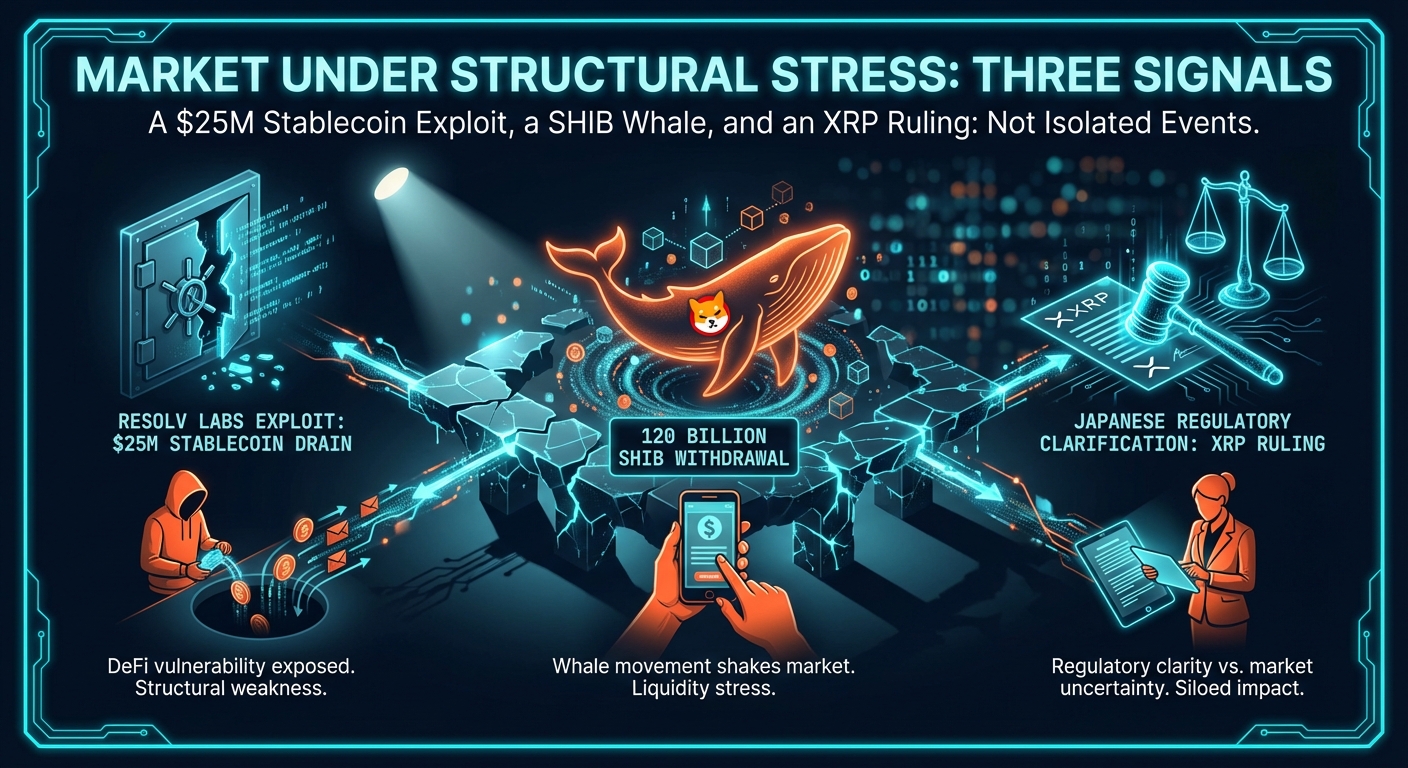
TL;DR: A $25 million exploit of Resolv Labs' stablecoin, a massive 120 billion SHIB withdrawal from exchanges, and a key Japanese regulatory clarification on XRP collectively signal a market defined by persistent, siloed risks in protocol security, asset concentration, and legal ambiguity. This fragmentation presents significant due diligence challenges for institutional investors.
What happened
Three distinct signals materialized across the digital asset ecosystem on March 22, 2026. At 21:17:59Z, an attacker exploited DeFi protocol Resolv Labs, draining approximately $25 million in USDC after minting millions of the protocol's native stablecoin. In a separate event, on-chain data showed a withdrawal of 120 billion Shiba Inu (SHIB) tokens from centralized exchanges to a private wallet. Concurrently, reports clarified that Japan's Financial Services Agency (FSA) does not classify XRP under the Financial Instruments and Exchange Act (FIEA).Why now — the mechanism
The common thread connecting these disparate events is the exposure of deep, structural risks inherent to the current market. Each signal highlights a different vertical of risk that capital allocators must navigate.1. Protocol Risk: The Resolv Labs incident was triggered by a smart contract vulnerability, reportedly an uncontrolled minting function. This class of exploit allows an attacker to create an unlimited supply of a token, in this case the protocol's stablecoin, which was then swapped for high-value assets like USDC before the token's value collapsed. This demonstrates that fundamental code-level risks persist even within the stablecoin sector, which is often perceived as a lower-risk corner of DeFi.
2. Market Structure Risk: The 120 billion SHIB withdrawal represents a significant supply shock orchestrated by a single entity. While the exact value fluctuates, this quantity is material relative to daily trading volumes and indicates conviction for long-term holding or a move into a DeFi protocol. It underscores the risk of concentrated ownership in certain assets, where the actions of a few large holders can disproportionately impact liquidity and price stability, independent of broader market trends.
3. Regulatory Risk: Japan's FIEA clarification for XRP is a prime example of jurisdictional fragmentation. While this stance de-risks XRP for Japanese institutions by placing it outside securities law, it stands in contrast to the ongoing litigation by the U.S. Securities and Exchange Commission (SEC). This global disunity means an asset's legal status is not portable, creating complex compliance burdens and demonstrating that regulatory risk must be assessed on a per-jurisdiction basis. Cross-verified across 2 independent sources · Intelligence Score 68/100 — computed from signal velocity, source diversity, and event significance.
What this means for you
For institutional investors, these signals mandate a multi-layered due diligence framework that addresses distinct risk categories. A favorable regulatory ruling in one country does not mitigate smart contract risk in a protocol holding the asset, nor does it address liquidity risks from whale concentration. As of 2026-03-22T21:17:59Z, the lack of a unified risk landscape requires discrete analysis for technology, market structure, and regulation for every potential allocation.Of these three risks, protocol-level security presents the most acute and binary threat. Institutional capital allocation strategies should therefore enforce a strict policy against engaging with protocols that lack multiple audits from reputable firms and a proven history of securing significant total value locked (TVL). Exposure to assets with high on-chain concentration should be capped and monitored continuously for large-scale movements.